
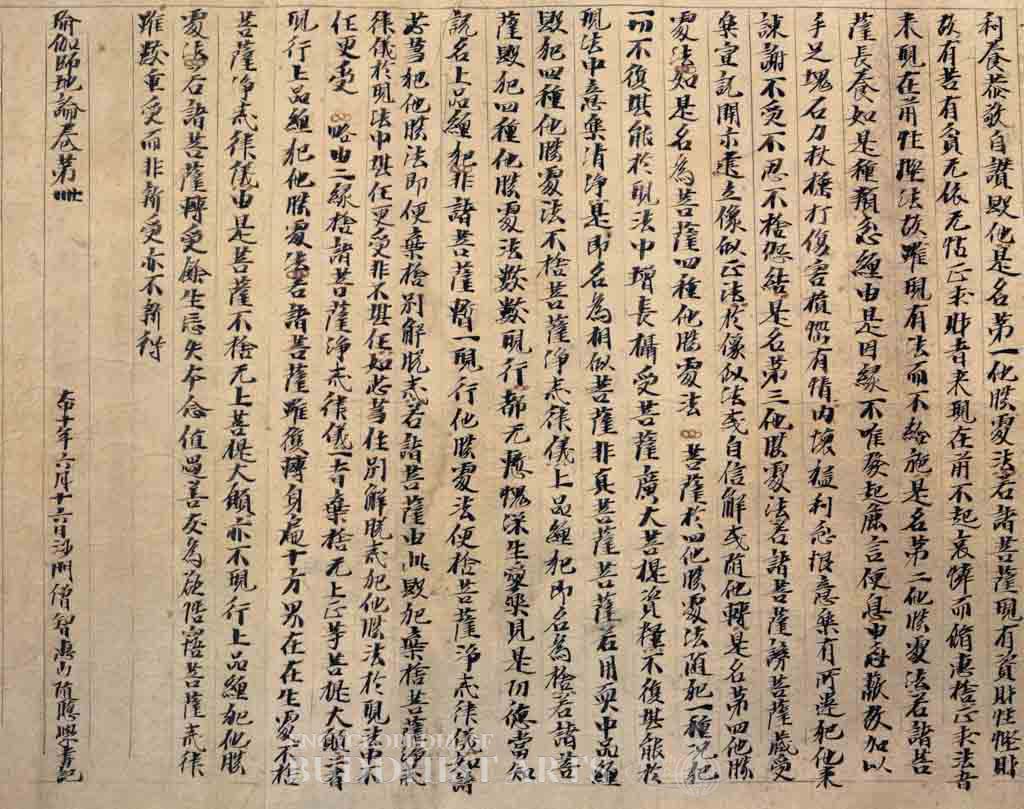
Yogacarabhumi Sastra - Fascicle 40 (left end section)
Ink on paper
Yogacarabhumi Sastra - Fascicle 40
CHINA; Tang dynasty
The Yogacarabhumi Sastra is Asanga’s documentation of Maitreya Bodhisattva’s teachings of the contemplative method of Yogacara delivered as a commentary by Maitreya, who descended from Tusita Heaven to speak in Ayodhya of central India. The commentary is a fundamental text in the Yogacara school and the Faxiang school in China. It was translated into Chinese by the Tripitaka Master Xuanzang.
The postscript at the end of the scroll indicates notes recorded by monk Sengzhi Huishan in 856. Most of the characters appear hastily written in sharp contrast to the cautious and ordered scripts executed by sutra copyists because the scroll was produced in the form of a lecture note.
The scroll consists of 263 lines containing 26 to 30 characters each. Each character is structured with an inclined form and spaced tightly within a dense layout. A subtle clerical style is observed in the largely regular or running script, and the strokes are uniquely composed with a strong, antiquated touch. The scroll has many examples of variant characters, which provides a glimpse into the state of calligraphy during the Mid-Tang (756–846) and Late Tang (846–907) periods.
For more details, go to the Encyclopedia of Buddhist Arts: Calligraphy, page 279.
Cite this article:
author = Hsingyun and Youheng and Youlu and Pokorski, Stefanie and Mankuang and Edson, Gary,
booktitle = {Encyclopedia of Buddhist Arts: Calligraphy },
pages = 279,
title = {{Yogacarabhumi Sastra - Fascicle 40}},
volume = 17,
year = {2016}}