
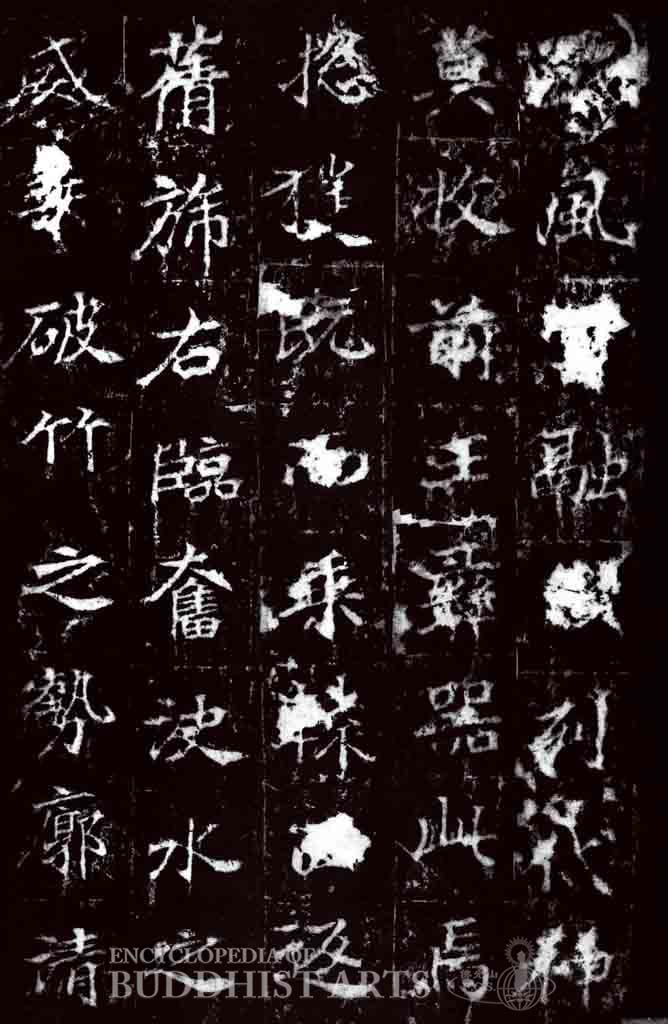
Dengci Temple: Stele (detail)
Rubbing
Dengci Temple: Stele
CHINA, Henan, Xingyang; Tang dynasty
This stele was erected at Dengci Temple in Xingyang by the imperial order of Emperor Taizong (reigned 626–649) of the Tang dynasty according to a postscript written at the bottom of the stone. The stele inscription consists of 32 lines with 65 characters each. Emperor Taizong commemorated some of those who lost their lives after a series of wars and the consequent unification of the country by ordering the construction of temples and steles in their names at seven different battlefield sites. Only this and the stele at Zhaoren Temple remain.
The calligraphy is tight in composition, with straight, angular brushwork and powerful brushstrokes. It pairs the thick and dense calligraphic style of the Northern Dynasties (386–581) with the rigorous and detailed regular script style of the Tang dynasty, and results in a piece that is considered to be a fine example of combined styles from the Southern and Northern Dynasties (386–589). Yang Shoujing, a famous Qing dynasty (1644–1911) historian, praised the piece by stating, “Stylistically similar to that of the Northern Wei calligraphy, and without any weak strokes, the work is a startling composition of exceptional strength. Comparisons can also be made to the styles of Ouyang Xun and Yu Shinan.”
For more details, go to the Encyclopedia of Buddhist Arts: Calligraphy, page 47.
Cite this article:
author = Hsingyun and Youheng and Youlu and Pokorski, Stefanie and Mankuang and Edson, Gary,
booktitle = {Encyclopedia of Buddhist Arts: Calligraphy },
pages = 47,
title = {{Dengci Temple: Stele}},
volume = 17,
year = {2016}}