
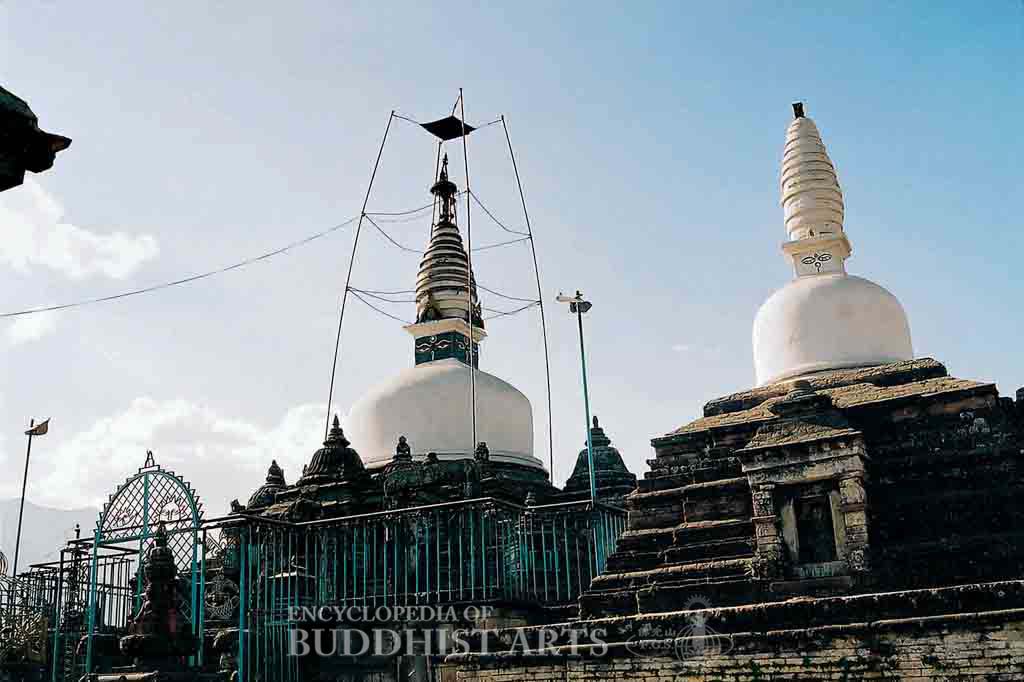
Cilanco Temple
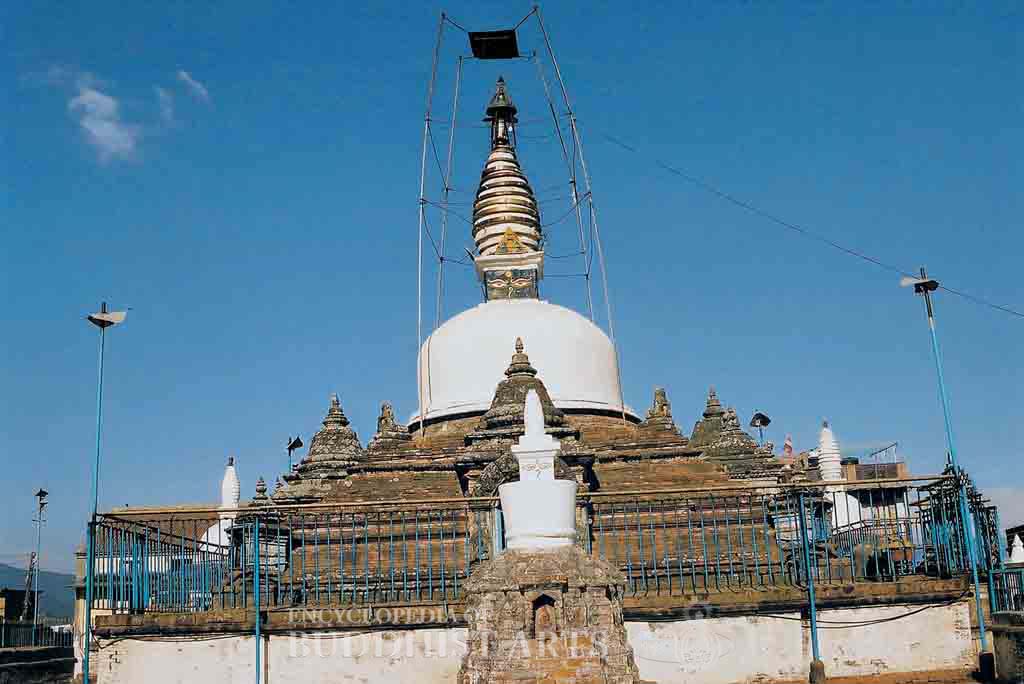
Cilanco Temple: Main Stupa
Cilanco Temple
NEPAL, Kathmandu, Kirtipur
The temple is also known as Kirtipur Temple and is also spelled Chilancho Temple. Its Sanskrit name is Jagatpala Varma Samskarita Padmakastha Giri Mahavihara. Located on top of a hill in Kirtipur, it is one of the two temples located outside Patan but listed as one of the Eighteen Major Temples of Patan. An inscription found at the large stupa states that the temple was founded in 1515 by a nobleman Jagatpala Varma. There are records of a few renovations and additions in the 17th and 18th centuries. In 1934 it was damaged by an earthquake and was later renovated.
The temple complex consists of the main shrine and the main stupa surrounded by four smaller stupas. The main shrine is located on the southern edge of the complex. It is an elongated three-story brick building, in front of which there are two small stone lions and a bell. Next to this are repoussé images of Sariputra and Maudgalyayana. Above the doorway to the shrine there is a repoussé tympanum with an unusual design. There are three standing, eight-armed, three-headed figures, with the central one probably being Aksobhya Buddha, but they are dressed in long flowing garments in the fashion of Rajput princes. In the center of the second story there are five windows that connect with one another and a small window on each side. The third story has a protruding balcony.
The main stupa is 11 m high and constructed in brick and stone. It is similar in layout to Swayambhu Stupa. Four of the Five Dhyani Buddhas are enshrined at the four cardinal points of the base. The stupa body is white in the shape of an inverted bowl, on top of which there is a square harmika decorated with Buddha’s eyes on each side. It is surmounted by a spire with 13 bronze stacked rings. Around the main stupa there are four smaller white stupas with structures similar to the main one.
For more details, go to the Encyclopedia of Buddhist Arts: Architecture A-F, page 174.
Cite this article:
author = Hsingyun and Youheng and Johnson, Peter and Mankuang and Lancaster, Lewis,
booktitle = {Encyclopedia of Buddhist Arts: Architecture A-F},
pages = 174,
title = {{Cilanco Temple}},
volume = 1,
year = {2016}}