
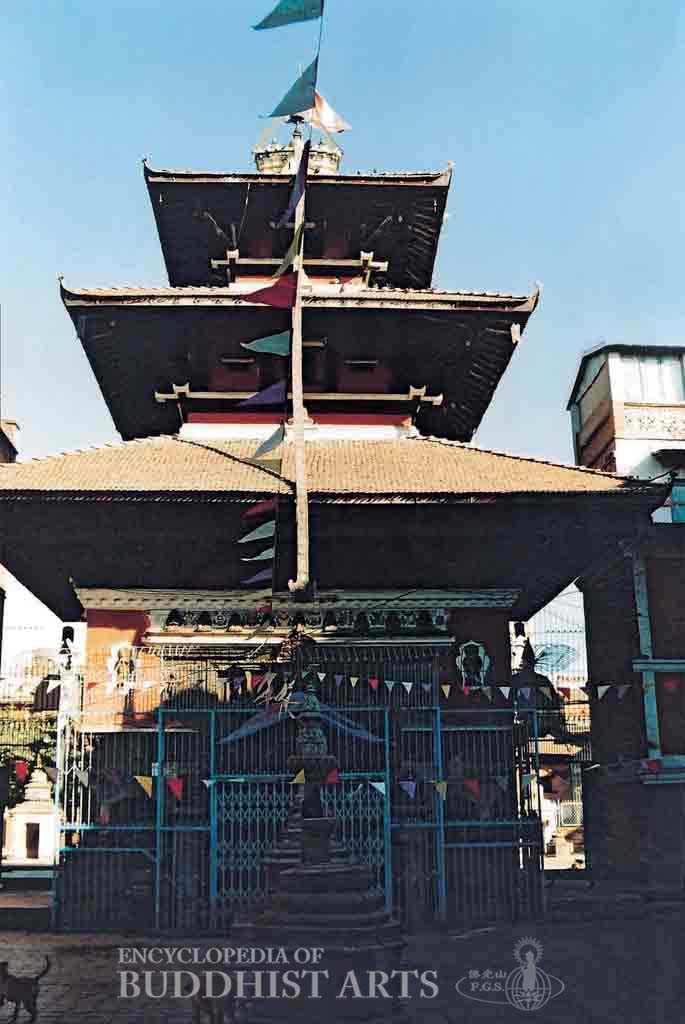
Bhinche Temple
Bhinche Temple
NEPAL, Patan
The Sanskrit name for this temple is Sankaradeva Samskarita Mayuravarna Mahavihara, and it is also known as Visnu Chen Temple or Bisuni Chen Temple. It is one of the oldest temples in Patan and is well preserved. It is said that King Sankaradeva (reigned circa 1067–1080) from the Thakuri dynasty (circa 879–1250) constructed this temple and that a peacock helped him locate the temple on the spot where an image of Visnu was unearthed. Mayura means Peacock and therefore one of the names of the temple is closely related to this story. However, the earliest historical reference to the temple is found in an inscription dated 1430. In 1934 the temple was damaged due to an earthquake and was reconstructed in 1939.
The temple complex consists of an enclosed courtyard which contains the main shrine. The main gate is located on the north side. The courtyard is paved with bricks and extends over a wide area. There are two stone pillars, three small stupas and mandalas within it.
The main shrine is a freestanding structure on the eastern side of the courtyard. The shrine consists of three stories with three eaves. At its entrance there is an archway of oil lamps, two stone lions, and two giant bells cast in the 19th century. The doorway to the shrine is adorned with brass repoussé images of Sariputra and Maudgalyayana, as well as double pennants with the Six-Syllable Mantra, “om mani padme hum.” The tympanum above the doorway is decorated with images of Aksobhya Buddha, Prajnaparamita and Avalokitesvara Bodhisattvas, symbolizing the Triple Gem of the Buddha, Dharma, and Sangha. Above them there are images of the Five Dhyani Buddhas. The facade of the main shrine has the usual set of five windows, with the central window finished in gold trim. At the sides there are bronze repousse images of Padmapani Bodhisattvas. Above the window there are nine images, seven of which are identified as the Seven Buddhas of the Past, and the two at the ends are Prajnaparamita and Manjusri Bodhisattvas. The triple eaves are covered with tiles and supported by engraved struts. There is a set of three stupas on the roof. A metal streamer hangs down from the topmost eave. Inside the main shrine there is an image of Aksobhya Buddha facing west.
For more details, go to the Encyclopedia of Buddhist Arts: Architecture A-F, page 78.
Cite this article:
author = Hsingyun and Youheng and Johnson, Peter and Mankuang and Lancaster, Lewis,
booktitle = {Encyclopedia of Buddhist Arts: Architecture A-F},
pages = 78,
title = {{Bhinche Temple}},
volume = 1,
year = {2016}}