
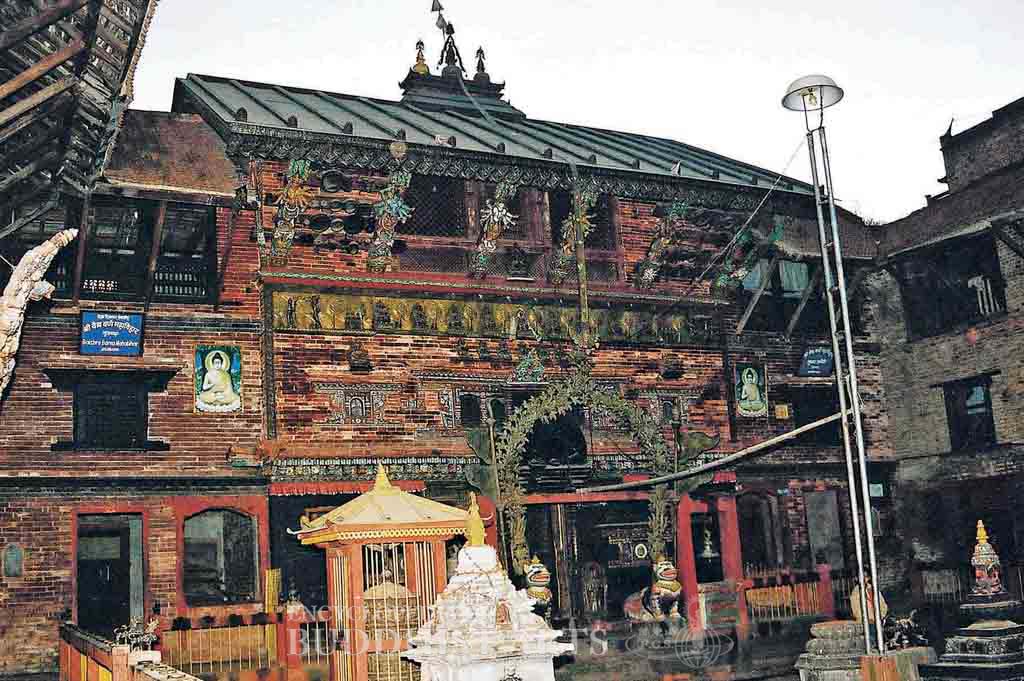
Guji Temple
Guji Temple
NEPAL, Patan
Guji Temple’s Sanskrit names are Vaisya Sri Divakara Varma Mahavihara or Divakara Varma Samskarita Vaisravarna Mahavihara. The exact year of construction is unknown. The earliest reference to the temple is found in a manuscript dated 1253 during the Malla dynasty (1200–1768), therefore the temple had already been built before then.
The main shrine is situated on the southern side of a large enclosed courtyard. It is three stories high with only one eave. The gateway to the shrine is guarded by two stone lions, next to which there are triangular flags and bells. The gateway consists of an openwork arch in brass repoussé decorated with floral designs and Five Dhyani Buddhas. A few steps from the gateway there is a carved doorway, above which there is a tympanum with an image of Manjusri, flanked by two four-armed figures. Above these figures there are the Five Dhyani Buddhas surmounted by Vajrasattva. On the second story, the facade is decorated with the usual set of five windows, with the addition of seven small gilded figures and a row of nine figures. The seven figures are the Five Dhyani Buddhas flanked by two Taras, and the nine figures are the same five Buddhas with Avalokitesvara, Cintamani Avalokitesvara, Prajnaparamita, and Tara. The third story is an open hallway with a screen in lattice work. The eave is supported by six struts decorated with multi-armed figures. The roof is topped by three gilded stupas. A gilt streamer hangs from the roof down to the set of five windows. Inside the shrine there is a large image of Aksobhya Buddha.
The courtyard is paved and contains a variety of objects, including a stone Dharmadhatu mandala, a large prayer wheel, and a small stupa.
For more details, go to the Encyclopedia of Buddhist Arts: Architecture G-L, page 414.
Cite this article:
author = Hsingyun and Youheng and Johnson, Peter and Mankuang and Lancaster, Lewis,
booktitle = {Encyclopedia of Buddhist Arts: Architecture G-L},
pages = 414,
title = {{Guji Temple}},
volume = 2,
year = {2016}}