
Tanga Temple
Tanga Temple
NEPAL, Patan
It is also called Caku Temple and its Sanskrit name is Balarcana Dev Samskarita Jyesthavarna Mahavihara. It is suggested that King Balarcana Dev (reign years unknown) built this temple in the 7th century during the Lichhavi period (circa 300–879). However, the earliest record found mentioning this temple is dated 1125 during the Thakuri period. It underwent major renovation in 1866.
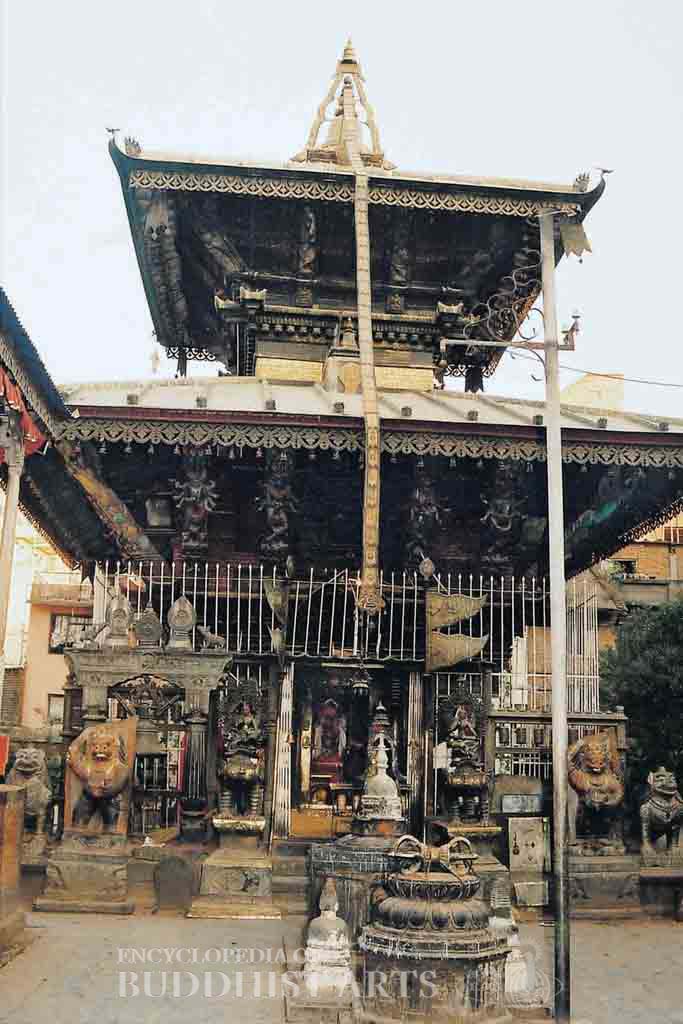
Facing west, the main shrine is a freestanding two-story building with two eaves. There are double doors on each of the four sides of the shrine. On the tympanum above the main door there is a copper repoussé image of Padmanarttesvara, an Eighteen-Armed Avalokitesvara in a dancing pose holding a lotus in each hand. Padmanarttesvara is flanked by four attendants, two with four arms and two with six arms. They are identified as Tara, Sudhana, Bhrkuti, and Hayagriva. A small statue of Amitabha Buddha is found below the tympanum. Next to the lower part of the door posts there is a repoussé copper image of a Three-Headed, Six-Armed Bhairava on each side. The tympana above the other three double doors are made of wood and are decorated with carvings of Vajrayana deities. There is a red statue of Padmapani Bodhisattva inside the main shrine.
The lower eave of the temple is supported by slanted struts that are decorated with five protector deities known as Pancaraksa, namely Mahapratisara, Mahasahasrapramardini, Mahamayuri, Mahasitavati, and Mahamantranusarini. The upper eave is gilded and decorated with a golden stupa and a three-tier canopy at the top. The struts supporting the upper eave are covered with fine repoussé brass images of Bodhisattvas. A metal ribbon with images of Buddhas and Bodhisattvas hangs down from the top of the eave to the gate. Within the courtyard in front of the main shrine there are six small stupas, a Dharmadhatu mandala, and a large Tibetan prayer wheel.
For more details, go to the Encyclopedia of Buddhist Arts: Architecture T-Z, page 1090.
Cite this article:
author = Hsingyun and Youheng and Johnson, Peter and Mankuang and Lancaster, Lewis,
booktitle = {Encyclopedia of Buddhist Arts: Architecture T-Z},
pages = 1090,
title = {{Tanga Temple}},
volume = 4,
year = {2016}}