
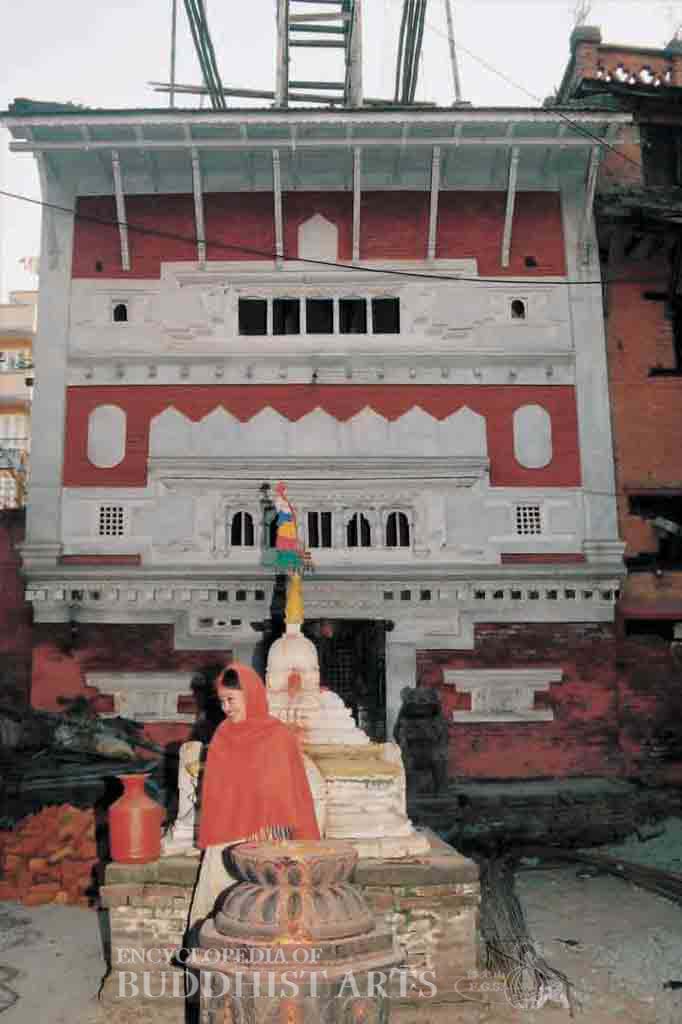
Cuka Temple
Cuka Temple
NEPAL, Patan
The Sanskrit name for this temple is Manadeva Samskarita Cakravarna Mahavihara. It is located south of Tanga Temple. Although it is one of the oldest temples in Patan and listed as one of the major temples in the city, it is now a branch temple of the Kwa Temple. The temple is believed to have been built by King Manadeva I (reigned circa 464–505) of the Licchavi period. Its present appearance is a result of large-scale renovation undertaken in recent years.
The main feature of the temple is the main shrine. It is a brick and stone structure in alternating colors of white and red. The entrance to the shrine is guarded by two stone lions. There are rows of real and false windows on the second and third stories. Each row depicts the Five Dhyani Buddhas and other deities. The eaves are supported by eight plain struts. In front of the main shrine there are a small stone stupa with a Sumeru throne base and an inverted bowl body, and the remains of a stone mandala.
For more details, go to the Encyclopedia of Buddhist Arts: Architecture A-F, page 181.
Cite this article:
author = Hsingyun and Youheng and Johnson, Peter and Mankuang and Lancaster, Lewis,
booktitle = {Encyclopedia of Buddhist Arts: Architecture A-F},
pages = 181,
title = {{Cuka Temple}},
volume = 1,
year = {2016}}