
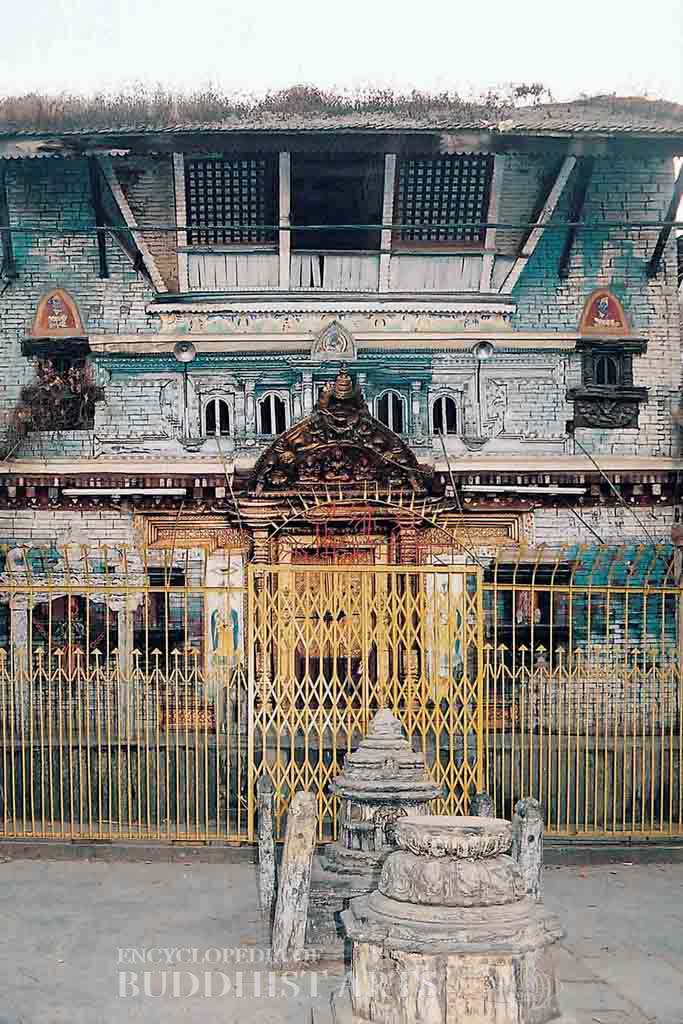
Ta Temple
Ta Temple
NEPAL, Patan
Its Sanskrit name is Bhuvanakara Varma Samskarita Dharmakirti Mahavihara. An older form of the name is Tava Temple. It is one of the oldest temples in Patan and is said to have been founded by Bhuvanakara Varma, but the exact year of its construction is unknown. The earliest reference to the temple is found in an inscription dated 1427, therefore the temple must have been built before then.
The temple complex consists of a main shrine, a large stupa, and two Dharmadhatu mandalas. The main shrine is a simple, three-story, standalone building. The tympanum above the entrance is decorated with repoussé images of the Vairocana Buddha, Aksobhya Buddha, and Ratnasambhava Buddha. In the center of the second story there are five windows. Above the central window there is a small tympanum with a Buddha image. To the left and right there are also windows, above which are tympana painted with Buddhist images. The tiled roof is unadorned and in a state of disrepair. There is a statue of Aksobhya Buddha facing north within the main shrine.
In front of the main shrine, the stone mandalas are mounted on an octagonal base. A large, old stupa almost as tall as the main shrine dominates the rest of the courtyard. The stupa stands on a rectangular platform. The base of the stupa is in the form of a stepped pyramid with a Buddha niche on each side. The body of the stupa consists of the usual dome with a harmika, a spire of stacked rings and a finial. There is an inscription in front of the stupa dated 1699.
For more details, go to the Encyclopedia of Buddhist Arts: Architecture T-Z, page 1075.
Cite this article:
author = Hsingyun and Youheng and Johnson, Peter and Mankuang and Lancaster, Lewis,
booktitle = {Encyclopedia of Buddhist Arts: Architecture T-Z},
pages = 1075,
title = {{Ta Temple}},
volume = 4,
year = {2016}}