
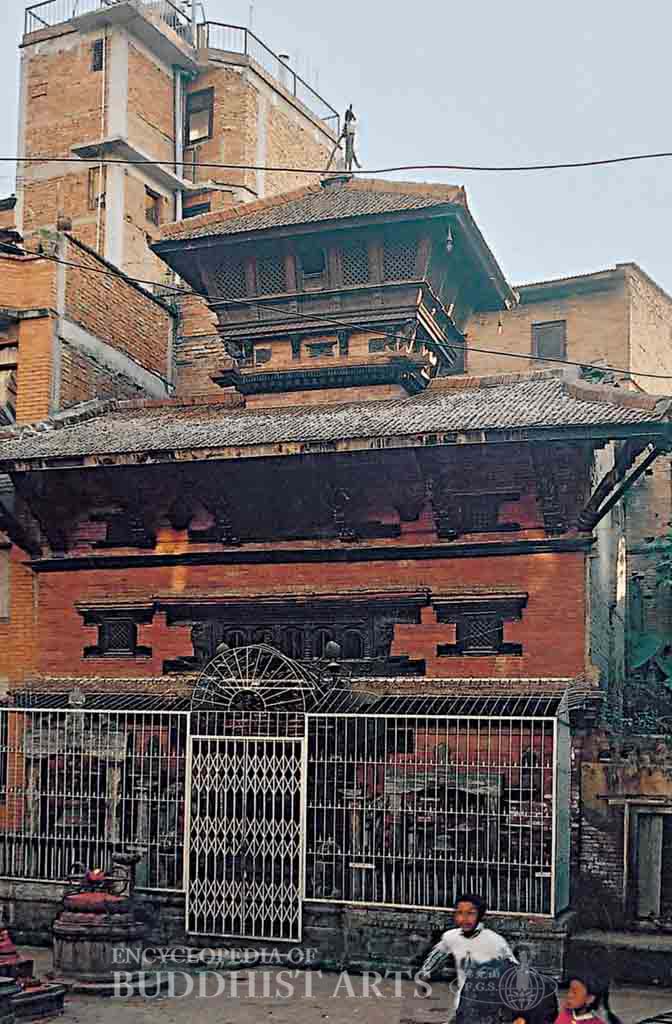
Wam Temple
Wam Temple
NEPAL, Patan
This temple’s Sanskrit name is Suryavarma Samskarita Vajrakirti Mahavihara. It is one of the best preserved temples in Patan. The exact year of its construction is unknown, but the earliest reference to the temple is on a palm leaf manuscript dated 1441.
The temple consists of a courtyard within which the most significant building is the main shrine. The entrance to the shrine is guarded by two stone lions. On either side of the lions is a bell, one large and one small. A few steps from the gate there is a finely carved doorway, next to which there are metal flags and two stone Bodhisattvas with headdresses and ornaments. The Bodhisattva on the right holds a vajra and bell, and the one on the left holds a mirror and a small stupa on a lotus. Above the doorway there is a tympanum in repoussé decorated with images of Aksobhya Buddha and Prajnaparamita and Avalokitesvara Bodhisattvas, symbolizing the Triple Gem of the Buddha, Dharma, and Sangha. Above the three central figures there are six four-armed Bodhisattvas. The facade of the shrine is made of brick. The eaves are supported by carved struts. In the center of the roof there is an inverted trapezoid structure with a pyramidal hip roof surmounted by a finial. The main shrine houses an image of Aksobhya Buddha facing north.
The courtyard is paved with brick and there are a number of objects within it: a few small stupas, a brass Dharmadhatu mandala, and a pillar with two reliefs of devotees. One of the stupas is in Licchavi style but it is unusual: instead of the usual blank shrines it features two series of Buddhas. The lower part of the stupa has images of four Dhyani Buddhas, and in the upper niches there are four images of Vairocana Buddha, one facing in each direction.
For more details, go to the Encyclopedia of Buddhist Arts: Architecture T-Z, page 1171.
Cite this article:
author = Hsingyun and Youheng and Johnson, Peter and Mankuang and Lancaster, Lewis,
booktitle = {Encyclopedia of Buddhist Arts: Architecture T-Z},
pages = 1171,
title = {{Wam Temple}},
volume = 4,
year = {2016}}