
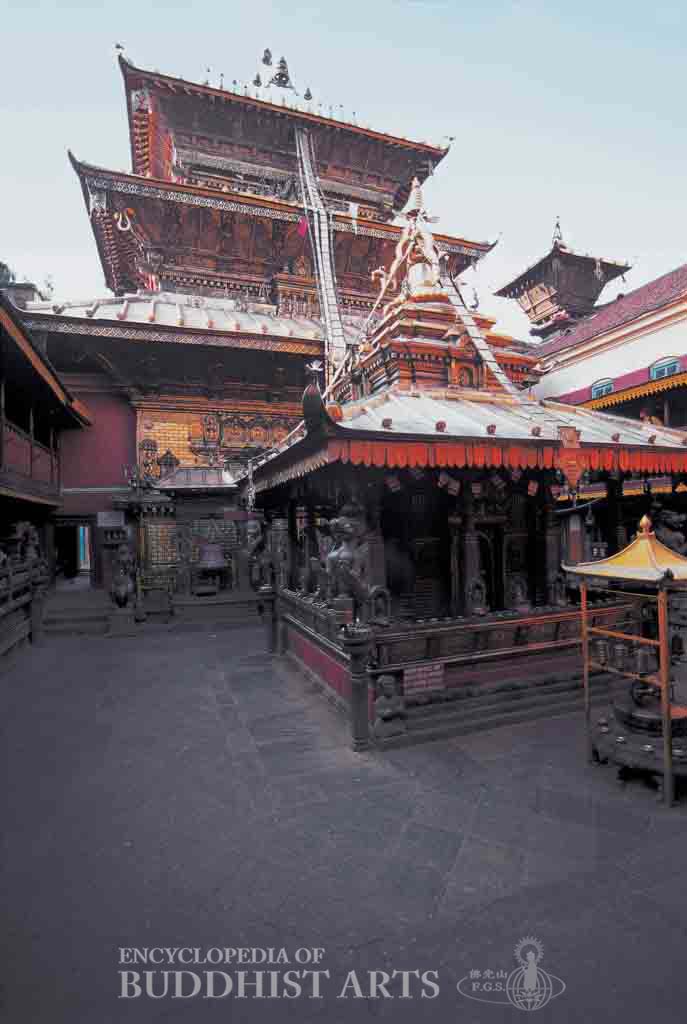
Kwa Temple
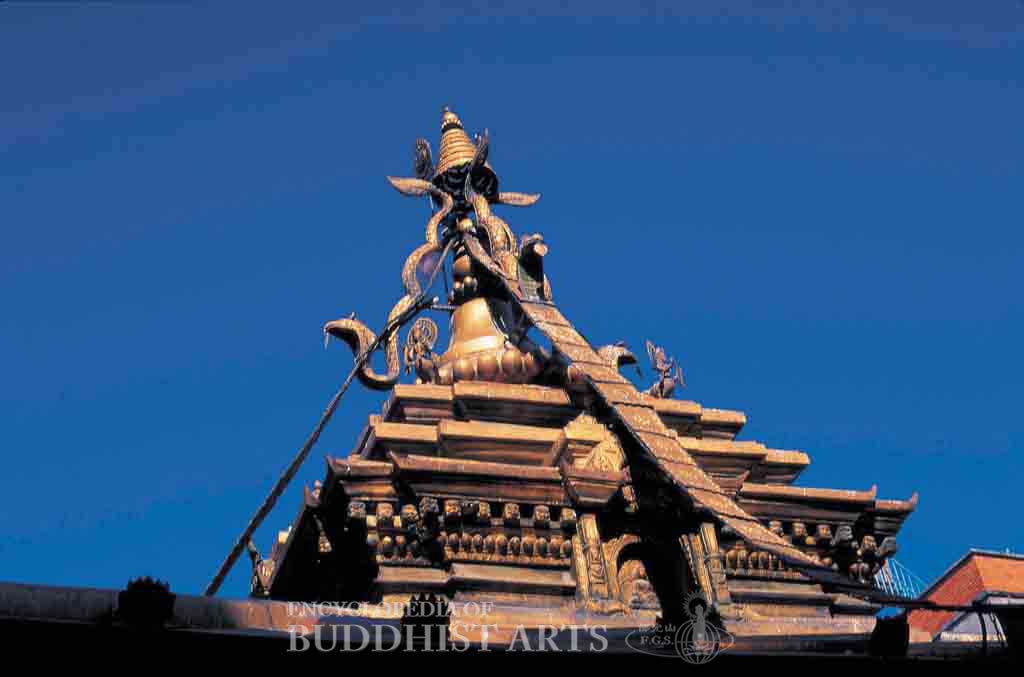
Kwa Temple: Small Square Shrine - Golden Stupa
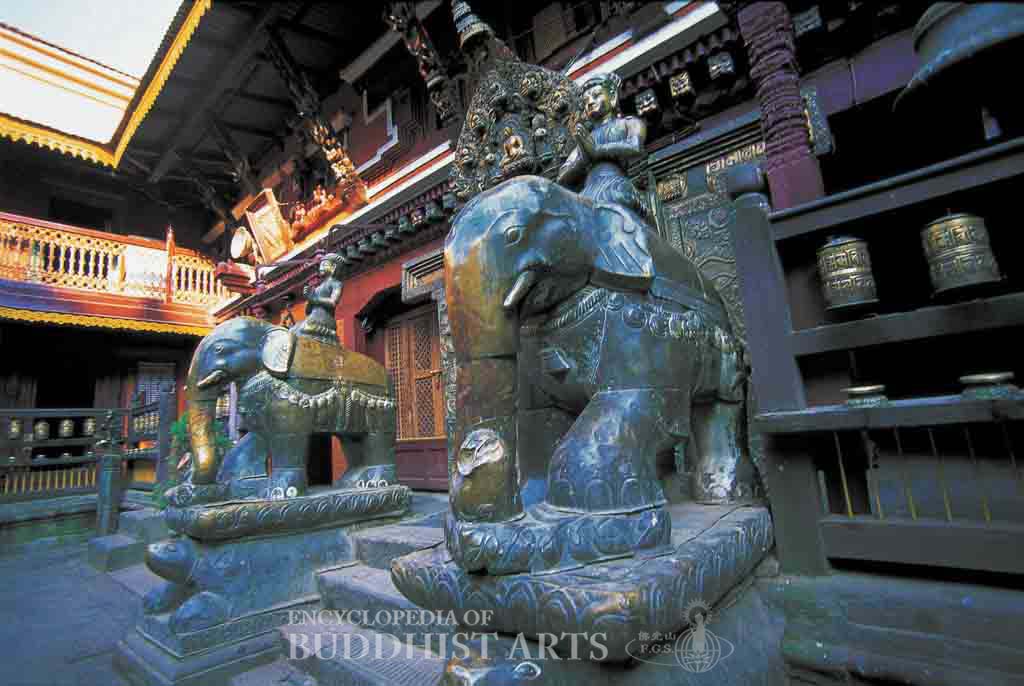
Kwa Temple: Main Courtyard
Kwa Temple
NEPAL, Patan
Kwa comes from an old Newari word Kwatha, which means Fort. Built outside the boundary of a palace, it used to be called Kwathalakhu Bihar; however, with the tendency to shorten words in the Newari language, the temple was later named Kwatha Temple and then given its present name. Its Sanskrit name is Bhasker Dev Samskarita Hiranyavarna Mahavihara or Suvarna Mahavihara. It is popularly known as the Golden Temple. It is the most famous and most lavishly decorated of Patan’s Eighteen Major Temples, and has the largest sangha in the Kathmandu Valley. It is said that it was built in the 12th century by King Bhasker Dev of the Thakuri dynasty (circa 879–1250), but the earliest record of its existence dates to 1409. In 1979 the Kathmandu Valley, including Kwa Temple, was inscribed on the UNESCO World Heritage List.
The temple complex has two courtyards and there are four main buildings around the main courtyard including the main shrine. The main gate is located in the east, guarded by two large stone lions. After passing through the front courtyard, the main courtyard is entered through a highly-decorated arched doorway. The main shrine is in the west of the main courtyard. It is four stories high with three-tier gilded eaves. The entire doorway of the shrine is finished in gilt repoussé, and the lintels are decorated with beautiful and complicated Buddha images. Within the shrine there is a statue of Sakyamuni Buddha. On the east side of the main courtyard there is a two-story building, in front of which there is a pair of metal elephants standing on top of tortoises and surmounted by Avalokitesvaras. The two-story building in the north is enshrined with statues of Amoghapasa Avalokitesvara on the upper story and Vajrasattva on the lower. In the south, there is another two-story building where a statue of Amitabha Buddha is enshrined on the upper story and a statue of Tara on the lower. In the corners of the main courtyard, there are bronze statues of Avalokitesvara in different forms.
Another distinctive structure is the single-story small square shrine in the center of the courtyard. It is entirely covered with gold and other metals. The shrine has a pyramidal roof with a golden stupa set on top. It is decorated with four nagas raising their heads, while their bodies are curved. Four open-mouthed animals representing Dharma protectors stand at the four corners. Inside there is a stupa, similar in structure to the Swayambhu Stupa, surrounded by statues of Bodhisattvas. This shrine is said to be the oldest structure of the temple complex.
For more details, go to the Encyclopedia of Buddhist Arts: Architecture G-L, page 640.
Cite this article:
author = Hsingyun and Youheng and Johnson, Peter and Mankuang and Lancaster, Lewis,
booktitle = {Encyclopedia of Buddhist Arts: Architecture G-L},
pages = 640,
title = {{Kwa Temple}},
volume = 2,
year = {2016}}