
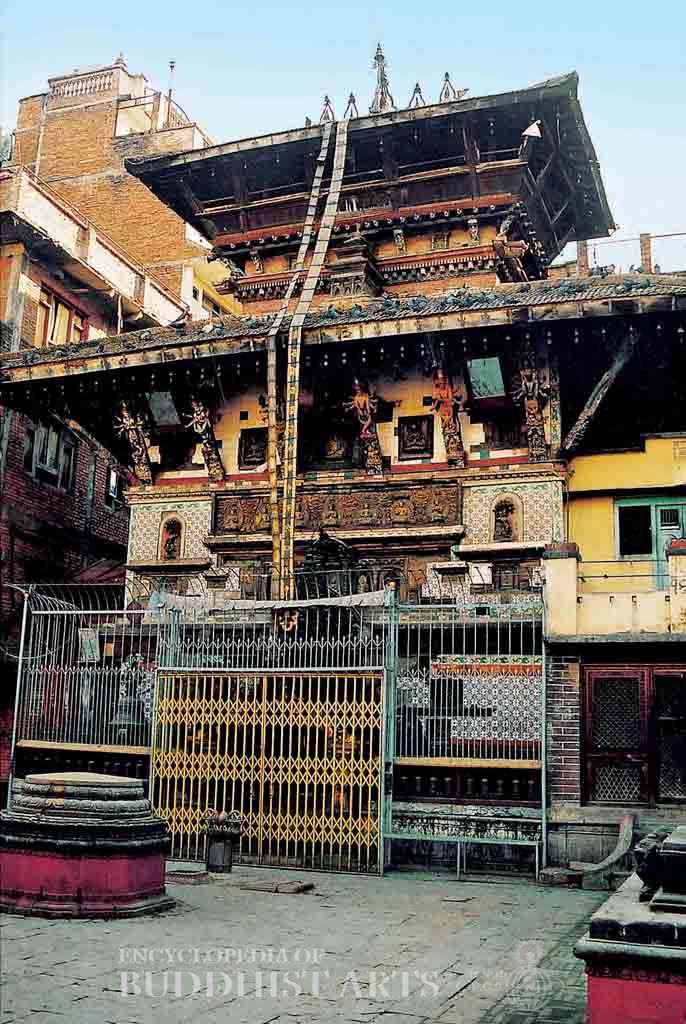
Bu Temple: Main Shrine
Bu Temple
NEPAL, Patan
The temple has the Sanskrit name Vidyadhara Sarma Samskarita Yasodhara Mahavihara. It is said that the temple was built by a Brahmin named Vidyadhara Sarma and was later renovated by Yasodhara, a Brahman widow, during the reign of King Sankaradeva (reigned circa 1067–1080) of the Thakuri dynasty (circa 879–1250). The earliest dated reference to the temple is a copper inscription from the year 1426, hence it is certain that the temple was built before the 15th century.
The courtyard and buildings cover an area of 2,900 sq m. The main gate is on the southern side of the courtyard.The main shrine is not opposite the main gate but to the left of it. Facing east, the main shrine is three stories high with two eaves. The lower eave is wide and deep, and it is supported by slanted struts with carvings of a multi-armed deity. The upper eave is in the form of an inverted trapezoid. In the center of the roof there are five copper stupas. The arched doorway of the shrine is guarded by two metal lions, and is flanked by brass figures of Sariputra and Maudgalyayana at the base of the arch. The doorway has a highly decorated tympanum in repoussé, depicting the Five Dhyani Buddhas and six Bodhisattvas, with an image of Vajrasattva at the very top. On the facade of the main shrine there are Five Dhyani Buddhas in the usual row of five windows, above which there is another row of seven windows with the same Buddhas flanked by two Tara images. Inside the main shrine there is an image of a large seated Amitabha Buddha in gilt copper.
At the center of the courtyard there are stupas, shrines, and mandalas, some of which bear inscriptions with dates.
For more details, go to the Encyclopedia of Buddhist Arts: Architecture A-F, page 98.
Cite this article:
author = Hsingyun and Youheng and Johnson, Peter and Mankuang and Lancaster, Lewis,
booktitle = {Encyclopedia of Buddhist Arts: Architecture A-F},
pages = 98,
title = {{Bu Temple}},
volume = 1,
year = {2016}}