
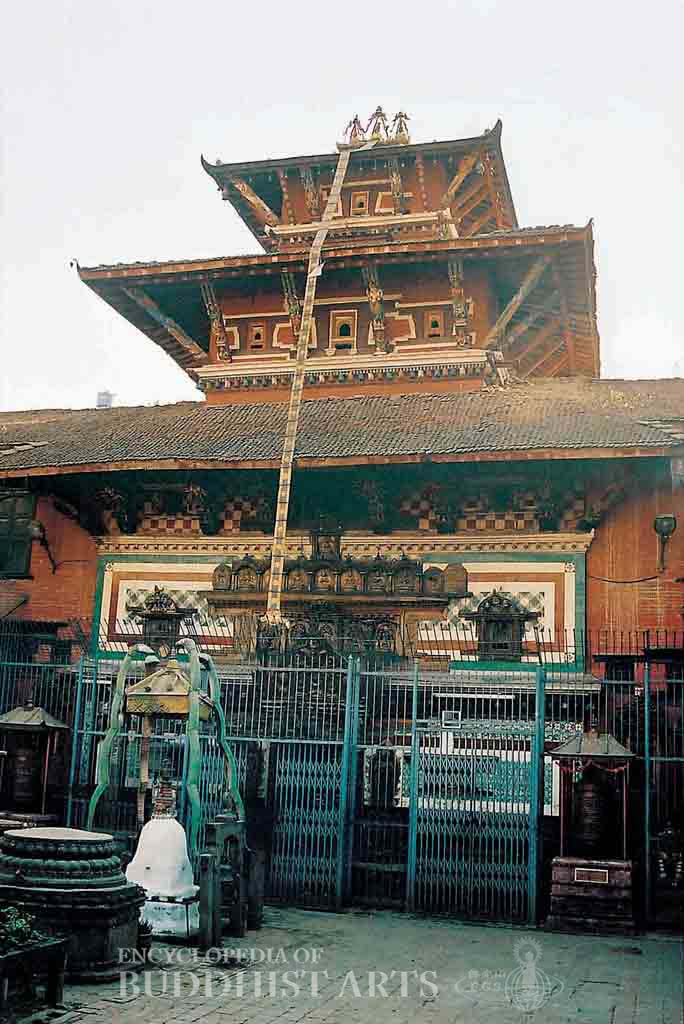
Ha Temple
Ha Temple
NEPAL, Patan
Ha Temple is also known as Hakha Temple or Hatako Temple and its Sanskrit name is Laksmi Kalyana Varma Samskarita Ratnakara Mahavihara. Ha Temple is one of the few well-preserved temples in Patan. According to the chronicles, it was built by King Mahadevikama Deva (reigned 1015–1039) of Thakuri. It was moved from its original site in Durbar Square to its present location in the 17th century by King Siddhi Narasimha (reigned 1619–1661) of Malla. It underwent renovation in 1983.
The temple consists of a large courtyard and two small courtyards at the sides of the main shrine. The street entrance consists of a brick facade with a single doorway, two small false windows on the lower story, and large lattice windows on the upper story. It is guarded by two giant stone lions. The arched part of the doorway is highly decorative. The top part of the arch depicts the Five Dhyani Buddhas, and below them there is a Four-Armed Manjusri and an Eight-Armed, Three-Eyed Manjusri. The false windows on each side of the doorway have wooden statues of a Four-Armed Manjusri and a seated Avalokitesvara Bodhisattva.
The main shrine is situated on the southern side of the main courtyard, opposite the entrance. It is three stories high with three eaves. The doorway to the shrine is guarded by two Avalokitesvara riding on brass lions, each holding a sword in the right hand and a trident in the left. There are repoussé images of Sariputra and Maudgalyayana at each side of the doorway. Above the doorway there is a delicate tympanum in copper repoussé: an image of Vairocana Buddha is in the upper section and Aksobhya Buddha, Prajnaparamita, and Avalokitesvara, symbolizing the Triple Gem, are portrayed in the lower section. The eaves of each story are supported by a number of decorated struts. The brass supas sit in the center of the roof. Within the main shrine there is a giant bronze statue of Aksobhya Buddha. A number of mandalas and small stupas in brass or stone are arranged in the center of the courtyard.
For more details, go to the Encyclopedia of Buddhist Arts: Architecture G-L, page 417.
Cite this article:
author = Hsingyun and Youheng and Johnson, Peter and Mankuang and Lancaster, Lewis,
booktitle = {Encyclopedia of Buddhist Arts: Architecture G-L},
pages = 417,
title = {{Ha Temple}},
volume = 2,
year = {2016}}