
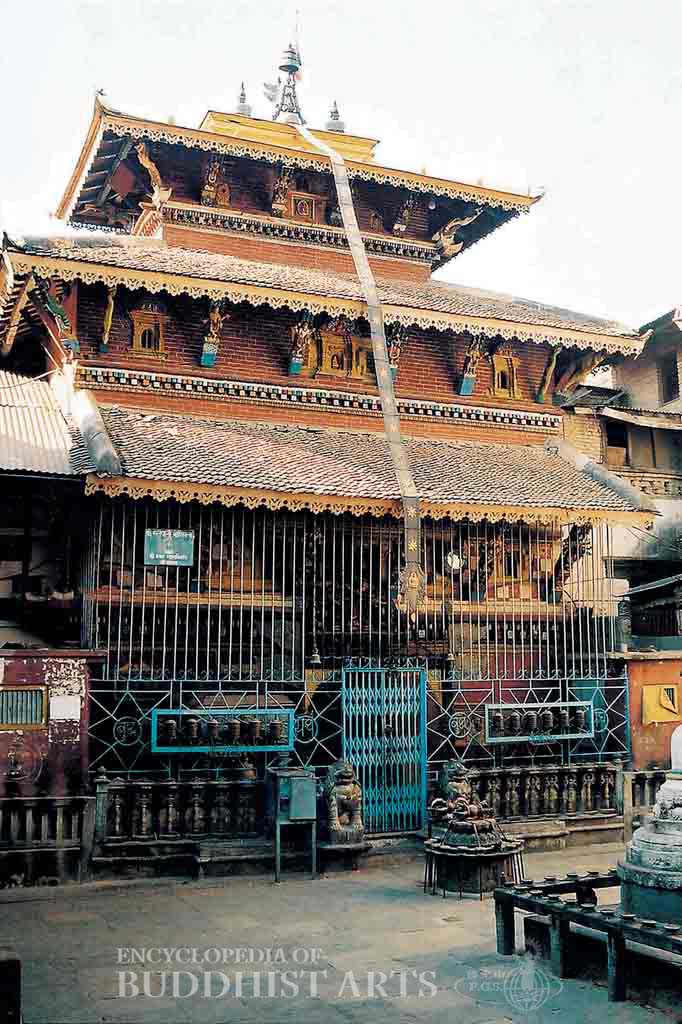
Si Temple
Si Temple
NEPAL, Patan
The temple’s name is also spelled Shi Temple and it is known in Sanskrit as Sri Vaccha Mahavihara. It is located on the western edge of Patan and is the westernmost temple in that city. The exact year of its construction is unknown. The earliest reference to the temple is in a manuscript dated 1389. It was renovated a few times, including in 1692 and 1905. In 1934 most of its buildings were destroyed by an earthquake and were later reconstructed.
The temple consists of a courtyard and main shrine. Above the entrance to the temple there is an engraved wooden tympanum with the image of a standing Vairocana Buddha. The main shrine is made of brick and consists of four stories with three eaves. In front of the entrance to the shrine there are two splendid stone lion guardians. Above the carved doorway there is a tympanum of repoussé with Aksobhya Buddha in the center, flanked by Prajnaparamita and Avalokitesvara Bodhisattvas, symbolizing the Triple Gem of the Buddha, Dharma, and Sangha. On the second story there is a set of five windows, with the lowest eave extending over them. All three eaves are made of tiles and are supported by carved struts. On top of the roof there are three stupas with a metal streamer hanging down to the second story. The main shrine contains a standing statue named Ratnapani Bodhisattva.
The building on the left side of the courtyard contains a shrine with a statue of Vasudhara and the building on the right has a room used for chanting. At the center of the courtyard there is a small white stupa with a yellow spire.
For more details, go to the Encyclopedia of Buddhist Arts: Architecture M-S, page 1017.
Cite this article:
author = Hsingyun and Youheng and Johnson, Peter and Mankuang and Lancaster, Lewis,
booktitle = {Encyclopedia of Buddhist Arts: Architecture M-S},
pages = 1017,
title = {{Si Temple}},
volume = 3,
year = {2016}}