
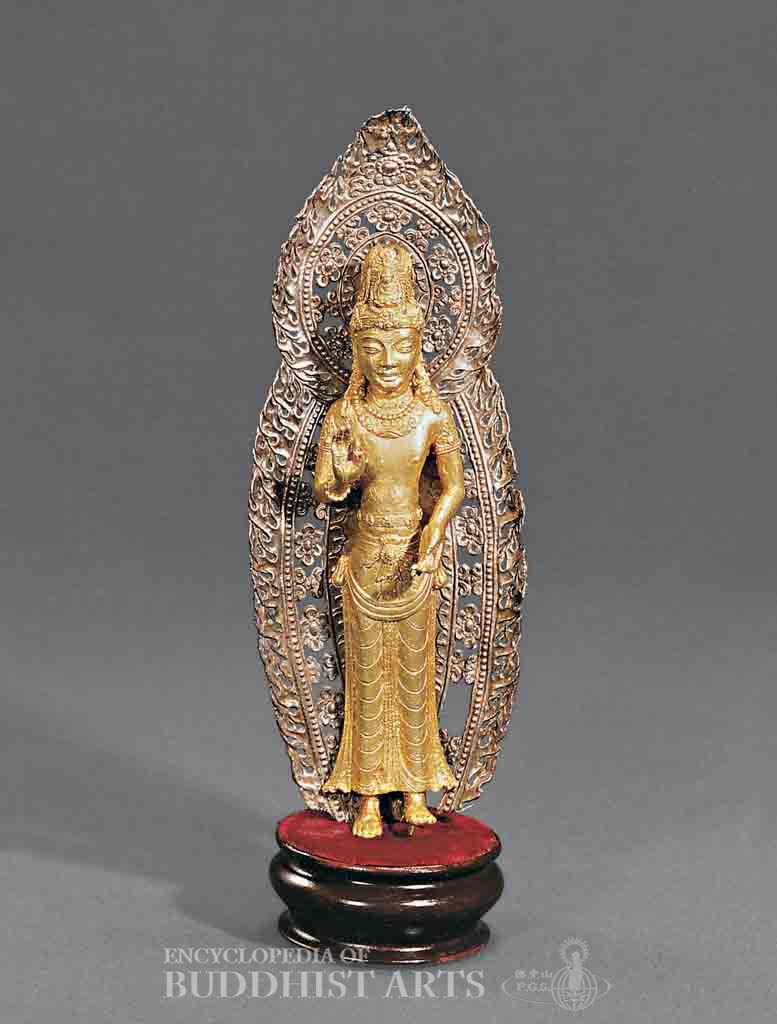
Chongsheng Temple Qianxun Pagoda: Ajaya Avalokitesvara
Gold
Chongsheng Temple Qianxun Pagoda: Ajaya Avalokitesvara
CHINA, Yunnan, Dali; Dali Kingdom
This statue was discovered in 1978 in the top section of Qianxun Pagoda. It is possible that this statue was made when Yunnan was part of the Nanzhao Kingdom (752–902), which later became the Dali Kingdom (937–1253). Devotion to Ajaya Avalokitesvara was found only in Yunnan.
The Bodhisattva’s headdress includes an image of a seated Buddha and there are ribbons hanging down to the shoulders. The figure has large eyes, a prominent nose, and a wide mouth with full lips. The standing figure makes the vitarka (teaching) and varada (wish-granting) mudras. The body is adorned with earrings, necklaces, armlets, and a bracelet. The lower garment has a sash tied around the waist, which derives from the Mathura style of the Gupta period (circa 320–550). A tenon is found beneath the feet, which was used to secure the statue to the missing pedestal. The aureole and nimbus are decorated with openwork flower and flame motifs.
Researchers found arsenic in the metal, which led experts to believe that the statue was not made in the region. More research in the design and style of clothing conclude that the statue probably originated from the Indian Pala period (circa 8th–12th century).
For more details, go to the Encyclopedia of Buddhist Arts: Sculpture A-F, page 258.
Cite this article:
author = Hsingyun and Youheng and Lovelock, Yann and Chou, Yuan and Huntington, Susan and Edson, Gary and Neather, Robert,
booktitle = {Encyclopedia of Buddhist Arts: Sculpture A-F},
pages = 258,
title = {{Chongsheng Temple Qianxun Pagoda: Ajaya Avalokitesvara}},
volume = 10,
year = {2016}}