
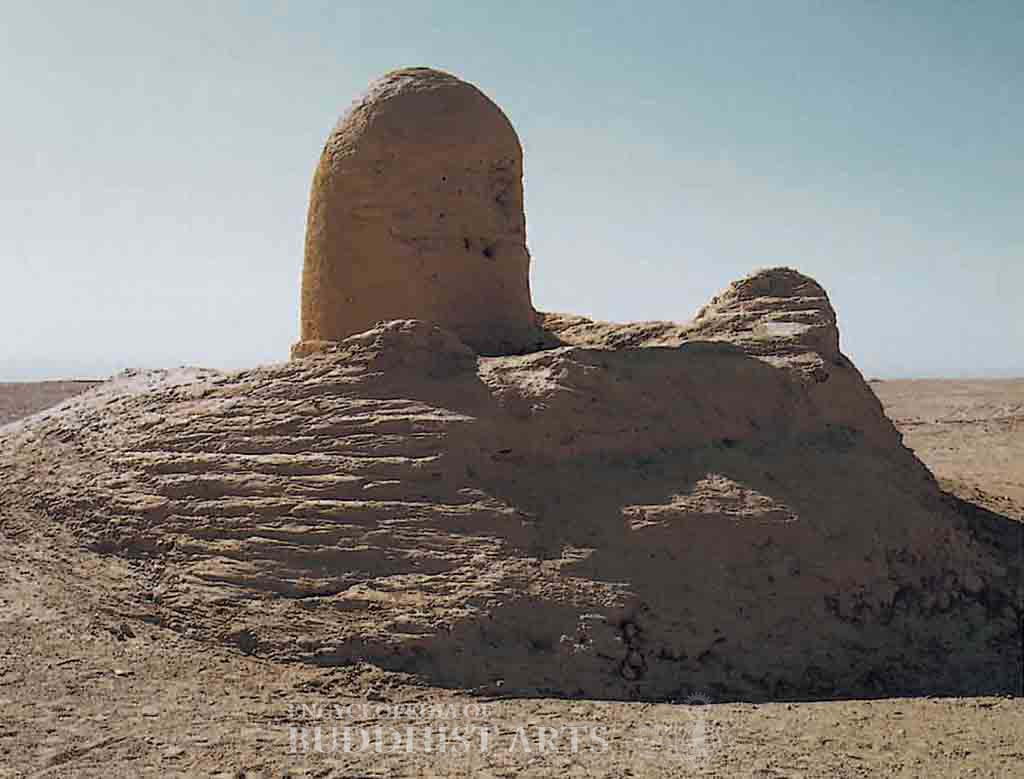
Miran: Stupa (Ruins)

Miran: Temple 2 (Ruins)
Miran
CHINA, Xinjiang, Bayingolin
The Miran ruins are located approximately 70 km east of Ruoqiang and 150 km south of the ancient city of Loulan (Kroran). Miran was built in the 3rd century and was abandoned during the Tang dynasty (618–907). Between 1906 and 1907, Aurel Stein, a British archaeologist, carried out excavations at Miran and removed a large number of artifacts, including statues and frescoes. It was listed as a National Cultural Heritage Site in 2001.
There are ruins of 15 Buddhist temples and stupas distributed over the site. The most exquisite sculptures and frescoes can be found at Temple 2, and at Stupas 3 and 5. Among them are winged heavenly beings, figures making offerings, Sakyamuni Buddha and disciples, and the Prince Sudana Jataka, which are in the collections of the National Museum in New Delhi and National Museum of Korea in Seoul. At Temple 2, the columns flanking the niches in the external wall are decorated with shapes such as diamond patterns or whirling spiral motifs, while the capitals of the columns are Corinthian in style. The niches contain painted reliefs. This early form of Buddhist architecture and art in the Xinjiang region reflects strong Gandharan influences.
For more details, go to the Encyclopedia of Buddhist Arts: Architecture M-S, page 743.
Cite this article:
author = Hsingyun and Youheng and Johnson, Peter and Mankuang and Lancaster, Lewis,
booktitle = {Encyclopedia of Buddhist Arts: Architecture M-S},
pages = 743,
title = {{Miran}},
volume = 3,
year = {2016}}