
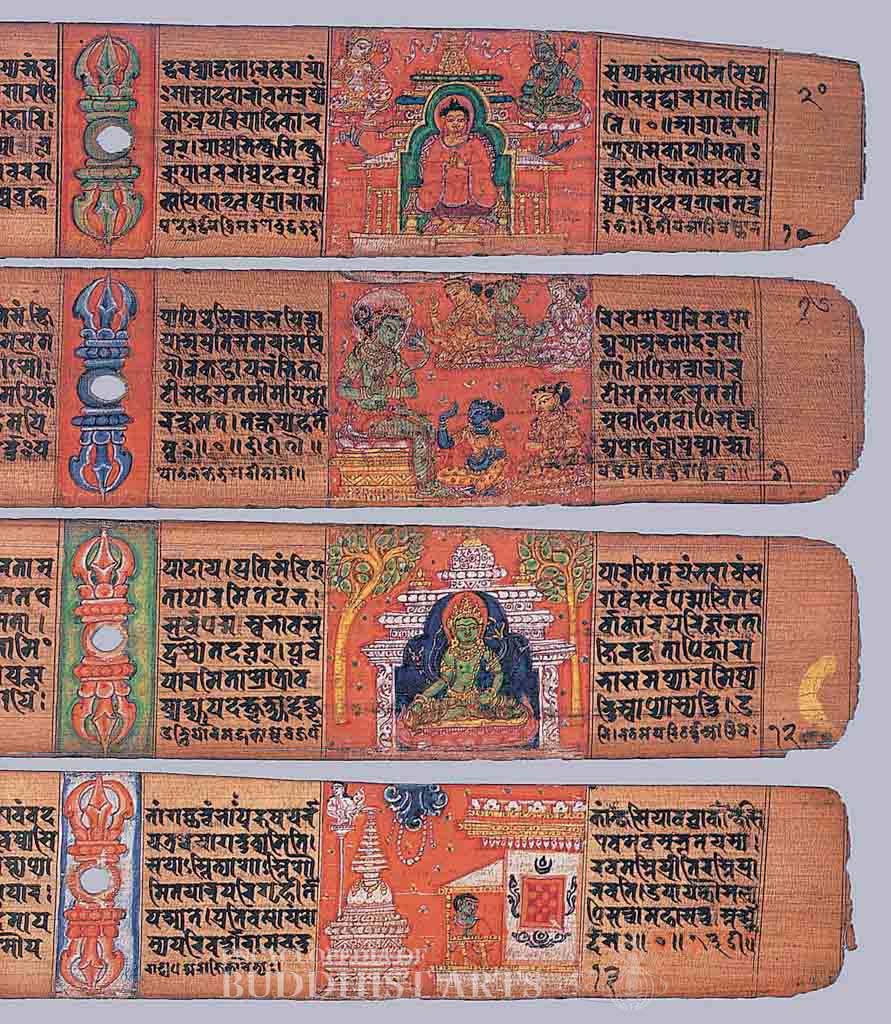
Sri Hlam Temple: Illustrated Manuscript of the Astasahasrika Prajnaparamita Sutra
Color on palm leaf
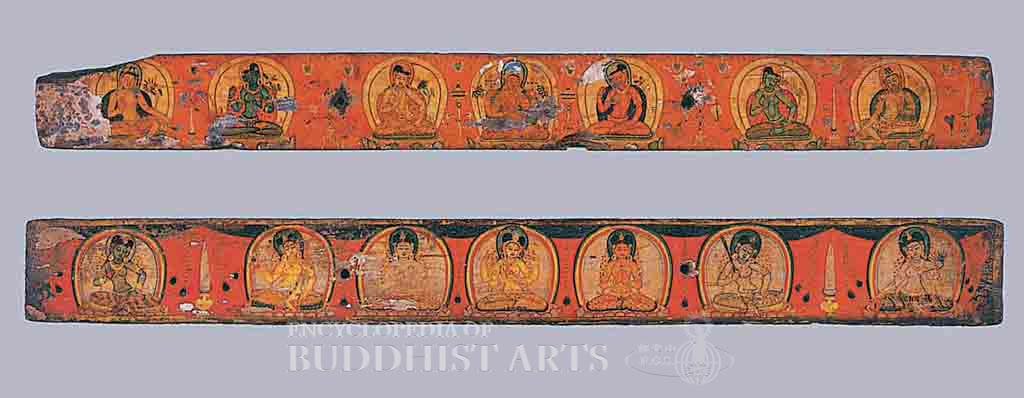
Sri Hlam Temple: Illustrated Manuscript of the Astasahasrika Prajnaparamita Sutra - Covers
Ink and color on wood
Sri Hlam Temple: Illustrated Manuscript of the Astasahasrika Prajnaparamita Sutra
NEPAL
Dated to 1015, this 223 page Sanskrit version of the Astasahasrika Prajnaparamita Sutra is the oldest colored palm leaf manuscript discovered in Nepal. It was transcribed by Sujatabhadra in Sri Hlam Temple. The illustrations depict Buddhist figures enshrined in temples. Beside each picture, there is an inscription that identifies the figures and temples depicted, and states the location where they can be found, encompassing sacred Buddhist sites all over Asia, particularly East India and Nepal.
Shown here, from top to bottom, are pages 20, 74, 89, and 127. All of the pictures are painted in bright colors against a red background. The illustration on page 20 is of a Buddha image from Pundravardhana (present day northern Bangladesh). The Buddha sits in a shrine and most likely forms the Dharmacakra (Dharma wheel) mudra. In the upper corners, White Tara and Green Tara sit on lotus thrones. On page 74, the illustration depicts Green Tara from Mount Potalaka, seated with legs pendent on a lotus throne, teaching the Dharma to a group of smaller figures on the right.
Vajrapani Bodhisattva from Swat is painted on page 89. The green-bodied Bodhisattva sits in full lotus position within a white shrine flanked by two trees. Page 127 depicts the Asoka Pillar, Dharmarajika Stupa, and the Buddhist temple at Radhya (near Lauriya Nandangarh). A garuda stands atop the capital of the pillar. The Dharmarajika Stupa is composed of a patterned base, rounded body, and a spire of nine stacked rings. The roof of the temple and a window on the side are decorated with patterns. Black scrolling designs are painted around the window.
The front and back covers of the sutra are made of wood and measure 5.24 cm high and 54 cm long. They are each painted with seven Bodhisattvas. The Bodhisattvas representing the seven perfections are depicted on one of the covers, while on the other, Maitreya, Samantabhadra, Candraprabha, Avalokitesvara, Jaliniprabha, Gandhahasti, and Sagaramati are shown. Each Bodhisattva forms a different mudra and sits with their head slightly tilted, a common feature of Nepalese art.
For more details, go to the Encyclopedia of Buddhist Arts: Painting P-Z, page 868.
Cite this article:
author = Hsingyun and Youheng and Youlu and Wilson, Graham and Manho and Mankuang and Huntington, Susan,
booktitle = {Encyclopedia of Buddhist Arts: Painting P-Z},
pages = 868,
title = {{Sri Hlam Temple: Illustrated Manuscript of the Astasahasrika Prajnaparamita Sutra}},
volume = 16,
year = {2016}}