
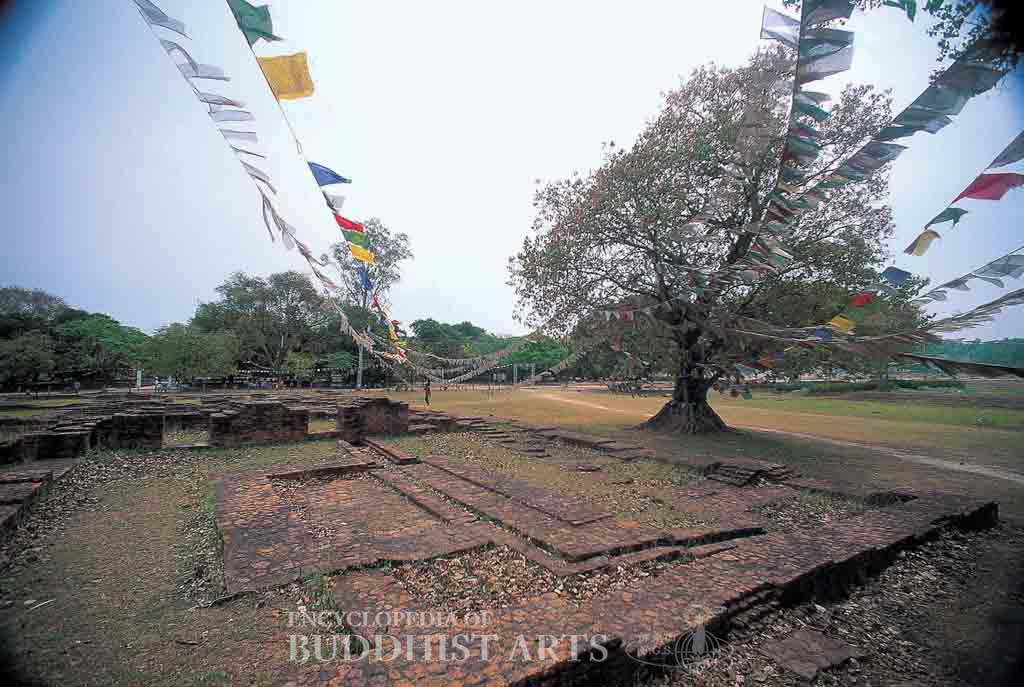
Lumbini
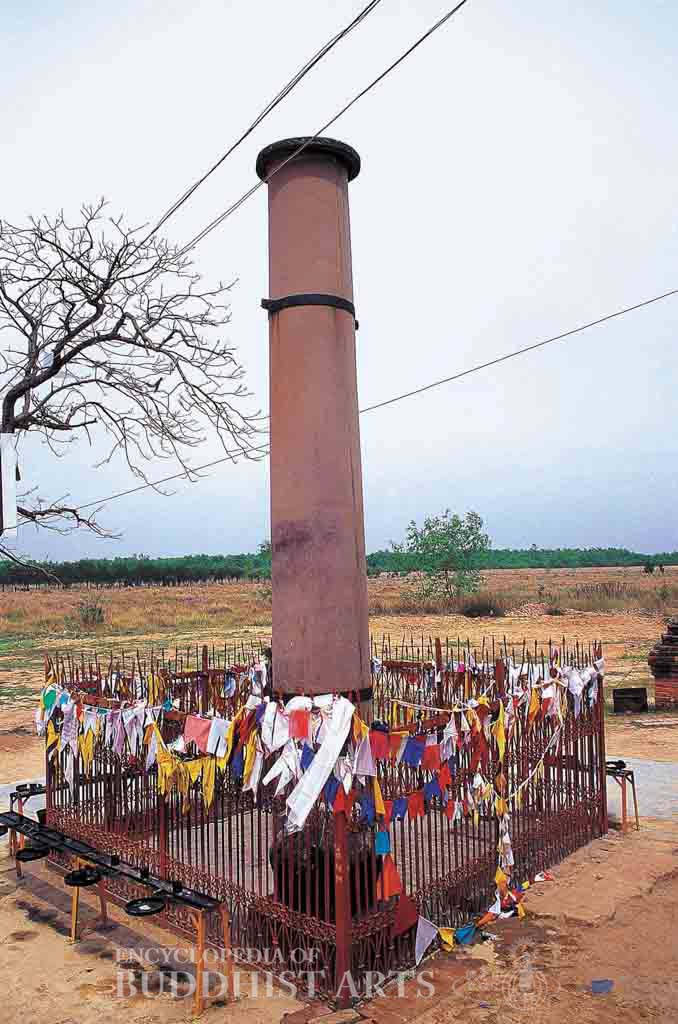
Lumbini: Asoka Pillar
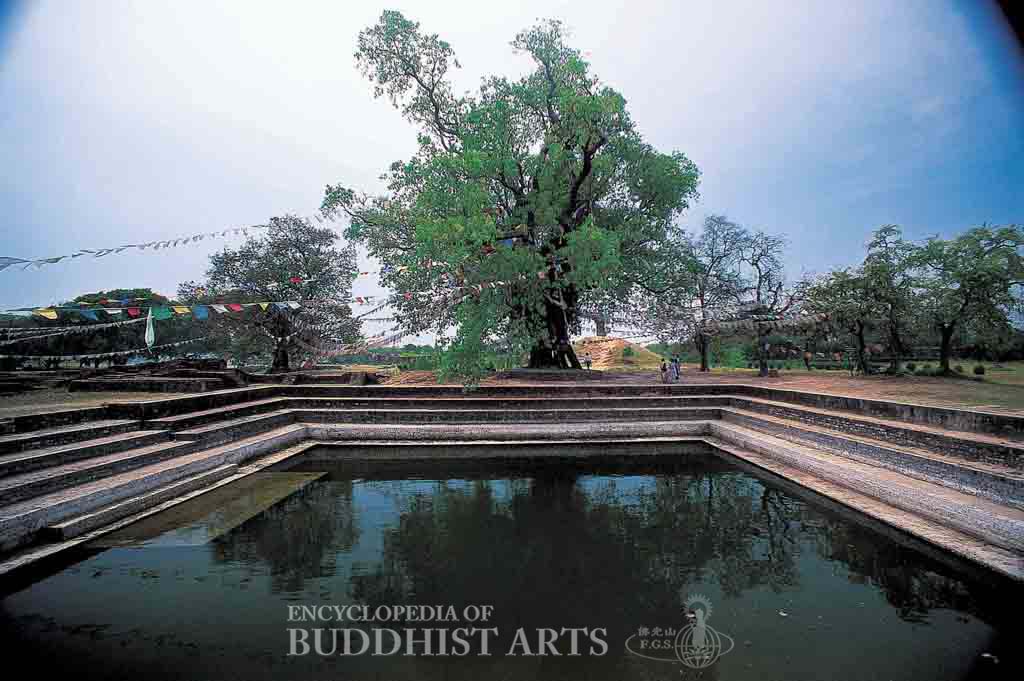
Lumbini: Puskarni Pool and Bodhi Trees
Lumbini
NEPAL, Bhairahawa
Lumbini is the birthplace of Sakyamuni Buddha. It is situated in the foothills of the Himalayas in Nepal, near the border with India. It used to be part of Uttar Pradesh in India until the 19th century. It is one of the Four Major Buddhist Sites together with Sarnath, where the Buddha taught the Dharma for the first time, Bodhgaya, where the Buddha attained enlightenment, and Kushinagar, where the Buddha entered parinirvana. With the decline of Buddhism in India, this place had been forgotten for many years. In 1896 Alois A. Fuhrer, a German archaeologist, and a group of Nepalese archaeologists led by Khadga Samser, then Governor of Palpa, rediscovered it and confirmed that the site was Lumbini. It was listed as a UNESCO World Heritage Site in 1997.
Lumbini Park was created by the Lumbini Development Trust with the help of UNESCO. The park consists of the Mahadevi Temple, the Puskarni (Sacred Pool), an Asoka Pillar, Bodhi trees and ruins of stupas, as well as monastic complexes. The Mahadevi Temple is a two-story Nepalese-style temple reconstructed in 1998. Inside there are temple ruins and a stone that marks the precise birthplace of the Buddha. In front of the temple there is a wide area with ruins of monastic residences and red brick stupas. It is believed that the monastic residences were built between the 5th and 3rd centuries BCE and the stupas were mainly constructed between the 3rd century BCE and the 6th century.
Next to the temple there are the remains of an Asoka pillar, with a height of around 6 m. Its stone surface is smooth but it is obviously cracked. It is inscribed with instructions from King Asoka (reigned circa 269–232 BCE) in Brahmi, “King Asoka is blessed by the Heavenly Kings and in the 22nd year of his enthronement, he came and worshipped here because Sakyamuni Buddha was born here. King Asoka decreed that a stone image of the Buddha be erected with a stone pillar and enclosed with railings, and that is the birthplace of the Buddha . . ..” According to the 7th century Chinese pilgrim Master Xuanzang, the capital of the pillar was originally carved with a horse but it was later destroyed by lightning.
In front of the Asoka pillar there is a rectangular pool, Puskarni, which was excavated in 1931. Legend has it that it is here that Queen Maya, mother of the Buddha, took a bath before giving birth. It is also the place where the Buddha took his first bath. Bodhi trees have now been planted by the pool.
A variety of Buddhist monasteries, temples, stupas, and other buildings have been constructed in Lumbini Park. They are financed by governments of various countries, as well as devotees worldwide. Some of the largest monasteries in Lumbini are from China, Korea, Japan, Myanmar, and Thailand. The area is separated into eastern and western monastic zones, with the eastern having Theravada monasteries, and the western having Mahayana and Vajrayana monasteries.
For more details, go to the Encyclopedia of Buddhist Arts: Architecture G-L, page 705.
Cite this article:
author = Hsingyun and Youheng and Johnson, Peter and Mankuang and Lancaster, Lewis,
booktitle = {Encyclopedia of Buddhist Arts: Architecture G-L},
pages = 705,
title = {{Lumbini}},
volume = 2,
year = {2016}}