
Leong San Temple
Leong San Temple
SINGAPORE
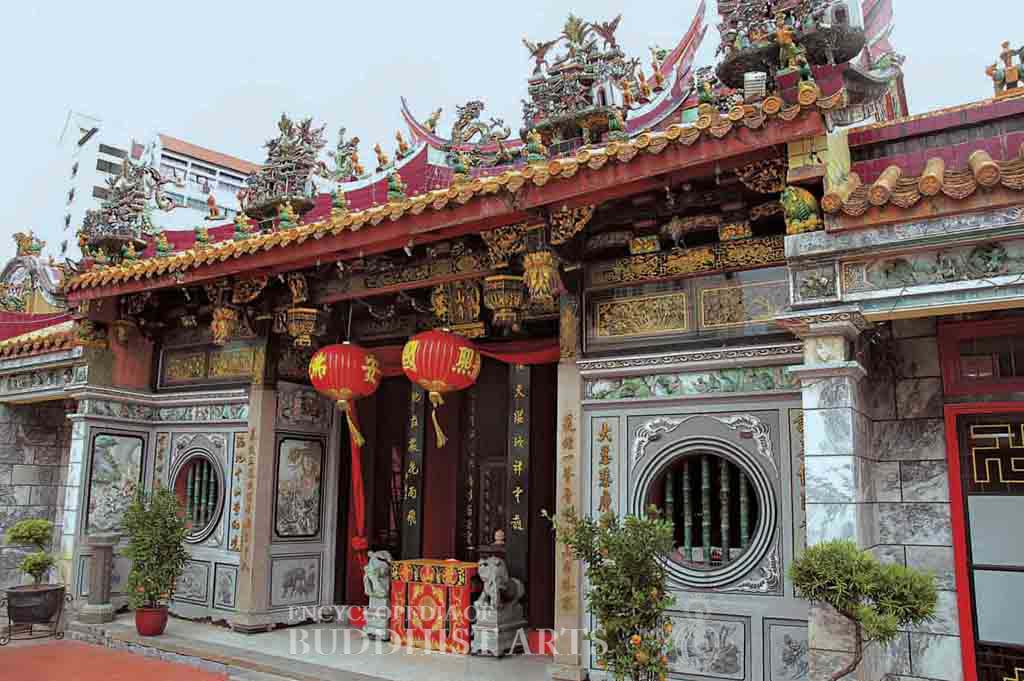
Leong San means Dragon Mountain. The temple was established by Master Zhuanwu in 1917 and is one of Singapore’s oldest temples. It used to be the ancestral hall for the Fujian Qiu clan and was later rebuilt with the aid of Tan Boon Kiat, a lay devotee. In 1945 the temple started the Long San School, providing education to children, which marked the beginning of the temple’s service to society. In 1952, when the abbot Zhuanfeng passed away, he was succeeded by Kong Hiap. Under his leadership, the Great Hero Hall was repaired, and Heyun Hall, which contains the Patriarch Hall and sutra repository, was built resulting in the temple’s current appearance.
The temple occupies approximately 2,300 sq m and is built in Southern Fujian style with high quality timber from China. The carved beams and painted columns are the work of expert Chinese craftsmen. A statue of Avalokitesvara Bodhisattva is enshrined within the temple. There are two stone lions in front of the entrance. The walls of the surrounding walkways are engraved with historical stories and auspicious images. Its folk art style is unusual and rarely seen in Singapore.
For more details, go to the Encyclopedia of Buddhist Arts: Architecture G-L, page 655.
Cite this article:
author = Hsingyun and Youheng and Johnson, Peter and Mankuang and Lancaster, Lewis,
booktitle = {Encyclopedia of Buddhist Arts: Architecture G-L},
pages = 655,
title = {{Leong San Temple}},
volume = 2,
year = {2016}}