
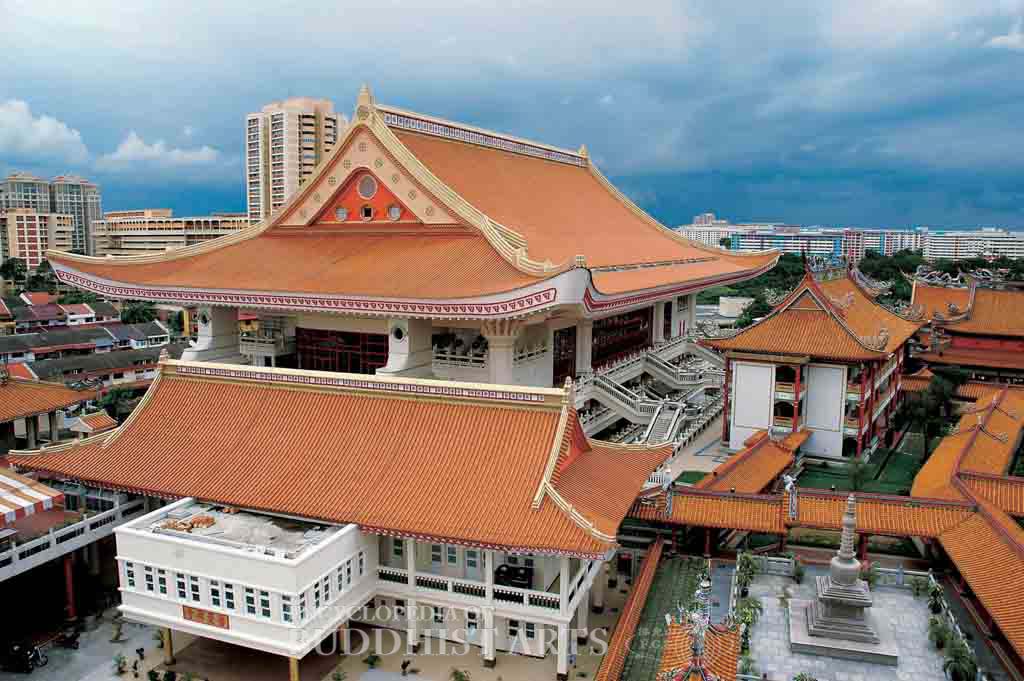
Kong Meng San Phor Kark See Monastery
Kong Meng San Phor Kark See Monastery
SINGAPORE
The monastery was founded by Master Zhuandao in 1921. The 12.1 ha site was donated by devotee Zheng Yusheng and the construction was funded by Aw Boon Haw and his brother. It was established as a monastery for practice, propagating the Dharma and accommodating monastics. It became the leading Buddhist monastery in Singapore. In 1947 the abbot Hongchoon carried out the renovation of the existing halls and added new facilities, such as the Free Life Pond and the abbot’s quarters. Since then there has been the construction of a number of additional buildings, greatly expanding the scale of the monastery.
The main buildings are the Great Hero Hall, Great Compassion Hall, drum and bell towers, Dharma Hall and library, Precepts Hall, Hall of Universal Brightness, Ten Thousand Buddha Pagoda, Hongchoon Memorial Hall, and Ancestral Hall. At the rear are the crematorium, Pu Tong Columbarium and Pu An Columbarium. The monastery is built in traditional Chinese style and the buildings have roofs covered in yellow glazed tiles.
The expansion of the Hongchoon Memorial Hall was completed in 2004. Within the hall, a 13.8 m high bronze Sakyamuni Buddha weighing 55 t is located in the Hall of No Form on the fourth story.
Next to the monastery there is a landscaped garden with a large pond. It provides a safe sanctuary for aquatic creatures, birds and animals. Pavilions and raised decks blend in well with the landscaping. These gardens and pavilions are a special feature of the monastery.
For more details, go to the Encyclopedia of Buddhist Arts: Architecture G-L, page 616.
Cite this article:
author = Hsingyun and Youheng and Johnson, Peter and Mankuang and Lancaster, Lewis,
booktitle = {Encyclopedia of Buddhist Arts: Architecture G-L},
pages = 616,
title = {{Kong Meng San Phor Kark See Monastery}},
volume = 2,
year = {2016}}