
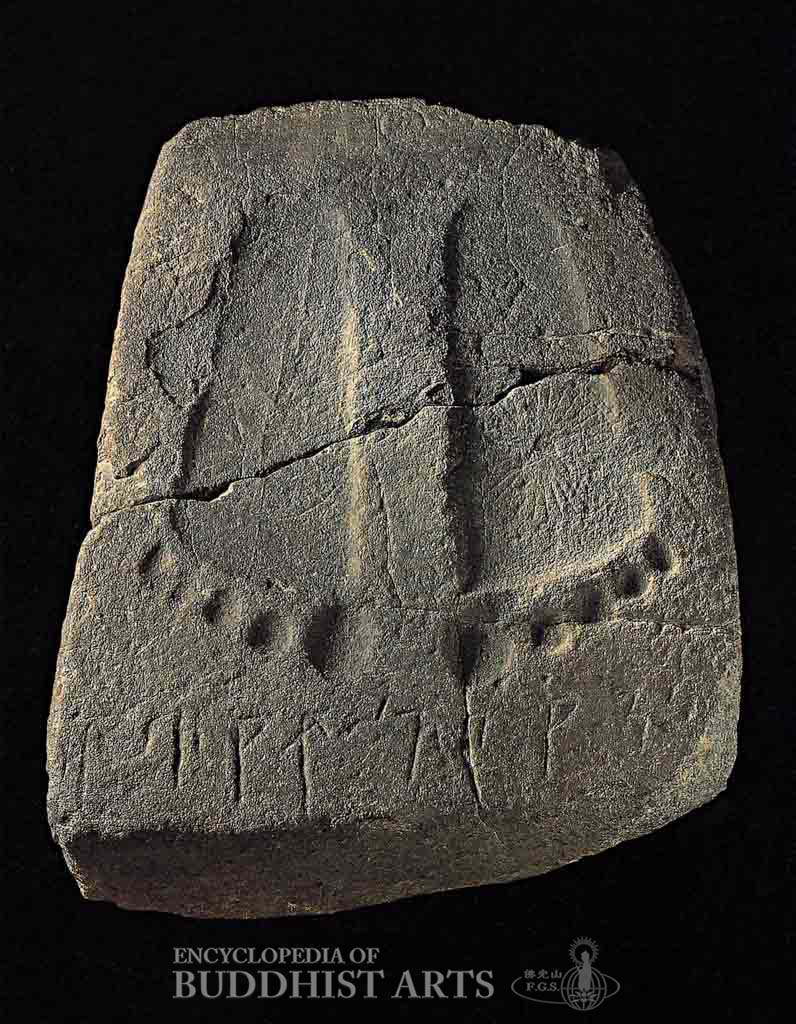
Swat: Footprints of the Buddha
Schist
Swat: Footprints of the Buddha
PAKISTAN, Khyber Pakhtunkhwa, Swat
These footprints are one of the more famous artifacts unearthed from the region. The Buddha traveled to the source of the Swat River to convert an evil naga, leaving behind these footprints according to legend. Chinese Master Xuanzang describes them in his Great Tang Records on the Western Regions. “They measure a foot and eight inches in length and more than six inches wide. Two Dharma wheels are located within the footprints while the toe prints feature a fish-shaped pattern.”
The imprints are clearly visible in the stone, though the Dharma wheels resemble more the ten million rays of light emitted by the Buddha that Xuanzang mentions in his account. A crack runs across the stone, while an inscription in Kharosthi at the bottom attests them as Sakyamuni’s footprints. Wang Xuance, a Tang dynasty (618–907) envoy once brought home and circulated his drawing of these footprints.
For more details, go to the Encyclopedia of Buddhist Arts: Sculpture St-Z, page 1178.
Cite this article:
author = Hsingyun and Youheng and Lovelock, Yann and Chou, Yuan and Huntington, Susan and Edson, Gary and Neather, Robert,
booktitle = {Encyclopedia of Buddhist Arts: Sculpture St-Z},
pages = 1178,
title = {{Swat: Footprints of the Buddha}},
volume = 13,
year = {2016}}