
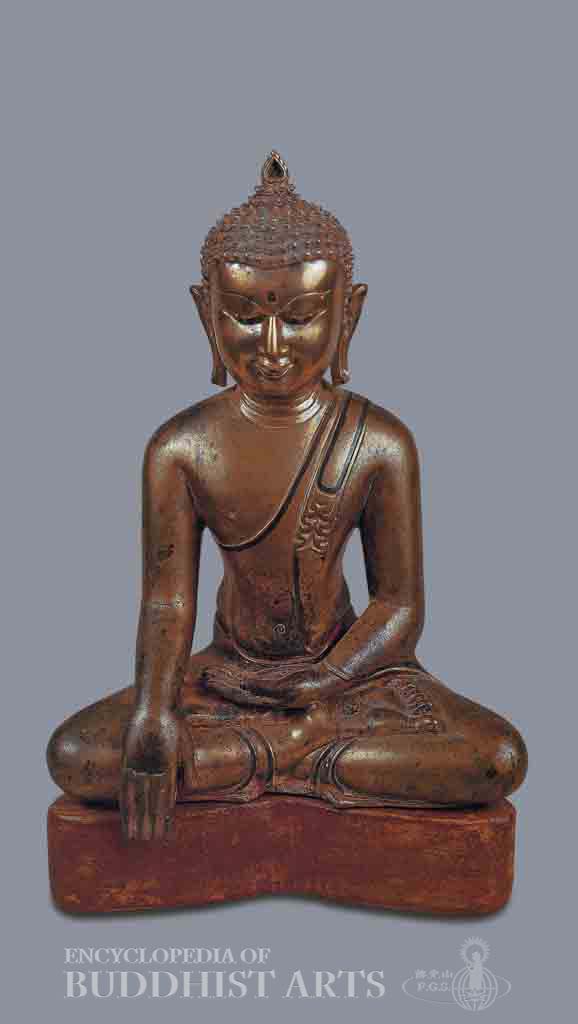
Seated Buddha
Bronze
Seated Buddha
MYANMAR; Bagan Empire
One of the elements of the Bagan (circa 849–1287) style is the way the Buddha leans forward slightly as he makes the bhumisparsa (earth-touching) mudra. Insets originally ornamenting the small usnisa and the urna are now missing. The earlobes are elongated on either side of the neck with its three lines. The hems of the monastic robe are outlined in black, and leave the right shoulder bare. The left part of the robe is neatly folded over the shoulder and has a ruffled end. The sheer material allows the navel to show, represented as a clockwise whirl, which is one of the Eighty Notobale Characteristics of a Buddha. Among the Thirty-Two Marks of Excellence visible here are the equal length of the fingers and toes, and the Dharma wheel on the sole of the foot.
For more details, go to the Encyclopedia of Buddhist Arts: Sculpture N-Sr, page 1023.
Cite this article:
author = Hsingyun and Youheng and Lovelock, Yann and Chou, Yuan and Huntington, Susan and Edson, Gary and Neather, Robert,
booktitle = {Encyclopedia of Buddhist Arts: Sculpture N-Sr},
pages = 1023,
title = {{Seated Buddha}},
volume = 12,
year = {2016}}