
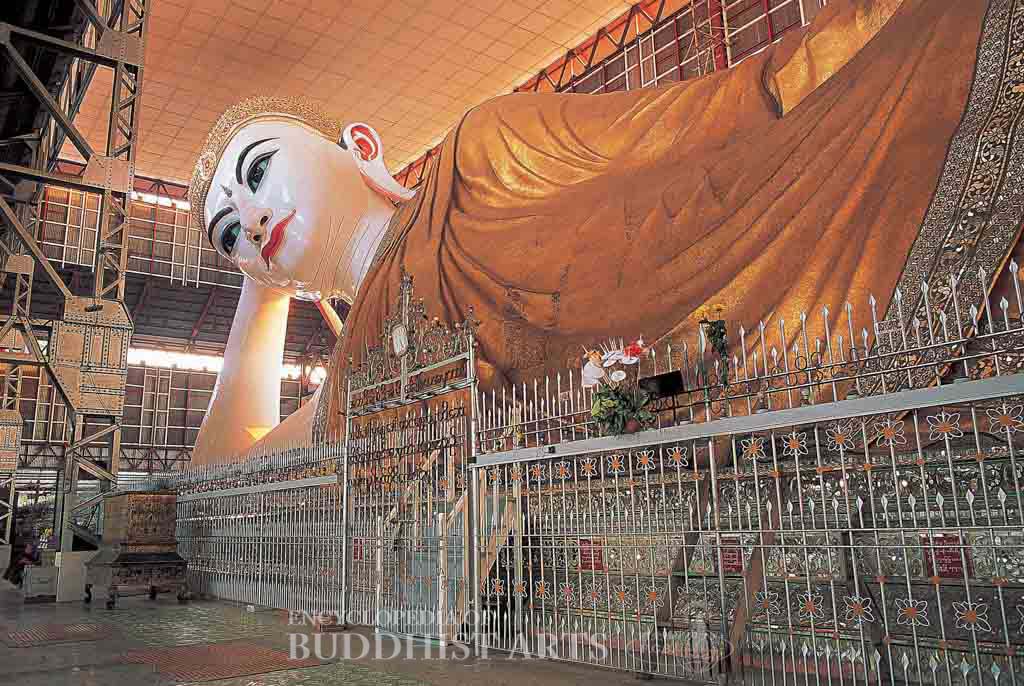
Chaukhtatgyi Pagoda: Reclining Buddha
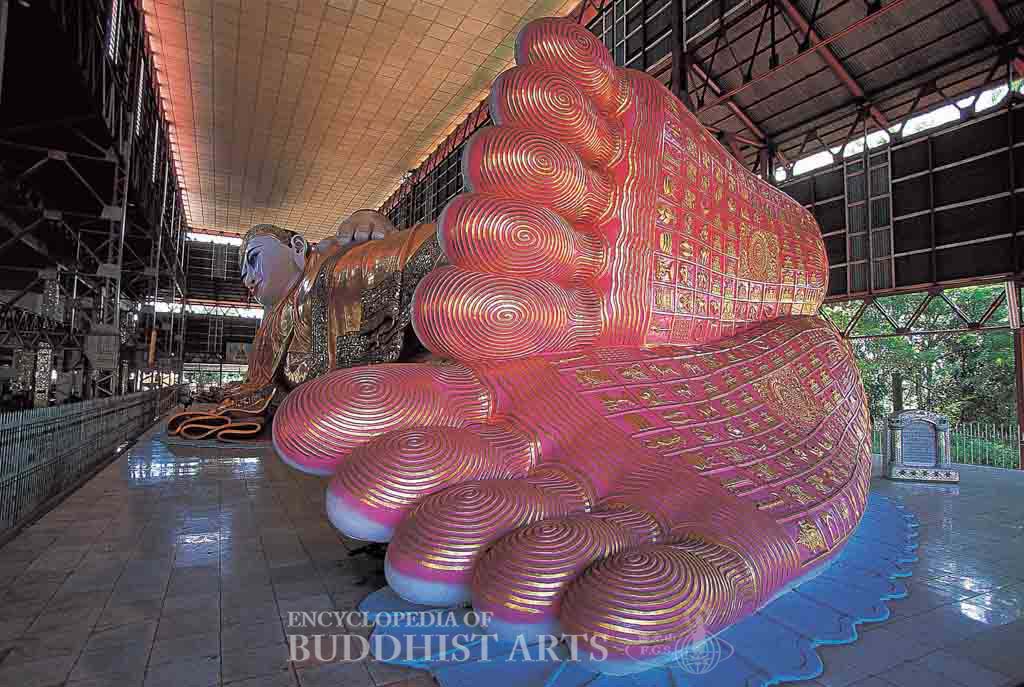
Chaukhtatgyi Pagoda: Reclining Buddha - Soles
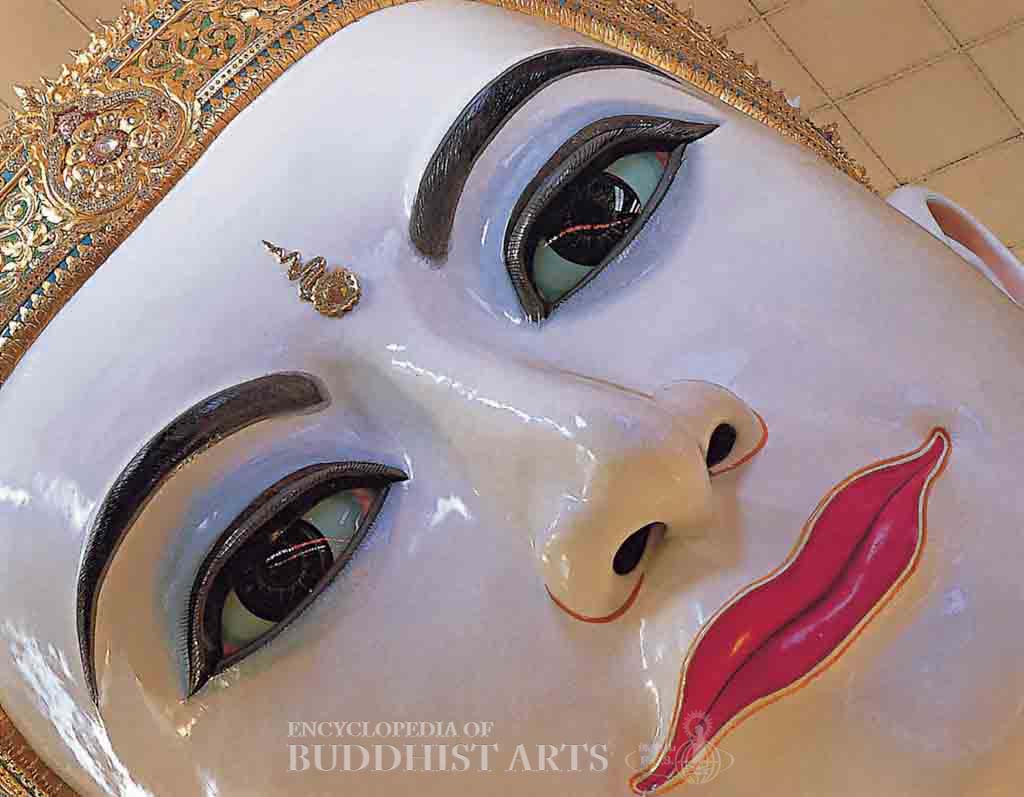
Chaukhtatgyi Pagoda: Reclining Buddha (detail)
Chaukhtatgyi Pagoda: Reclining Buddha
MYANMAR, Yangon
Initial construction of the statue started in 1909 but it was not completed until 1967. The statue, at 55 m long, is the third longest reclining Buddha in the country.
The Buddha has a white complexion with large eyes inlaid with glass and gems, giving them a realistic feel. A red gem forms the urna. The Buddha has no curls on the head but has a large usnisa with an ornately carved gold band lining the forehead. Since the eyes are open, the Buddha appears to be resting instead of passing into parinirvana.
The gold monastic robe leaves the right shoulder bare and is realistically presented with numerous folds. The hem of the robe is embellished with exquisite patterns created by mosaic tiles. The feet have been painted in two different shades of red with raised details in gold. The center of the soles feature a Dharma wheel surrounded by 108 squares. Each square has an image: 21 of them show animals, 59 have themes related to the human world, and 28 are of the spirit world. These images signify the Buddha’s liberation from all three realms.
For more details, go to the Encyclopedia of Buddhist Arts: Sculpture A-F, page 238.
Cite this article:
author = Hsingyun and Youheng and Lovelock, Yann and Chou, Yuan and Huntington, Susan and Edson, Gary and Neather, Robert,
booktitle = {Encyclopedia of Buddhist Arts: Sculpture A-F},
pages = 238,
title = {{Chaukhtatgyi Pagoda: Reclining Buddha}},
volume = 10,
year = {2016}}