
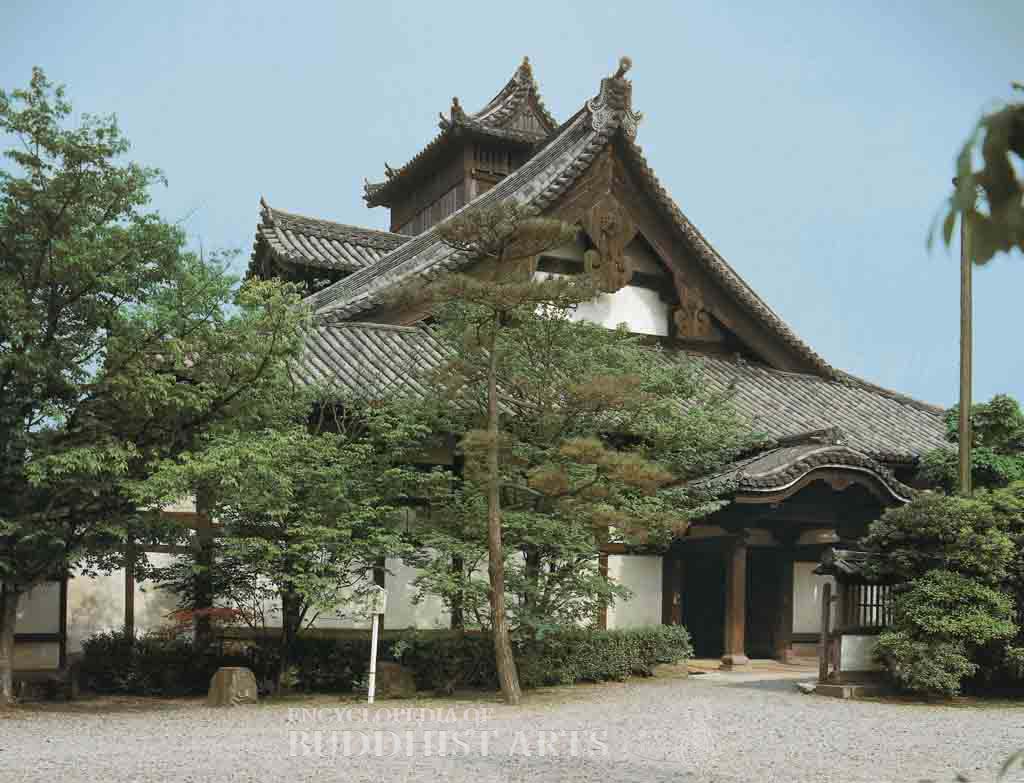
Myohoin Temple Kuri
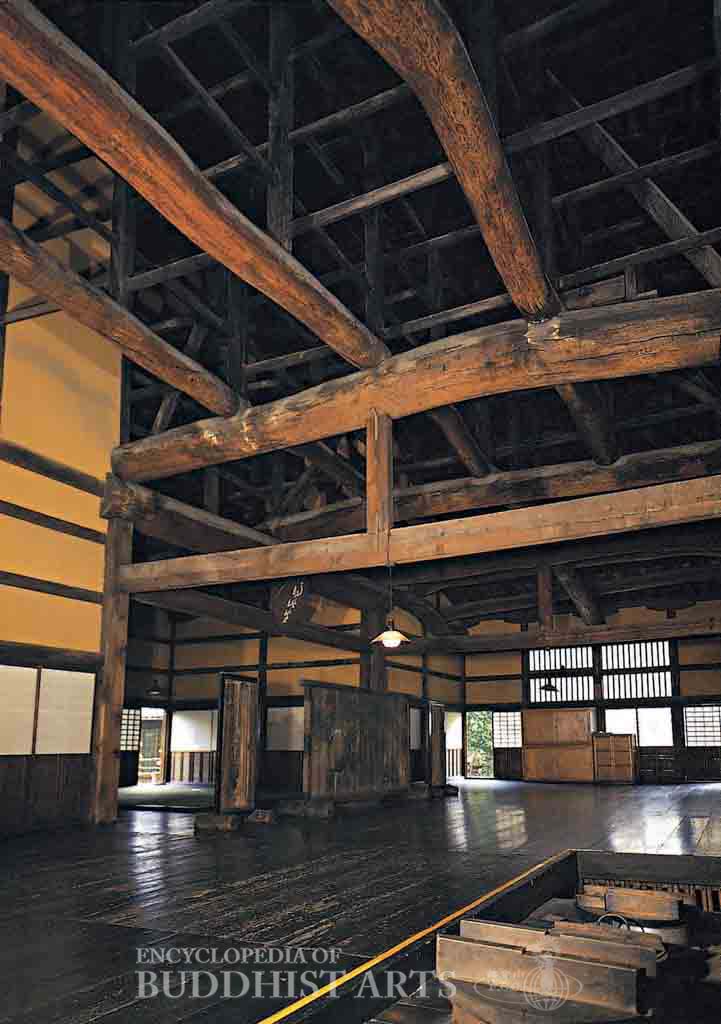
Myohoin Temple Kuri (interior)
Myohoin Temple Kuri
JAPAN, Kyoto
The kuri was built in either 1595 or 1604 during the Azuchi-Momoyama period. Apart from serving as the location for the preparation of offerings and meals for the monastics, such buildings sometimes also housed the offices for administrative and financial affairs. This building was listed as a National Treasure in 1957.
The south-facing, eleven-by-twelve bay building is 21.8 m wide and 23.7 m long. It has a single-eave hip-and-gable roof covered with cylindrical tiles. The extended roof in front of the entrance has a curved bargeboard. The north wing connects to the eaves and there is a chimney on the upper level of the north side. One third of the interior lacks flooring, whereas the rest has wood flooring. There are few columns, resulting in a greater sense of space. The roof is open, showing the traditional beam structure, which is very strong and stable.
For more details, go to the Encyclopedia of Buddhist Arts: Architecture M-S, page 757.
Cite this article:
author = Hsingyun and Youheng and Johnson, Peter and Mankuang and Lancaster, Lewis,
booktitle = {Encyclopedia of Buddhist Arts: Architecture M-S},
pages = 757,
title = {{Myohoin Temple Kuri}},
volume = 3,
year = {2016}}