
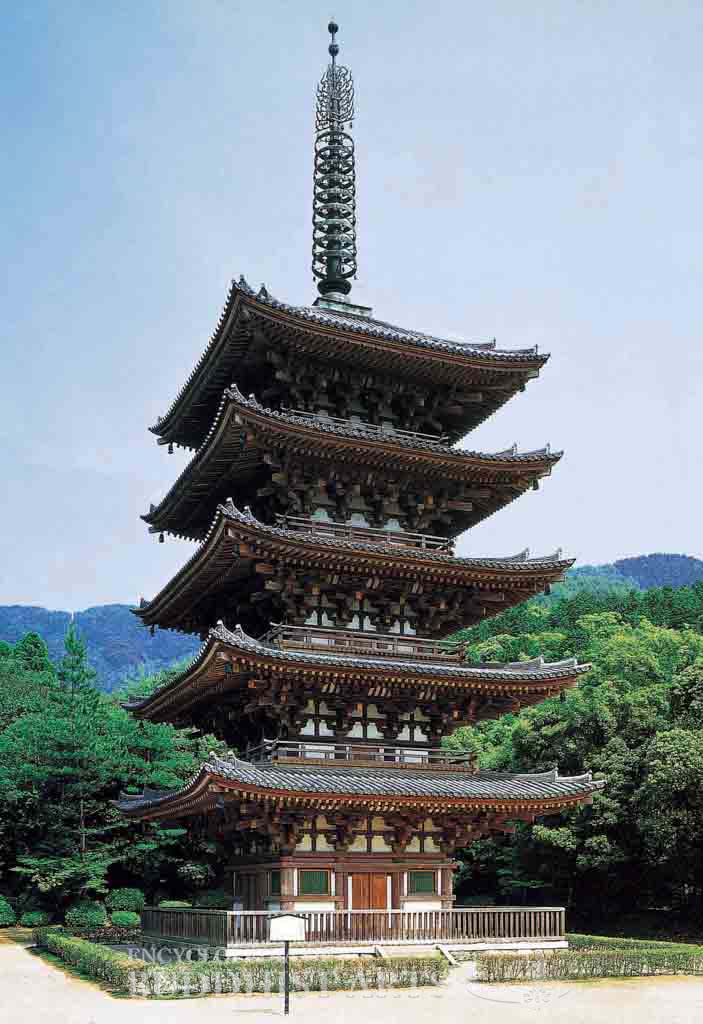
Daigoji Temple Five-Story Pagoda
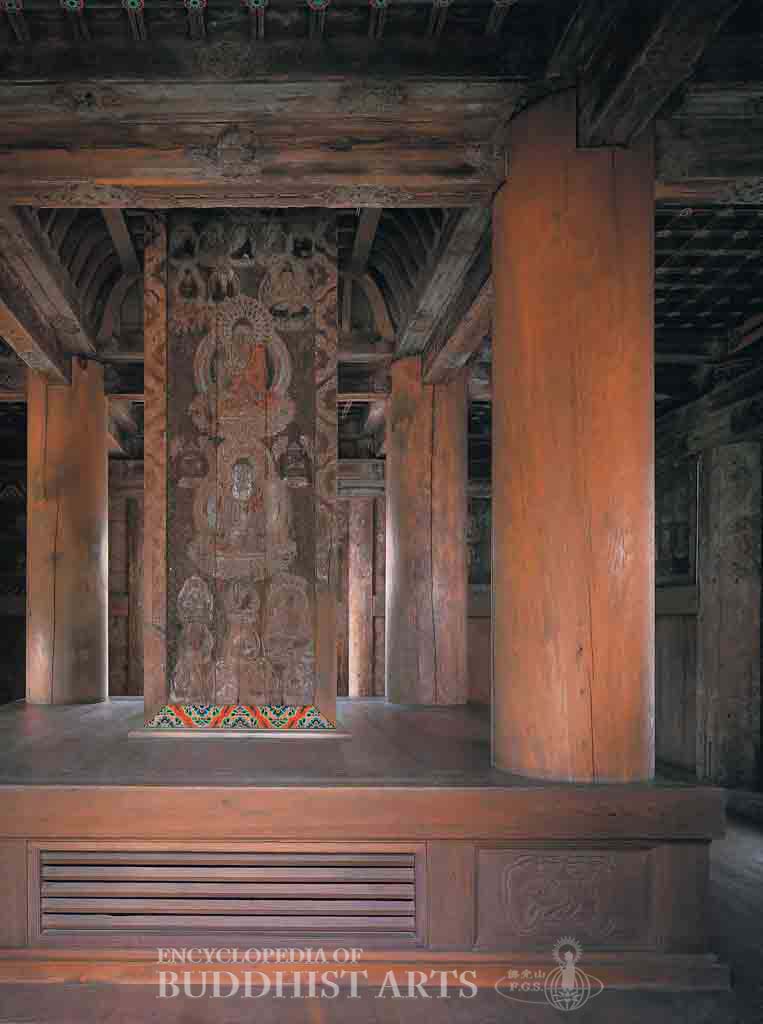
Daigoji Temple Five-Story Pagoda (interior)
Daigoji Temple Five-Story Pagoda
JAPAN, Kyoto
This is one of the oldest wooden structures in Kyoto. Its construction began in 931 during the Heian period, under the orders of Emperor Suzaku (reigned 930–946) to pray for the deceased Emperor Daigo (reigned 897–930). The pagoda was completed in 951, and it was listed as a National Treasure in 1951.
The three-by-three bay pagoda has an overall height of 38 m. The eaves are covered with cylindrical tiles and are supported by three-tier bracket sets. The spire consists of a harmika, an inverted bowl, a lotus-shaped base, stacked rings, flames, and jewels. The stacked rings take up one third of the pagoda’s height and it is an example of architecture from the Nara (710–794) and Heian (794–1185) periods. The central column and walls of the first story are decorated with Japanese Vajrayana Buddhist paintings, which are rare among existing Heian period murals. These murals were listed as a National Treasure. The interior beams, columns, and plafonds are also decorated with floral patterns.
For more details, go to the Encyclopedia of Buddhist Arts: Architecture A-F, page 195.
Cite this article:
author = Hsingyun and Youheng and Johnson, Peter and Mankuang and Lancaster, Lewis,
booktitle = {Encyclopedia of Buddhist Arts: Architecture A-F},
pages = 195,
title = {{Daigoji Temple Five-Story Pagoda}},
volume = 1,
year = {2016}}