
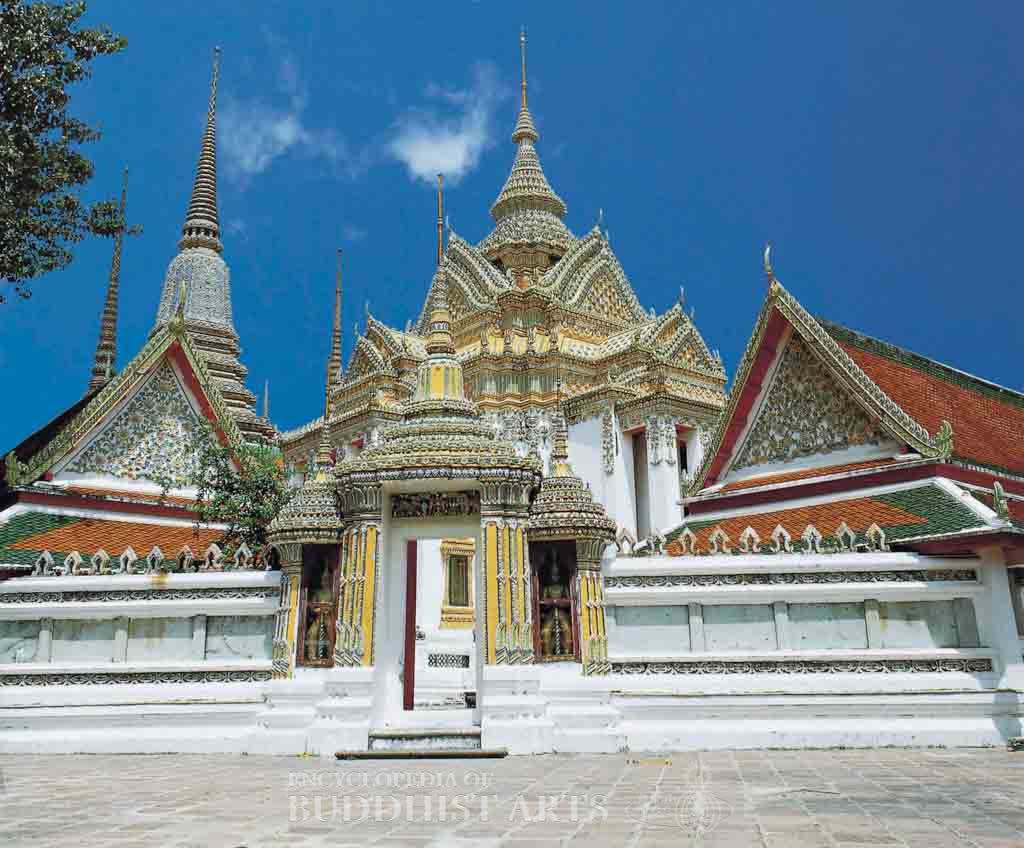
Wat Phra Chetuphon
Wat Phra Chetuphon
THAILAND, Bangkok
Also known as Wat Pho, Wat Phra Chetuphon is located to the south of the Grand Palace. It is the oldest and largest temple in Bangkok. Construction began in the Ayutthaya period (circa 1350–1767) under King Phetracha (reigned 1688–1703). Rama I (reigned 1782–1809) undertook renovation work, which was completed in 1801. In 1831, during the rule of Rama III (reigned 1824–1851), the temple was renovated and expanded with the goal of establishing a public art and education center. Narratives of the history of the temple, the history of Buddhism, literary texts, maxims, medical prescriptions, and descriptions of social customs were inscribed on the walls and stone tablets. The temple became renowned as the first university in Thailand. During the rule of Rama IV (reigned 1851–1868), a further stupa was added, resulting in the temple’s present layout.
The temple occupies an area of approximately 8 ha and is divided into eastern and western areas. The eastern area contains the ordination hall, four subsidiary halls, and monastic living quarters, while the western area includes the Sacred Great Stupas, the Reclining Buddha Hall, lecture halls, and a pavilion. There are 16 gateways to the temple and standing on each side of the gates there is a stone statue of a guardian. On the top of each gateway there is a miniature stupa decorated with multi-colored ceramic flowers, while the walls are whitewashed, resulting in a strong contrast between the colorful gateways and the plain walls. In the center of the eastern area there is the ordination hall, with a subsidiary hall located at the four cardinal points, each containing a Buddha statue. The four subsidiary halls are connected with inner and outer ambulatories, which demarcate the inner and outer zones of the monastery. There are 95 small stupas surrounding the central complex.
Immediately to the west of the monastery there is the group of four stupas known as the Sacred Great Stupas. The stupas are square with multiple corners and are decorated with colorful glazed tiles. Further west, on a north-south axis there are the Reclining Buddha Hall, Misakawan Park, pavilion, library, and lecture hall. The statue of the Reclining Buddha is 46 m long and is one of the largest such statues in the world. The Buddha is made of brick and plaster covered with gold leaf. The soles of the Buddha’s feet have thousand-spoke wheels inlaid with mother-of-pearl representing one of the 108 auspicious signs of the Buddha. The interior of the hall is decorated with carvings of door guardians, animals, and mythical creatures, as well as many other works of art. Rare and priceless works of art and antiques are also found in the temple museum.
For more details, go to the Encyclopedia of Buddhist Arts: Architecture T-Z, page 1219.
Cite this article:
author = Hsingyun and Youheng and Johnson, Peter and Mankuang and Lancaster, Lewis,
booktitle = {Encyclopedia of Buddhist Arts: Architecture T-Z},
pages = 1219,
title = {{Wat Phra Chetuphon}},
volume = 4,
year = {2016}}