
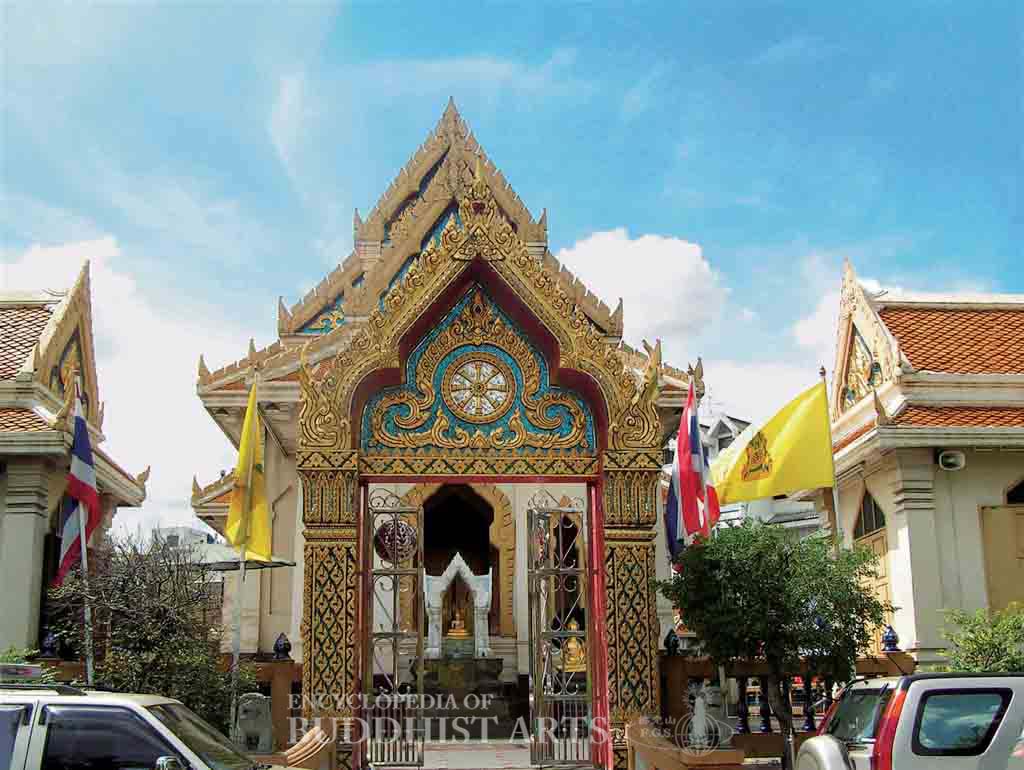
Wat Traimit Witthayaram: Main Temple Gate
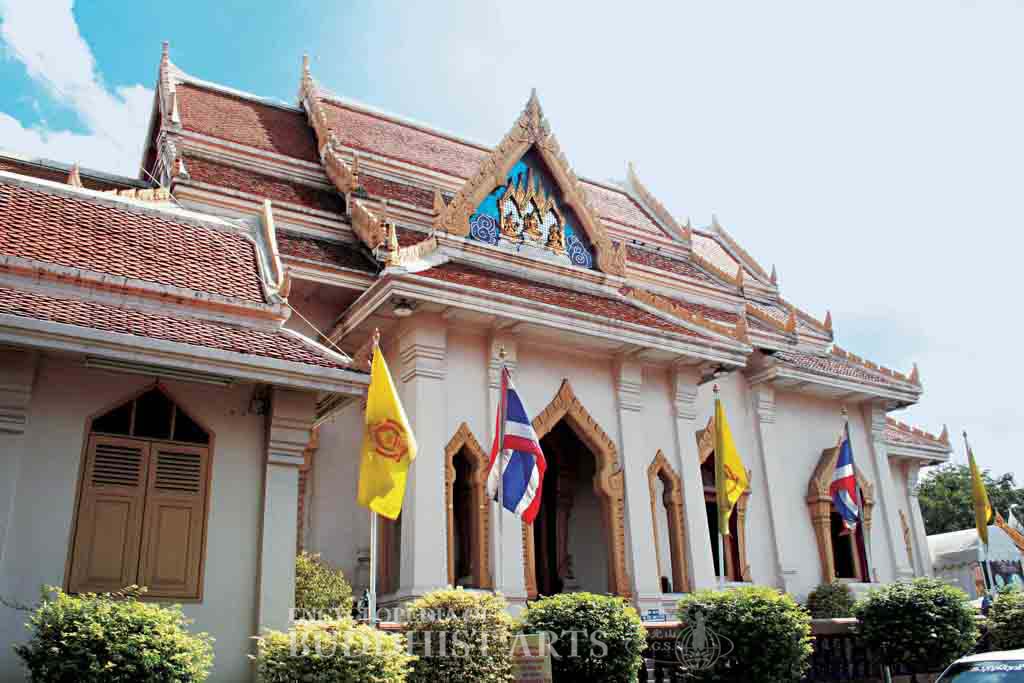
Wat Traimit Witthayaram: Ordination Hall
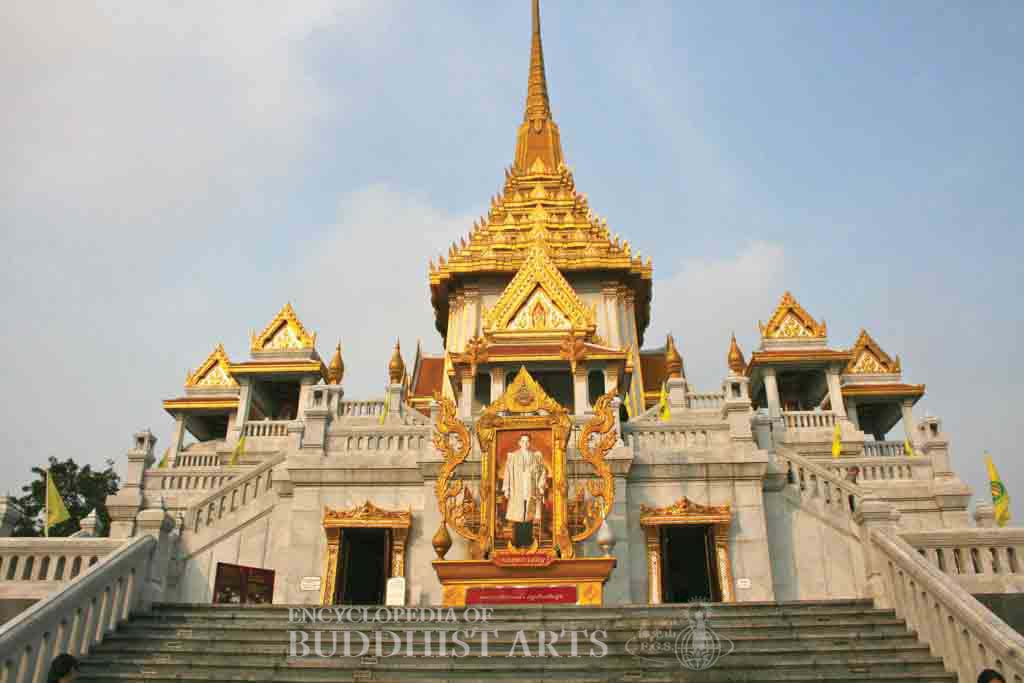
Wat Traimit Witthayaram: Golden Buddha Hall
Wat Traimit Witthayaram
THAILAND, Bangkok
Traimit means Three Good Friends, and Witthayaram refers to the Source of Knowledge and Education. It is also known as the Temple of the Golden Buddha. It is located on the western side of the Hua Lampong railway station in Bangkok. The temple is said to have been established in 1832 by three Chinese donors and was originally known as Wat Samchin (Three Chinese Temple). In 1939 it underwent a major renovation and was renamed Wat Traimit Witthayaram. The temple became famous in 1955 when a Buddha statue was being transferred to the temple; the statue dropped to the floor and the plaster covering fell off revealed the solid gold statue underneath. In 1956 it was listed as a second class royal temple with the full name Wat Traimit Witthayaram Worawiharn.
The temple includes the main temple gate, ordination hall, Buddha hall, and Golden Buddha Hall, as well as various educational institutions. The main temple gate is decorated with gilt carvings and stained glass. The tympanum is in Thai palatial style, with a Dharma wheel in the center, encircled by two gilt nagas on a blue background. Behind the main temple gate, there is the ordination hall with three-tier eaves and three roof sections. On each side there is a portico, whose roof is joined to the main roof. The front and rear gable ends of the ordination hall have two pediments, one on the upper gable and one on the lower one over the portico. The upper pediments are decorated with high reliefs of a standing Buddha, holding an alms bowl with both hands. The lower pediments, which are the same on all four sides, are adorned with three golden seated Buddha images. The ordination hall houses a fine Buddha image named Phra Buddha Tosapolayan, along with murals depicting the Life of the Buddha.
The Buddha hall has a simple exterior and used to contain the famous Golden Buddha from the Sukhothai period (circa 1238–1438). The statue is named Phra Phuttha Maha Suwan Patimakon and is commonly known as Phra Sukhothai Traimit. It measures 3 m high and weighs 5.5 t. It is the world’s largest seated Buddha cast in pure gold. The statue was moved to the Golden Buddha Hall, which was built especially for the statue. The Golden Buddha Hall is four stories high with many external staircases and pavilions. The lower part of the building is plain and painted white in contrast to the upper part, which is intricately decorated in gold. The pediments and bargeboards on the porticos and pavilions are golden in color and are decorated with nagas and garudas. The central structure of the Golden Buddha Hall is crowned with a golden Thai-style stupa, which is in the form of a multi-tier square pyramid surmounted by stacked rings followed by a multi-tier canopy. The overall architecture of the hall contrasts plain white walls with features highlighted in gold.
For more details, go to the Encyclopedia of Buddhist Arts: Architecture T-Z, page 1262.
Cite this article:
author = Hsingyun and Youheng and Johnson, Peter and Mankuang and Lancaster, Lewis,
booktitle = {Encyclopedia of Buddhist Arts: Architecture T-Z},
pages = 1262,
title = {{Wat Traimit Witthayaram}},
volume = 4,
year = {2016}}