
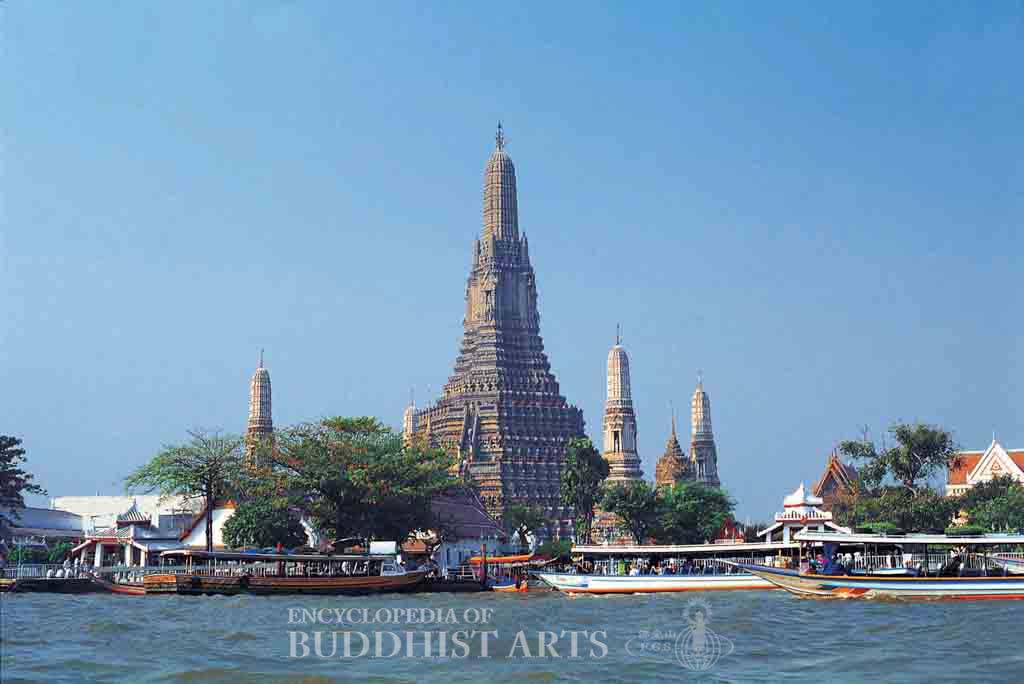
Wat Arun
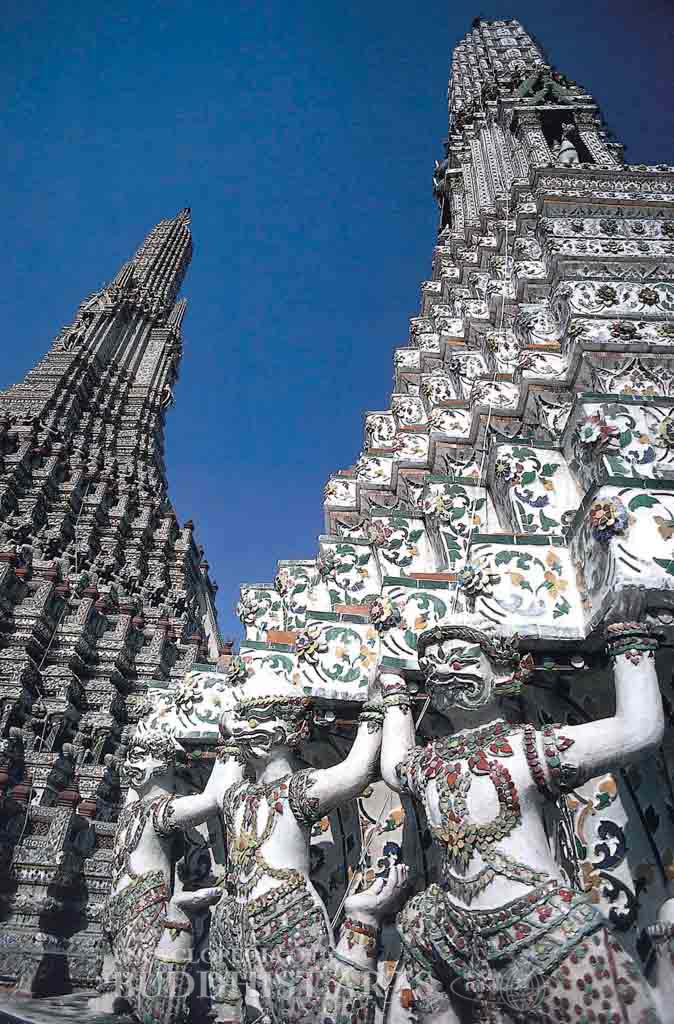
Wat Arun: Stupas (detail)
Wat Arun
THAILAND, Bangkok
Wat Arun means Temple of Dawn. Its full name is Arunratchawararam Ratchaworamahawihan and it is a first class royal temple. It was founded during the Ayutthaya period (1350–1767). It was designated a royal temple within the grounds of the palace of King Taksin (reigned 1767–1782). There are a number of stories regarding the naming of this temple: one of them is that it commemorates the establishment of the new dynasty; another is that it is at its most impressive in the early morning light. The temple was expanded during the time of King Rama II (reigned 1809–1824) and was completed under King Rama III (reigned 1824–1851). The temple is commonly called King Taksin Temple because of its connection with him.
The temple consists of a group of five Khmer-style stupas. The main stupa is known as Phra Buddha Stupa. It is built in brick and covered in stucco. The 79 m high main stupa is surrounded by four smaller stupas. The square base of the stupa is very high and is in two sections. Four sets of steep steps lead up to the first and second terraces, which are used for circumambulation. The lower part of the stupa body consists of multiple tiers tapering towards the upper part, which has a cuboid appearance with decorated corners. At the base of the spire there is a miniature stupa at each corner. The cylindrical spire has a rounded apex, followed by the finial with a multi-tier canopy.
The base and the lower part of the body have multiple corners and are covered in small niches. It is decorated with various motifs formed using numerous pieces of multi-colored Chinese porcelain, depicting figures in Thai style, as well as flowers, insects, birds, and animals in Chinese style. The four surrounding ancillary stupas are highly decorated and built in the same style as the main stupa, with each of them housing a statue of the Sakyamuni Buddha in one of the four stages of the Buddha’s life: birth, enlightenment, teaching the Dharma, and parinirvana. The five stupas of Wat Arun are a representation of Mount Sumeru and form a magnificent and majestic group of stupas.
For more details, go to the Encyclopedia of Buddhist Arts: Architecture T-Z, page 1182.
Cite this article:
author = Hsingyun and Youheng and Johnson, Peter and Mankuang and Lancaster, Lewis,
booktitle = {Encyclopedia of Buddhist Arts: Architecture T-Z},
pages = 1182,
title = {{Wat Arun}},
volume = 4,
year = {2016}}