
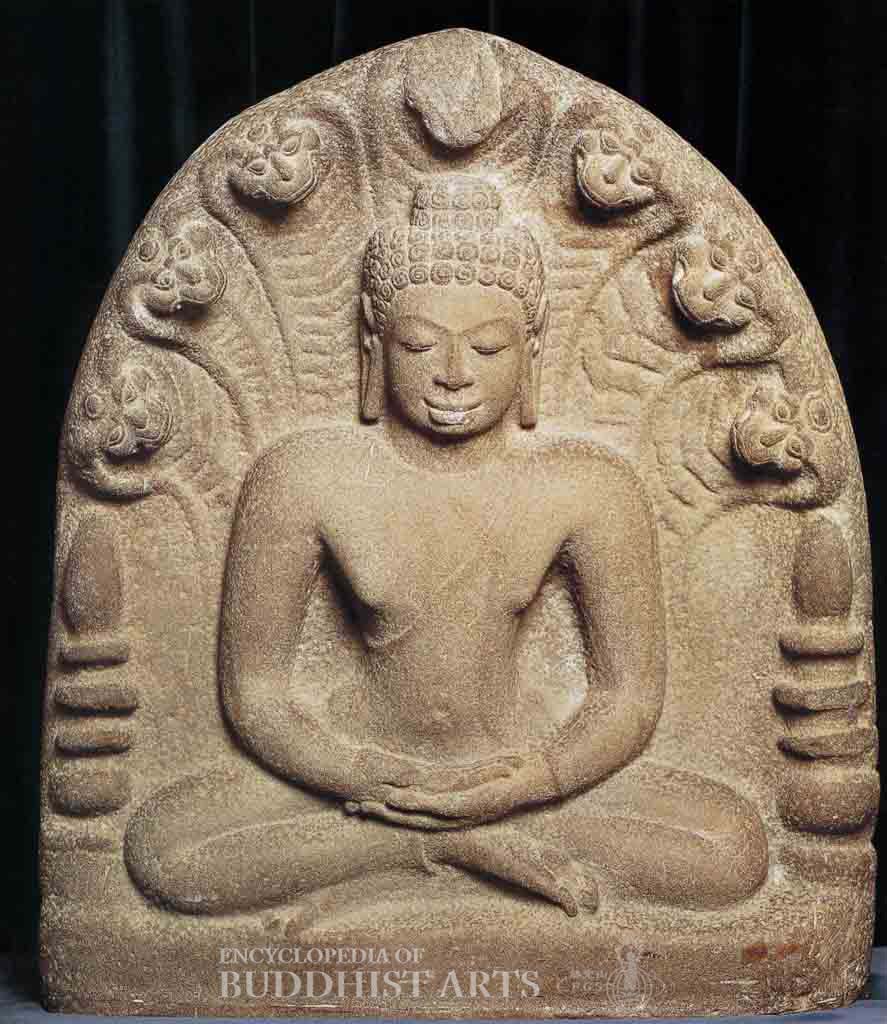
Prachinburi: Buddha Protected by Mucalinda
Sandstone
Prachinburi: Buddha Protected by Mucalinda
THAILAND, Prachinburi
Illustrated stories of Mucalinda, the Naga King who shields the meditating Buddha from a storm, are often found in Asian cultures. Dating to the Dvaravati Kingdom (circa 6th–13th century), this plaque is one of the earlier examples found in Southeast Asia.
The tranquil Buddha has the facial traits of the dominant Mon people, with a wide face, short chin, flat nose and thick lips. He sits cross-legged with hands in the dhyana (meditation) mudra. He wears a diaphanous monastic robe that leaves the right shoulder bare and allows the body to show through. The mandorla is arch-shaped with pagodas on either side. Seven hooded heads of the Naga King curve about the top and look down protectively.
For more details, go to the Encyclopedia of Buddhist Arts: Sculpture N-Sr, page 832.
Cite this article:
author = Hsingyun and Youheng and Lovelock, Yann and Chou, Yuan and Huntington, Susan and Edson, Gary and Neather, Robert,
booktitle = {Encyclopedia of Buddhist Arts: Sculpture N-Sr},
pages = 832,
title = {{Prachinburi: Buddha Protected by Mucalinda}},
volume = 12,
year = {2016}}