
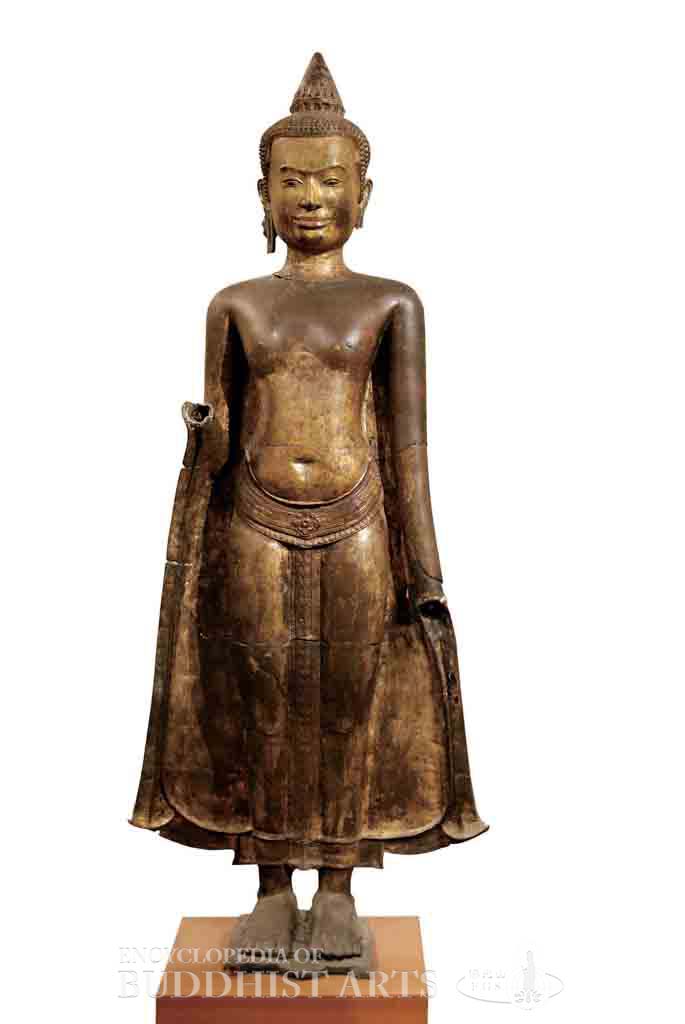
Standing Buddha
Gilt copper alloy
Standing Buddha
THAILAND; Dvaravati Kingdom
Experts believe the statue may be from U Thong or Suphan Buri. The facial shape and head decoration are in Khmer style, whereas the joined eyebrows and thick lips are characteristic of the Dvaravati period (circa 6th–13th century). The head has densely arranged small curls, above which the usnisa becomes a lotus bud. A band along the hairline separates the raised hair and the forehead. The features include expressive eyes and mouth in a squared face. The arms are held in a way that demonstrates the presence of a nearly transparent robe, allowing a deep fall over the right wrist, while the left arm spreads the material on that side. An ornamental belt secures the under-robe, and a pleated fold of the belt material runs from waist to ankles between the legs.
For more details, go to the Encyclopedia of Buddhist Arts: Sculpture St-Z, page 1154.
Cite this article:
author = Hsingyun and Youheng and Lovelock, Yann and Chou, Yuan and Huntington, Susan and Edson, Gary and Neather, Robert,
booktitle = {Encyclopedia of Buddhist Arts: Sculpture St-Z},
pages = 1154,
title = {{Standing Buddha}},
volume = 13,
year = {2016}}