
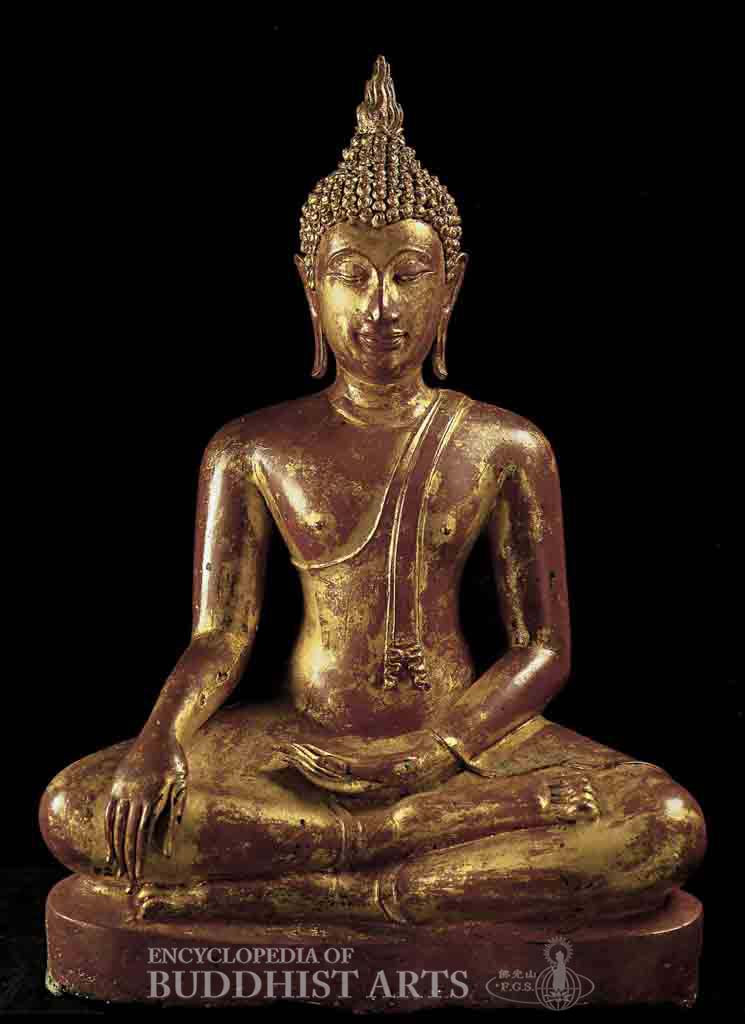
Seated Buddha
Gilt bronze and lacquer
Seated Buddha
THAILAND
Believed created during the Sukhothai Kingdom (circa 1238–1438), this statue is rare. Dense curls cover the head leading to a flame ornament above the usnisa. Eyebrows that converge into the line of the nose frame the half-closed downward gazing eyes. The ends of the elongated earlobes curve outward on either side of the neck. The close-fitting monastic robe leaves the right shoulder bare, while the end of the robe over the left shoulder is neatly folded in the Thai style and is represented with a ruffled edge. The figure sits in half lotus position on a plain base. The right hand curves forward in bhumisparsa (earth-touching) mudra while the left hand curves upward similarly as it rests in the lap. The length of the fingers and toes are equal; these elements are characteristics of a Buddha. The simplicity of the statue as well as the elegant curves and elongated limbs are part of the Sukhothai style.
For more details, go to the Encyclopedia of Buddhist Arts: Sculpture N-Sr, page 1033.
Cite this article:
author = Hsingyun and Youheng and Lovelock, Yann and Chou, Yuan and Huntington, Susan and Edson, Gary and Neather, Robert,
booktitle = {Encyclopedia of Buddhist Arts: Sculpture N-Sr},
pages = 1033,
title = {{Seated Buddha}},
volume = 12,
year = {2016}}