
Disciple
Terracotta
Disciple
THAILAND
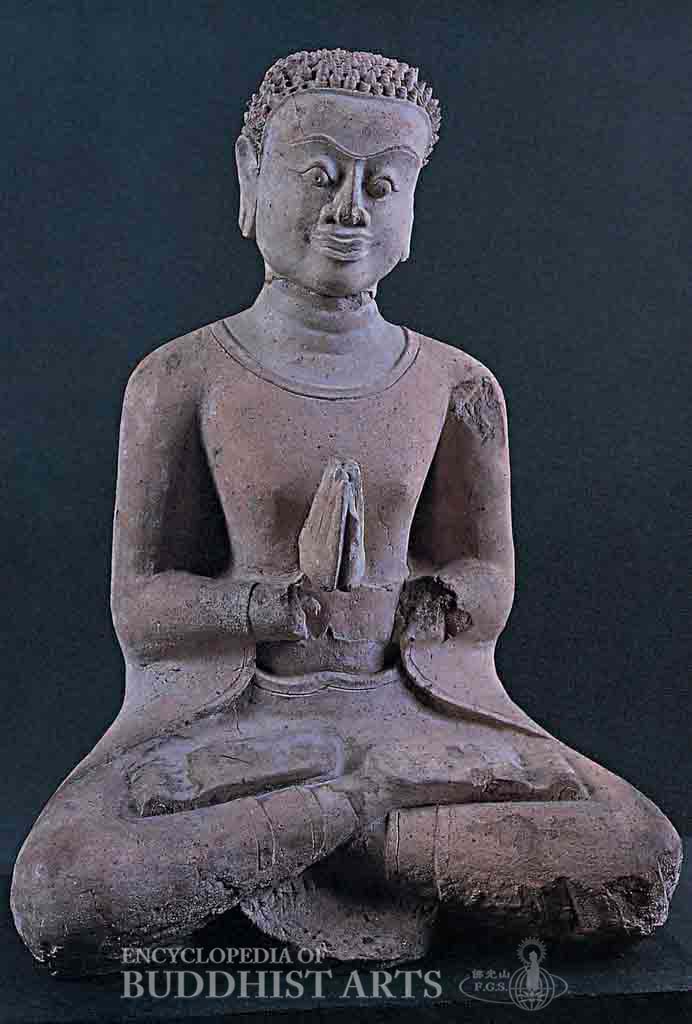
This sculpture, from the Haripunchai Kingdom (circa mid-7th century–1292), was created when Buddhism was the only prevalent religion. The statue is consequently devoid of Hindu influences from India. The Haripunchai style was adopted from 8th century onwards, and the materials used included stone, bronze, stucco, and terracotta but it is the terracotta artworks that makes the Haripunchai style stand out. Among these, images of praying disciples are unique.
The figure has dense curls that end in points. The facial features include the triple-curved eyebrows often seen in Dvaravati style, and intensely focused eyes, wide nose, and thick lips. Simple lines create the mustache and neck folds. The figure sits in full lotus position and the hands are in the anjali (reverence) mudra. Both the shoulders are covered by a round collared robe, with sleeves that hang in a graceful curve from the wrists. The garment material clings to the body, its presence being chiefly indicated by thin raised lines.
For more details, go to the Encyclopedia of Buddhist Arts: Sculpture A-F, page 295.
Cite this article:
author = Hsingyun and Youheng and Lovelock, Yann and Chou, Yuan and Huntington, Susan and Edson, Gary and Neather, Robert,
booktitle = {Encyclopedia of Buddhist Arts: Sculpture A-F},
pages = 295,
title = {{Disciple}},
volume = 10,
year = {2016}}