
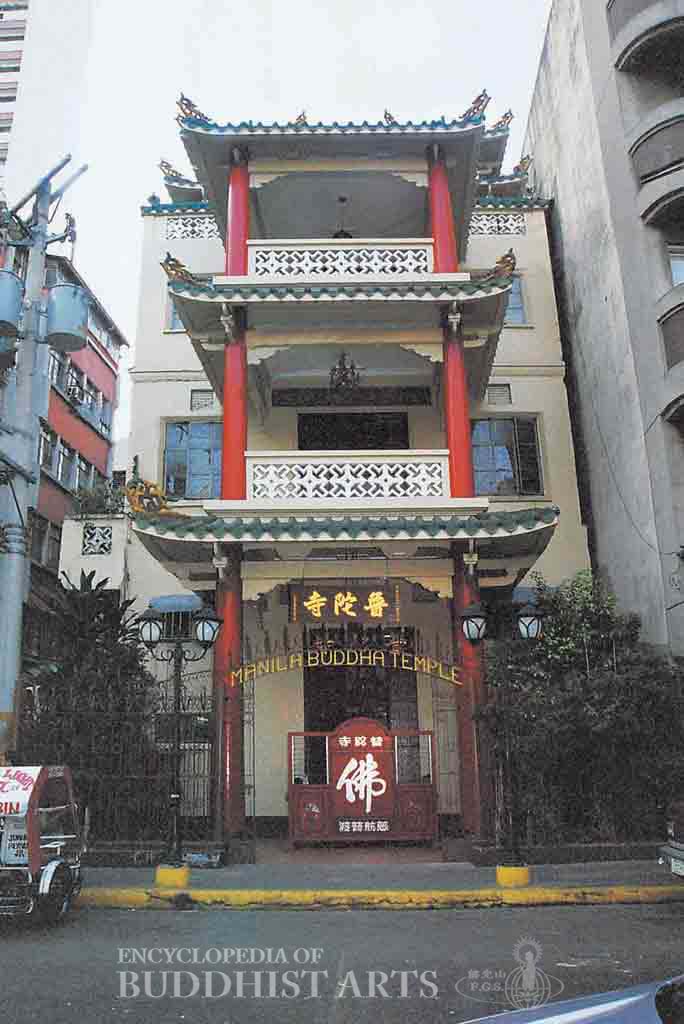
Manila Buddha Temple
Manila Buddha Temple
PHILIPPINES, Manila
The temple was established in 1951 by the monks Ruman and Ruyi to develop Buddhist culture, provide education, and participate in charitable activities. A branch temple was built in the city of Baguio in 1970.
The three-story temple occupies 400 sq m. Statues of Sakyamuni Buddha, the Medicine Buddha, and Amitabha Buddha are enshrined on the second story of the main hall. There is a portico at the front of the building with balconies above it. The roofs of the portico and balconies are supported by two pillars painted in brilliant red. The projecting roofs are covered with green glazed tiles and the balconies are lined with concrete balustrades. A light screen erected in front of the main entrance is emblazoned with the Chinese character for Buddha. Its form and position is characteristic of the screen walls found in traditional Chinese temples.
For more details, go to the Encyclopedia of Buddhist Arts: Architecture M-S, page 724.
Cite this article:
author = Hsingyun and Youheng and Johnson, Peter and Mankuang and Lancaster, Lewis,
booktitle = {Encyclopedia of Buddhist Arts: Architecture M-S},
pages = 724,
title = {{Manila Buddha Temple}},
volume = 3,
year = {2016}}