
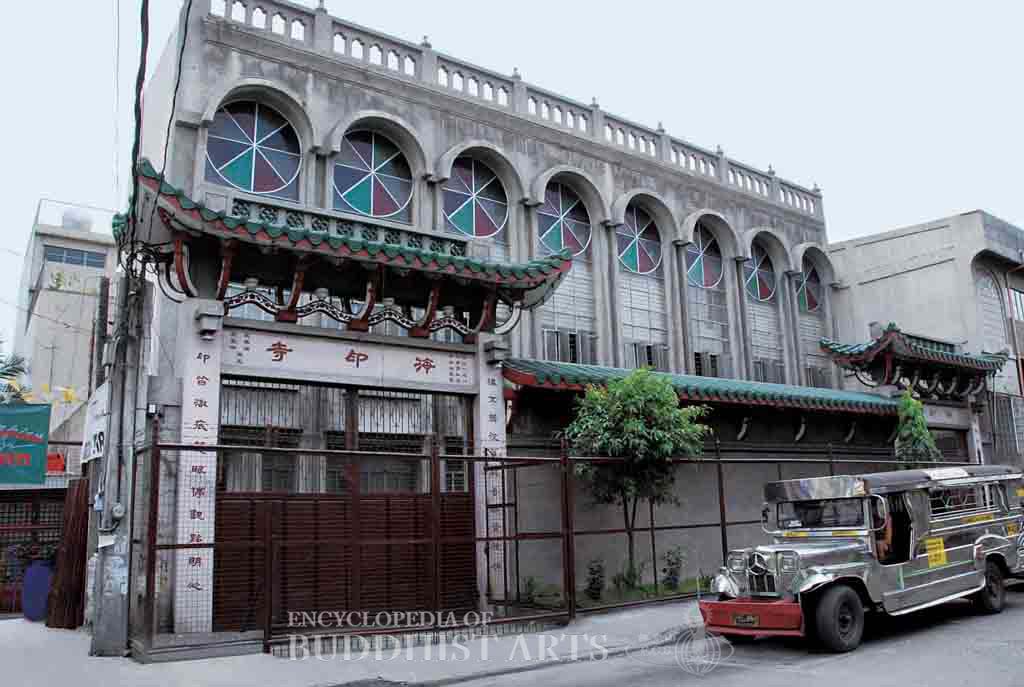
Hay En Temple
Hay En Temple
PHILIPPINES, Manila
Hay En means Reflection on the Sea. In 1960, Fujianese monk Xingyuan invited two female devotees, Yuanjing and Zhengyi, to the Philippines. In 1969 they leased two units in the Yan Ling Building in Manila for cultivation and Dharma propagation. This marked the beginning of Hay En Temple. Yuanjing had started practicing Buddhism at an early age at Haiyin (Reflection on the Sea) Temple in Quanzhou, Fujian, and the temple was given the same name in honor of her ancestral temple. With the increase in the number of devotees, a new location was acquired and the temple was relocated in 1976. In 1984, the temple received advice from Guangfan, a monk from Sengguan Temple, on the planning and building of its new premises. Hay En Temple is now one of the most popular temples in Manila. It is also a temple where women can study and practice Buddhism in the Philippines.
The temple occupies over 1,000 sq m and is a fusion of traditional Chinese and modern architectural styles. The two-story building has a dining hall on the first story and the main hall on the second. The main hall houses statues of Sakyamuni Buddha, Amitabha Buddha, and the Medicine Buddha.
For more details, go to the Encyclopedia of Buddhist Arts: Architecture G-L, page 433.
Cite this article:
author = Hsingyun and Youheng and Johnson, Peter and Mankuang and Lancaster, Lewis,
booktitle = {Encyclopedia of Buddhist Arts: Architecture G-L},
pages = 433,
title = {{Hay En Temple}},
volume = 2,
year = {2016}}