

Dazu Rock Carvings Beishan Cave 176: Illustration of the Sutra on the Descent of Maitreya
Stone
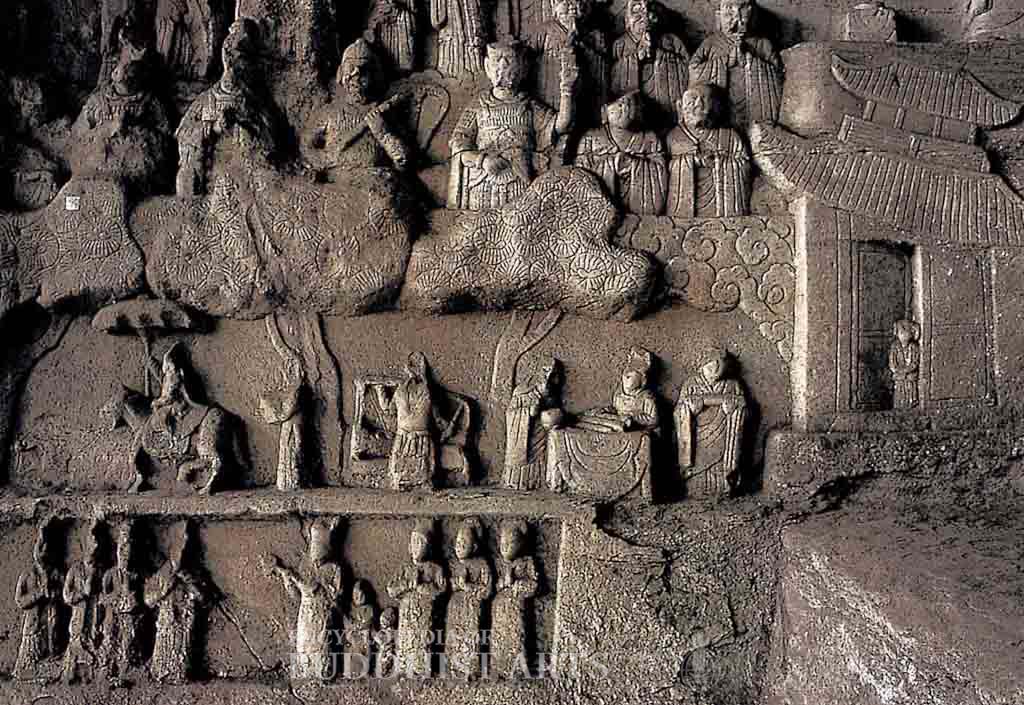
Dazu Rock Carvings Beishan Cave 176: Illustration of the Sutra on the Descent of Maitreya (detail)
Dazu Rock Carvings Beishan Cave 176: Illustration of the Sutra on the Descent of Maitreya
CHINA, Chongqing, Dazu; Northern Song dynasty
Cave 176 is situated in the central section of the Beishan Caves. The rectangular cave has a flat ceiling and measures 1.95 m wide, 2.72 m high, and 2.4 m deep. There is an inscription on the outer north wall stating that the cave was created in the year 1126 during the Song dynasty by the artisans Fu Yuanju and his son Shineng, and contains an illustrated carving of the Sutra on the Descent of Maitreya.
The main statue in front of the back (east) wall is Maitreya Buddha, who sits in full lotus position on a lotus throne. The raised base of the throne is carved with lions interspersed with heavenly musicians. Maitreya forms a mudra with one hand, while the other rests on his knee. A canopy decorated with apsaras, a pagoda, clouds, birds, and other designs is above Maitreya. Flanking Maitreya are disciples with their palms joined and wearing monastic robes. Numerous other figures are behind the disciples.
The main statues on the south and north walls, standing out prominently on raised ledges, are Manjusri riding on a lion and Samantabhadra riding an elephant. The heads of both statues are damaged. Surrounding these figures are carvings of stories from the sutra. One such carving depicts King Sankha, a cakravartin (wheel-turning monarch) who would rule the world during the birth of Maitreya Buddha. He leads 84,000 officials to renounce. Unfortunately, this cave has suffered severe weathering and many of the characters and stories are now difficult to identify.
For more details, go to the Encyclopedia of Buddhist Arts: Caves A-E, page 285.
Cite this article:
author = Hsingyun and Youheng and Johnson, Peter and Mankuang and Huntington, Susan and Edson, Gary and Neather, Robert,
booktitle = {Encyclopedia of Buddhist Arts: Caves A-E},
pages = 285,
title = {{Dazu Rock Carvings Beishan Cave 176: Illustration of the Sutra on the Descent of Maitreya}},
volume = 5,
year = {2016}}