
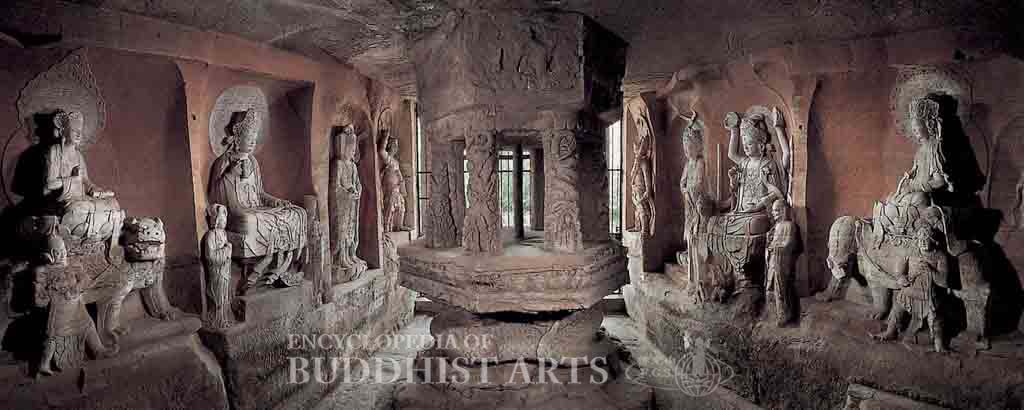
Dazu Rock Carvings Beishan Cave 136
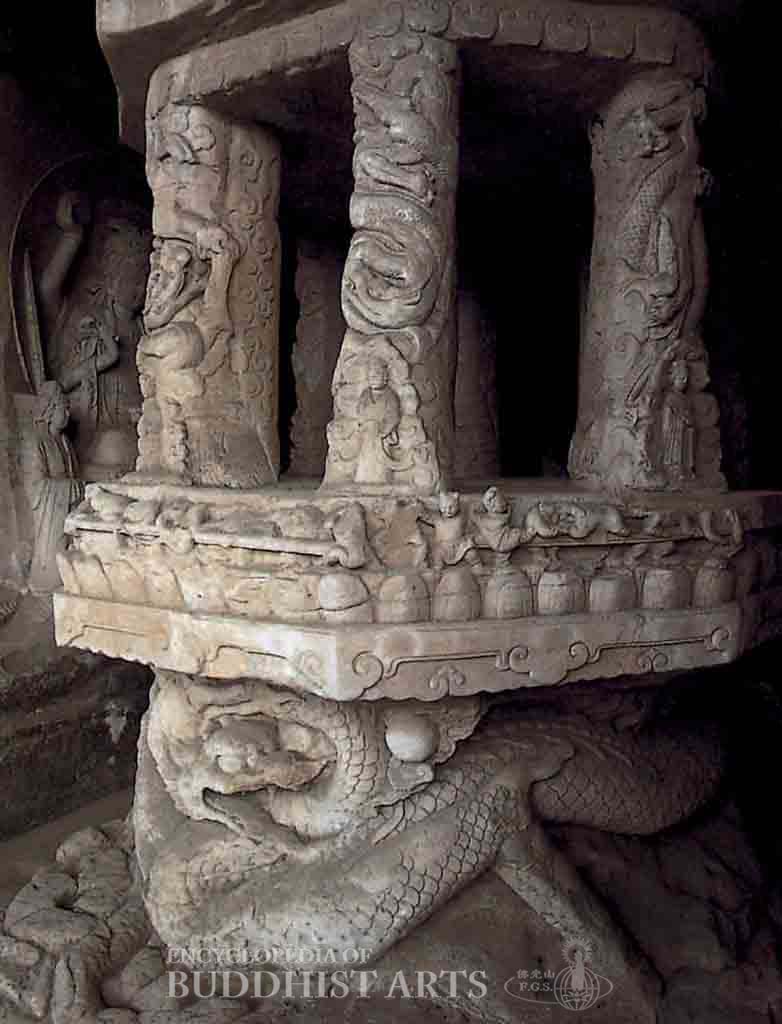
Dazu Rock Carvings Beishan Cave 136: Central Pillar - Revolving Sutra Case
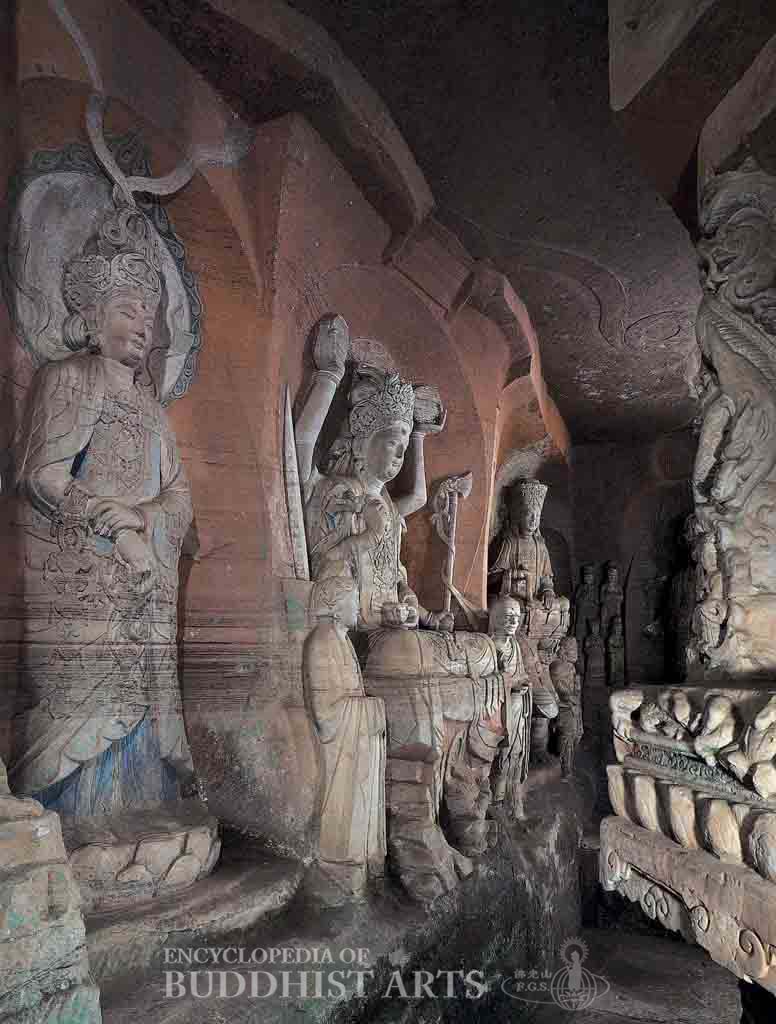
Dazu Rock Carvings Beishan Cave 136: North Wall
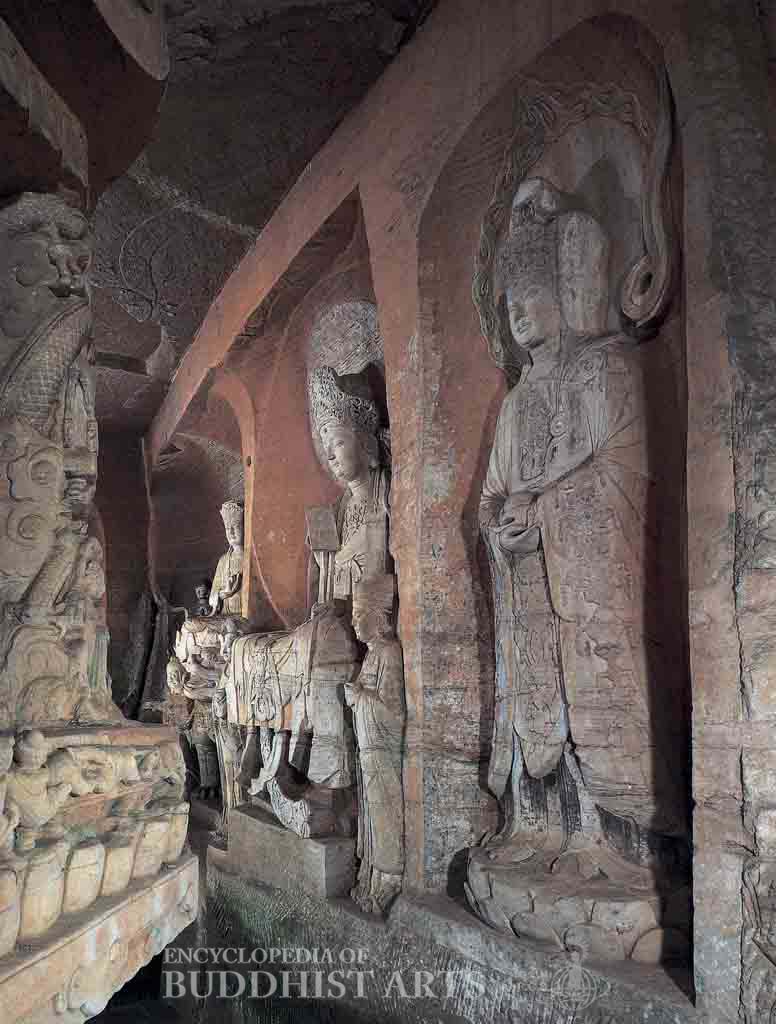
Dazu Rock Carvings Beishan Cave 136: South Wall
Dazu Rock Carvings Beishan Cave 136
CHINA, Chongqing, Dazu
Situated in the middle section of the site, this cave is 4.1 m wide, 4.06 m high, and 6.79 m deep. It is a rectangular central pillar cave, with the central pillar carved into the shape of an octagonal revolving sutra case. The five inscriptions in the cave state that it was constructed between the years 1142 and 1146 during the Southern Song dynasty. There is also a signature inscription carved with Xu An, sculptor from Yingchuan (present day Xuchang, Henan).
The base of the central pillar is carved with dragons and pearls. An octagonal platform decorated with children at play is above the base. Eight posts carved with dragons and standing figures are erected at the eight corners of the platform, supporting a solid octagon carved with heavenly palaces.
There is a 1.5 m high statue of Sakyamuni Buddha in front of the back (east) wall. The Buddha sits in full lotus position on a lotus throne, surround by two disciples, two Bodhisattvas, and two children. The south wall displays, from left to right: Manjusri Bodhisattva, Avalokitesvara Bodhisattva holding a seal, and Cintamani Avalokitesvara. On the north wall, from right to left, are Samantabhadra Bodhisattva, Sun-Moon Avalokitesvara Bodhisattva, and Avalokitesvara holding prayer beads. Wrathful deities with wide eyes and fearsome expressions are depicted on both sides of the cave entrance on the front (west) wall. The deity on the left holds a stick in one hand and the other raised in a fist. The deity on the right holds a pole in one hand and a stole in the other. All of the sculptures in the cave are considered classic examples of Song dynasty (960–1279) cave art.
For more details, go to the Encyclopedia of Buddhist Arts: Caves A-E, page 277.
Cite this article:
author = Hsingyun and Youheng and Johnson, Peter and Mankuang and Huntington, Susan and Edson, Gary and Neather, Robert,
booktitle = {Encyclopedia of Buddhist Arts: Caves A-E},
pages = 277,
title = {{Dazu Rock Carvings Beishan Cave 136}},
volume = 5,
year = {2016}}