
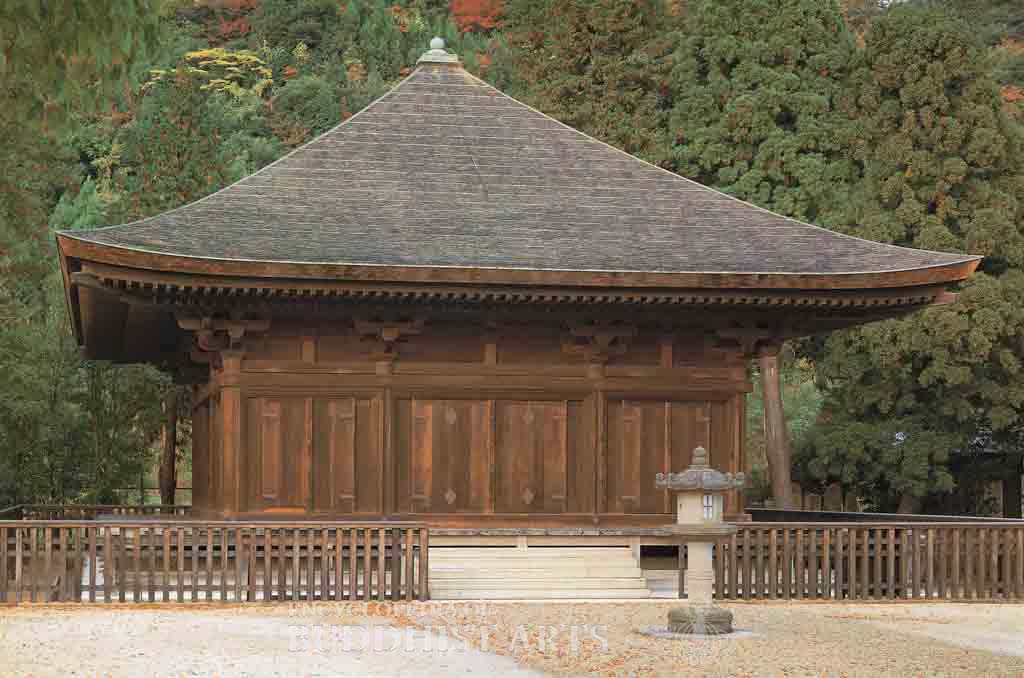
Ganjoji Temple Amitabha Hall
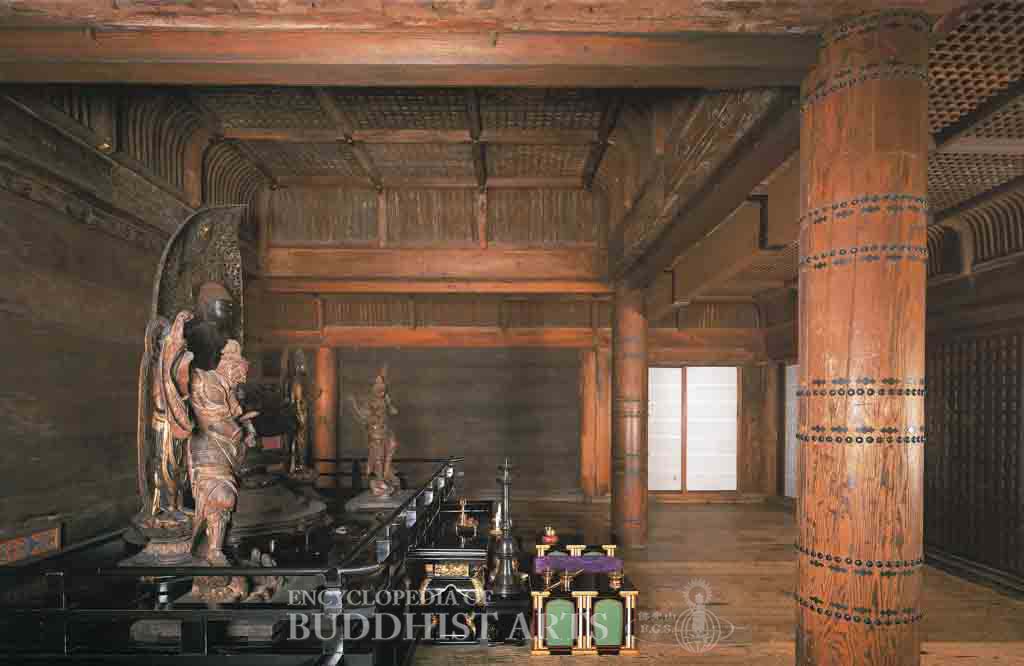
Ganjoji Temple Amitabha Hall (interior)
Ganjoji Temple Amitabha Hall
JAPAN, Fukushima, Iwaki
The hall was built in 1160 by Tokuni to appease the soul of her deceased husband, Iwaki Norimichi, who was the feudal lord of Iwaki. The hall was commonly called after its location, Shiramizu Amitabha Hall. There is a large pond in front of the hall that is listed as a historical site. The hall was listed as a National Treasure in 1952.
The three-by-three bay hall has a single-eave pyramidal roof covered with shingles. There are doors on all four sides and it is surrounded by a veranda. The thick eaves are supported by three-tier bracket sets. The ceiling has grid patterns with curved sides, and there are traces of color found on the wood. Statues of the Amitabha Buddha Triad and two Heavenly Kings are enshrined on a black Sumeru platform. They have been listed as Important Cultural Properties. The hall is a good example of the Amitabha Halls built during late Heian period (794–1185).
For more details, go to the Encyclopedia of Buddhist Arts: Architecture G-L, page 361.
Cite this article:
author = Hsingyun and Youheng and Johnson, Peter and Mankuang and Lancaster, Lewis,
booktitle = {Encyclopedia of Buddhist Arts: Architecture G-L},
pages = 361,
title = {{Ganjoji Temple Amitabha Hall}},
volume = 2,
year = {2016}}