
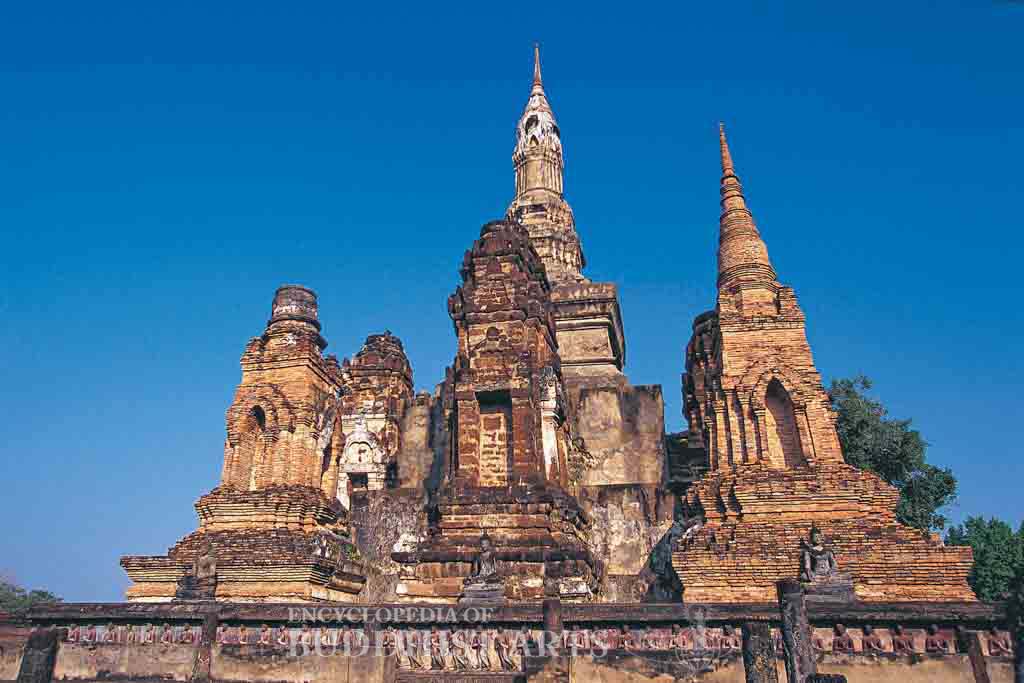
Wat Mahathat: Nine Stupas

Wat Mahathat

Wat Mahathat: Nine Stupas - Base Platform (detail)
Wat Mahathat
THAILAND, Sukhothai
Wat Mahathat means Temple of the Great Relic. Located approximately 440 km north of Bangkok, Wat Mahathat is the first Buddhist temple built by the Thai people. Construction of the temple began during the 13th century under the rule of King Sri Indraditya (reigned circa 1240–1260) of the Sukhothai period (circa 1238–1438). It served as a royal temple for prayers. In 1340 King Leothai (reigned circa 1298–1346) expanded the main stupa to house the sacred hair and neck bone relics of the Buddha. He also ordered the temple to be reconstructed in brick. Many subsequent monarchs continued to renovate and modify the temple, making it Sukhothai’s most important temple. Since the temple is constructed in brick, it is in a much better preserved condition than the timber structures built in the late Ayutthaya period (circa 1350–1767). As part of the Historic Town of Sukhothai and Associated Historic Towns, it was listed as a UNESCO World Heritage Site in 1991.
The architecture of the temple is a fusion of several styles including Khmer, Srivijayan, and Sri Lankan. It occupies an area of 4 ha and the entire complex is surrounded by a low brick boundary wall. Over 200 stupas, the bases of ten halls, the ruins of the ordination hall, and Buddha statues still remain. At the center of the temple, there are nine stupas standing on a double-layer square base platform. The main stupa is located at the center, with four brick stupas at the corners, and four laterite stupas at the four cardinal points. The main stupa soars above the subsidiary stupas, with its spire shaped like a lotus bud. This type of spire was confined to the Buddhist architectural style of the Sukhothai period. The Khmer-style laterite stupas, located at the four cardinal points, have niches with Buddha statues on three sides. Fine stucco reliefs depicting scenes from the Life of the Buddha are found on the arches above these niches. On the second tier of the base platform, there are high reliefs of walking monks. They have their palms joined and are circumambulating in an anticlockwise direction, which is an act of reverence to the Buddha. In front of the main stupa are the remains of a main hall with columns still standing. There is also a large seated Buddha statue in bhumisparsa (earth-touching) mudra. The temple complex is surrounded by a moat. Within the compound, there are four lotus ponds which shine in the sunlight, giving the temple a dazzling appearance.
For more details, go to the Encyclopedia of Buddhist Arts: Architecture T-Z, page 1205.
Cite this article:
author = Hsingyun and Youheng and Johnson, Peter and Mankuang and Lancaster, Lewis,
booktitle = {Encyclopedia of Buddhist Arts: Architecture T-Z},
pages = 1205,
title = {{Wat Mahathat}},
volume = 4,
year = {2016}}