
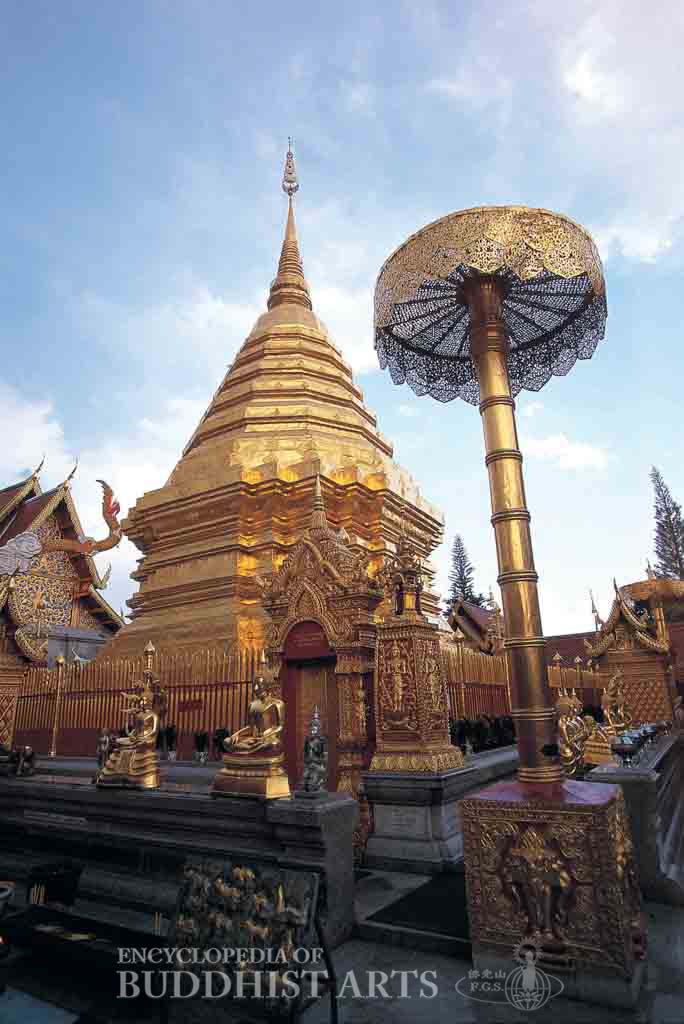
Wat Phra That Doi Suthep: Main Stupa
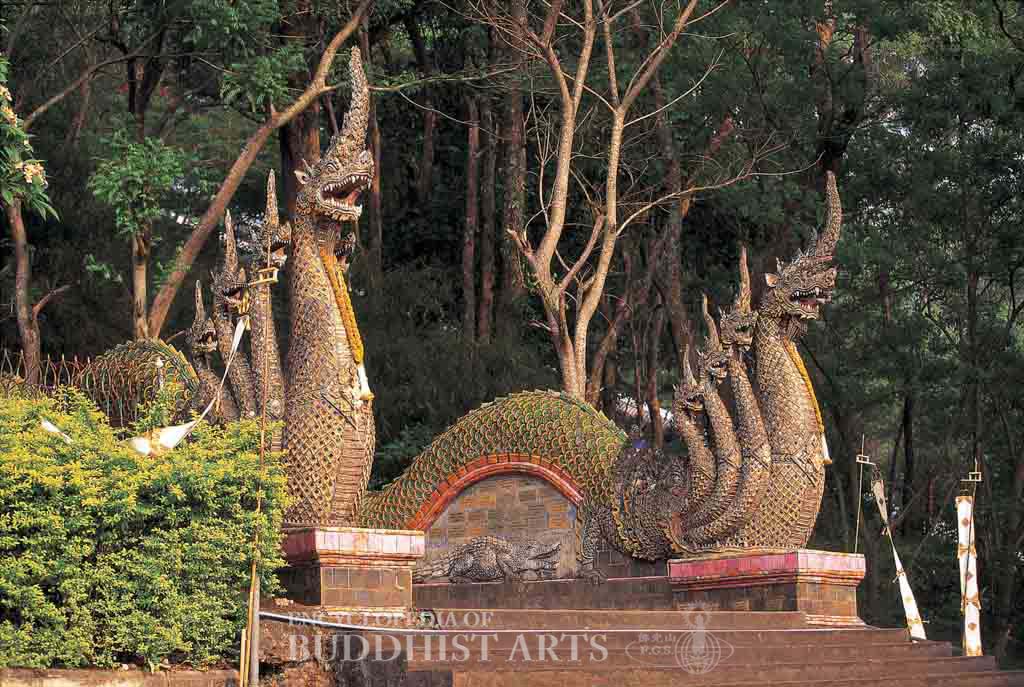
Wat Phra That Doi Suthep: Naga Staircase
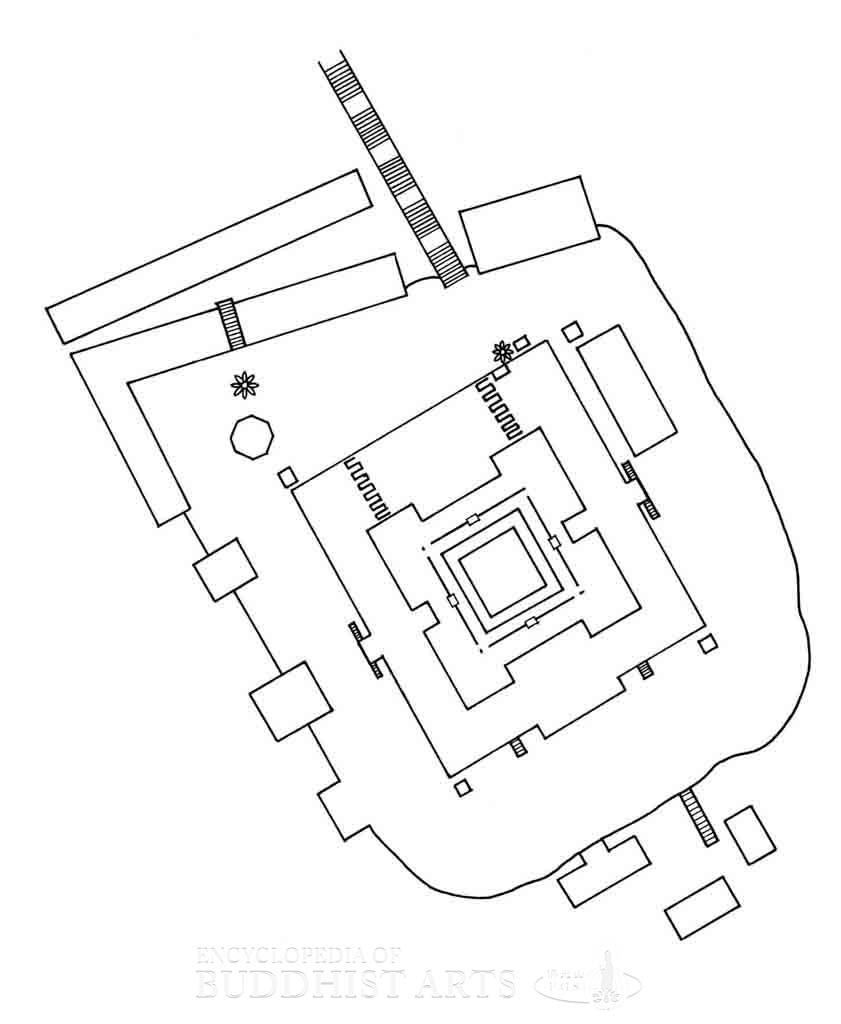
Wat Phra That Doi Suthep (site layout)
Wat Phra That Doi Suthep
THAILAND, Chiang Mai
The temple is located at the top of Doi Suthep overlooking Chiang Mai. It is a second class royal temple with the full name Wat Phra That Doi Suthep Ratchaworawihan. According to legend, a relic of the Buddha was strapped to the back of an auspicious white elephant, which was allowed to wander until it found a suitable place for the relic to be enshrined. After roaming around for some time, the elephant eventually climbed this mountain, but then passed away. It is said that the temple was subsequently built to house the relic carried by the elephant. Construction of the temple began in 1383 and the stupa housing the relic was expanded in 1525. In 1557 the naga staircase leading up to the temple was added and a road to the temple was built in 1935.
The temple faces southwest and consists of the main stupa, ordination hall, several Buddha halls, museum, and naga staircase. The main stupa is over 16 m high and is covered entirely in gilt copper repoussé plates with decorative patterns. It stands on a marble base platform. The high base of the stupa is square with multiple corners. The stupa body is octagonal and tapers upwards into a conical spire, which consists of stacked rings. A five-tier golden canopy forms the finial.
At each corner of the base platform there is a filigree canopy supported by a slim bamboo-shaped column whose base is decorated in repoussé reliefs. The stupa is surrounded by galleries, which contain various Buddha statues and murals depicting the Life of the Buddha. On the east and west sides of the galleries there are two halls whose inside walls are covered in murals. In the eastern hall there are murals depicting the legend of the elephant, while in the western hall the murals narrate the Vessantara Jataka.
The steep naga staircase consists of more than 200 steps. On top of the balustrades flanking the staircase there are the exceedingly long, undulating bodies of two makaras with bright orange and green scales. Four nagas can be seen emerging from the mouths of the makaras at the base of the steps. The glazed ceramic tiles of the makaras and nagas are very vibrant and bring these creatures to life. At the top of the naga staircase is a statue of the white elephant.
For more details, go to the Encyclopedia of Buddhist Arts: Architecture T-Z, page 1241.
Cite this article:
author = Hsingyun and Youheng and Johnson, Peter and Mankuang and Lancaster, Lewis,
booktitle = {Encyclopedia of Buddhist Arts: Architecture T-Z},
pages = 1241,
title = {{Wat Phra That Doi Suthep}},
volume = 4,
year = {2016}}