
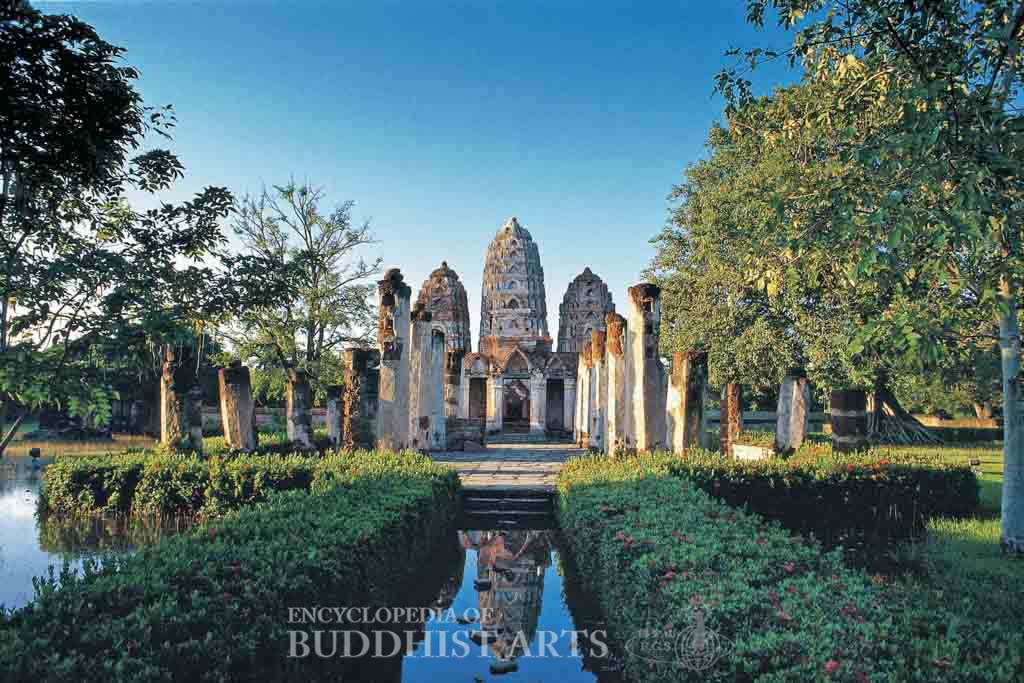
Wat Sri Sawai
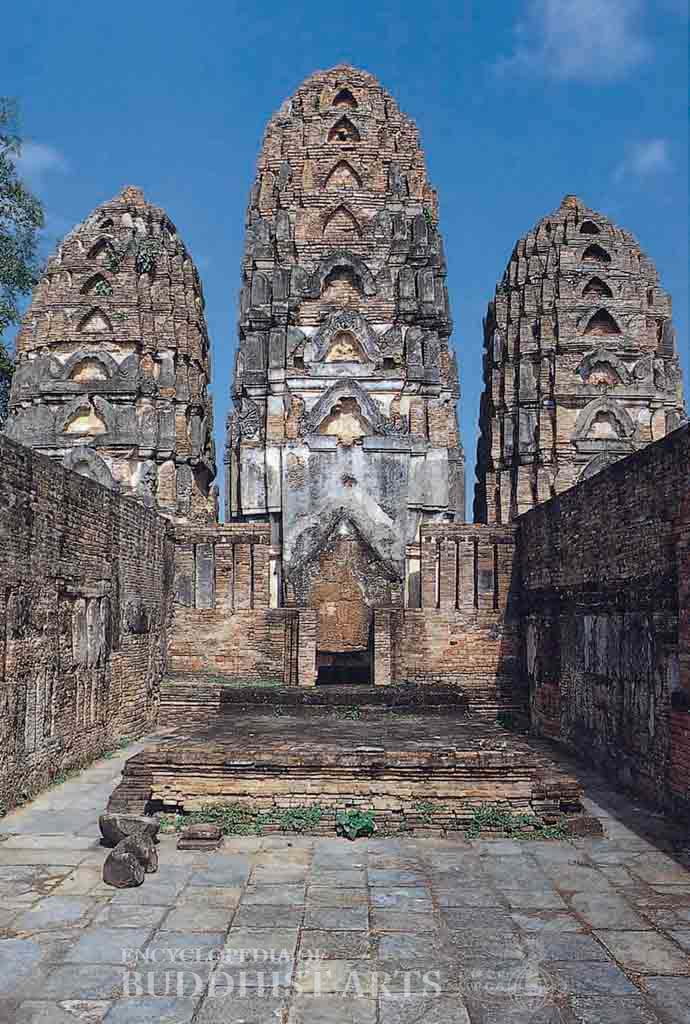
Wat Sri Sawai: Three Stupas and Main Hall
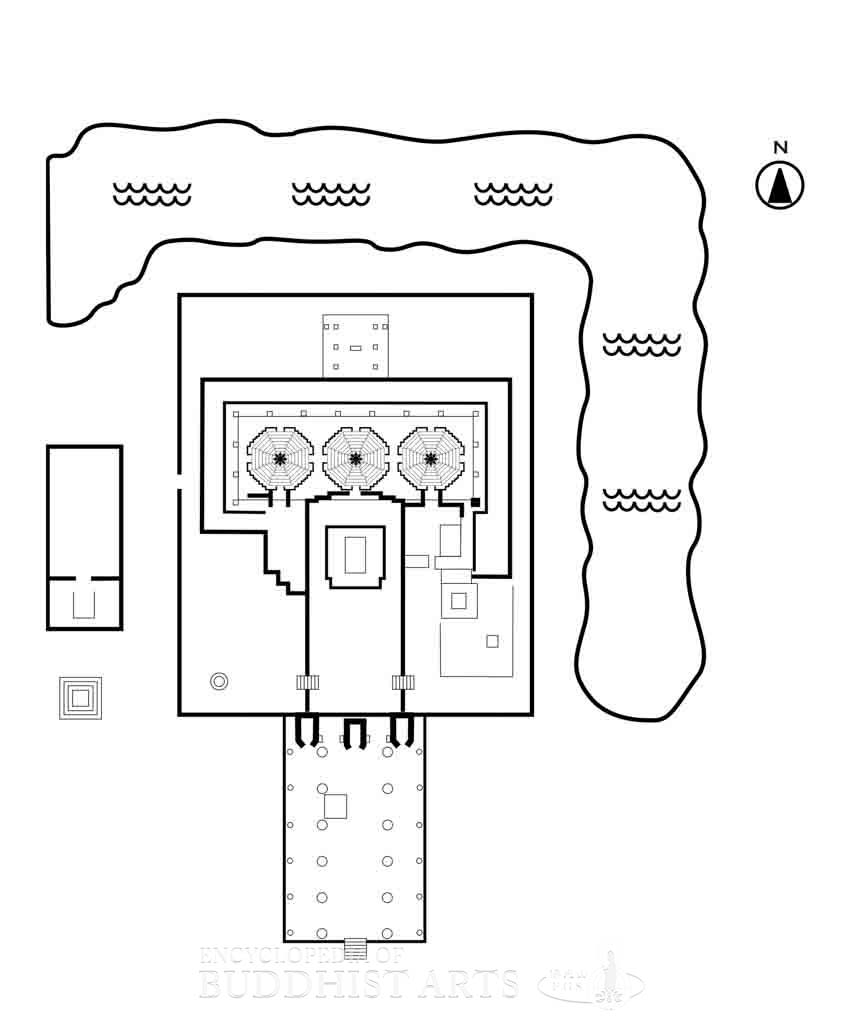
Wat Sri Sawai (site layout)
Wat Sri Sawai
THAILAND, Sukhothai
Wat Sri Sawai means the Temple of the Mangoes. The temple is located to the south of Wat Mahathat in Sukhothai. The Khmer-style stupas were constructed in the 13th century to form part of a Hindu temple. It was subsequently converted to a Buddhist temple and the main hall was built later during the Sukhothai period (circa 1238–1438). As part of the Historic Town of Sukhothai and Associated Historic Towns, it was listed as a UNESCO World Cultural Heritage Site in 1991.
Facing south, the temple consists of three stupas built side by side on an east-west axis, with the main hall extending south from the central stupa. The stupas all have a tapered curved shape. Their facades are decorated with niches. The stupa in the center is about 15 m high, while the stupas on either side are approximately 12 m high. They are made of laterite with the upper sections built of brick. It is therefore believed that the stupas were initially constructed by Khmer builders, leaving the top sections unfinished, and they were later completed by Thai builders using brick. There are traces of Hindu deities, Shiva and Vishnu, on the faces of the stupas, and on the antefixes there are stucco images of garudas, nagas, and humans.
The main hall, now without its roof, has three doorways and slits for ventilation and light. There is a small platform towards the rear of the hall where it is believed the Buddha image was once placed. Directly south of the boundary wall of the temple there is a colonnaded walkway, which was probably once covered by a wooden roof, forming a circumambulation path. It is now in ruins and only the tall columns remain.
For more details, go to the Encyclopedia of Buddhist Arts: Architecture T-Z, page 1256.
Cite this article:
author = Hsingyun and Youheng and Johnson, Peter and Mankuang and Lancaster, Lewis,
booktitle = {Encyclopedia of Buddhist Arts: Architecture T-Z},
pages = 1256,
title = {{Wat Sri Sawai}},
volume = 4,
year = {2016}}