
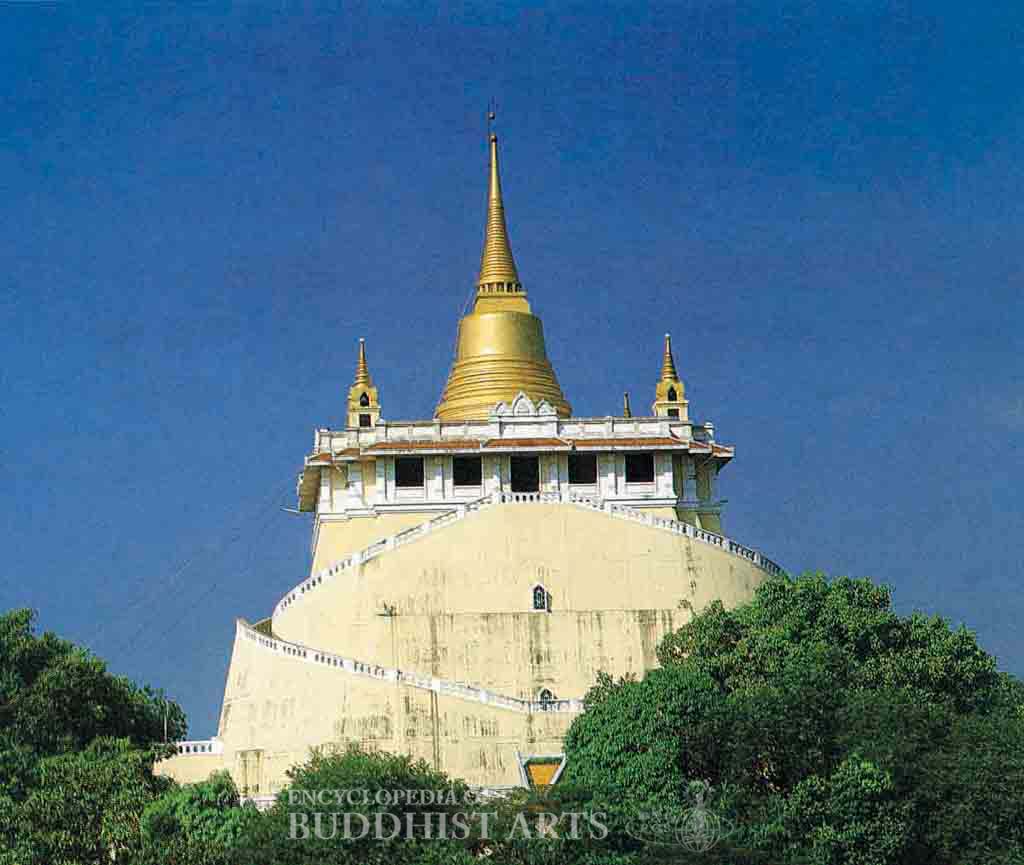
Wat Saket: Golden Mount
Wat Saket
THAILAND, Bangkok
The temple was originally named Wat Sakae and it is popularly known as the Temple on the Golden Mount. It is a second class royal temple with the full name Wat Saket Ratchaworamahawihan. It is one of the oldest temples in the local area, dating from the Ayutthaya Kingdom (circa 1350–1767). The temple was rebuilt by King Rama I (reigned 1782–1809), and two canals, Khlong Lod and Khlong Mahanar, were dug around the temple. Reconstruction and expansion continued under King Rama III (reigned 1824–1851) and King Rama IV (reigned 1851–1868), until it was completed under King Rama V (reigned 1868–1910).
The main structures include the Golden Mount and stupa, ordination hall, assembly hall, and sutra repository. The Golden Mount is an artificial hill piled up with mud and stone blocks, and strengthened with reinforced concrete. There are over 300 steps to the top of the hill, from which there is a panoramic view of the city of Bangkok. The stupa is built at the top of the hill on a very large base platform with multiple corners. At each corner is a much smaller stupa. The stupa is 150 m high from its base, which has a circumference of 330 m. The base of the stupa is round and curves upwards towards the bell-shaped body, which consists of circular mouldings followed by the smooth upper part. There is a square harmika followed by the base of the spire, which is surrounded by short columns supporting the stacked rings above. The smooth upper part of the spire comes to a sharp point and is surmounted by a jewel. There is a canopy at the finial. Relics of the Buddha given to King Rama V by the Indian government are enshrined within the stupa.
The ordination hall is in typical Thai style with a roof of multiple tiers and sections, and decorated with nagas and garudas. There are two sets of columns supporting the eaves of the portico. Surrounding the ordination hall, there are finely-decorated structures in the eight directions housing the boundary stones, which mark the sacred boundary of the hall. The ordination hall and assembly hall are connected by a covered walkway. The assembly hall is separated into east and west chambers by a brick wall. A seated Buddha, Luang Phor Dusit, is enshrined in the west chamber, while a standing Buddha, Phra Attharos, is installed in the east chamber.
For more details, go to the Encyclopedia of Buddhist Arts: Architecture T-Z, page 1250.
Cite this article:
author = Hsingyun and Youheng and Johnson, Peter and Mankuang and Lancaster, Lewis,
booktitle = {Encyclopedia of Buddhist Arts: Architecture T-Z},
pages = 1250,
title = {{Wat Saket}},
volume = 4,
year = {2016}}