
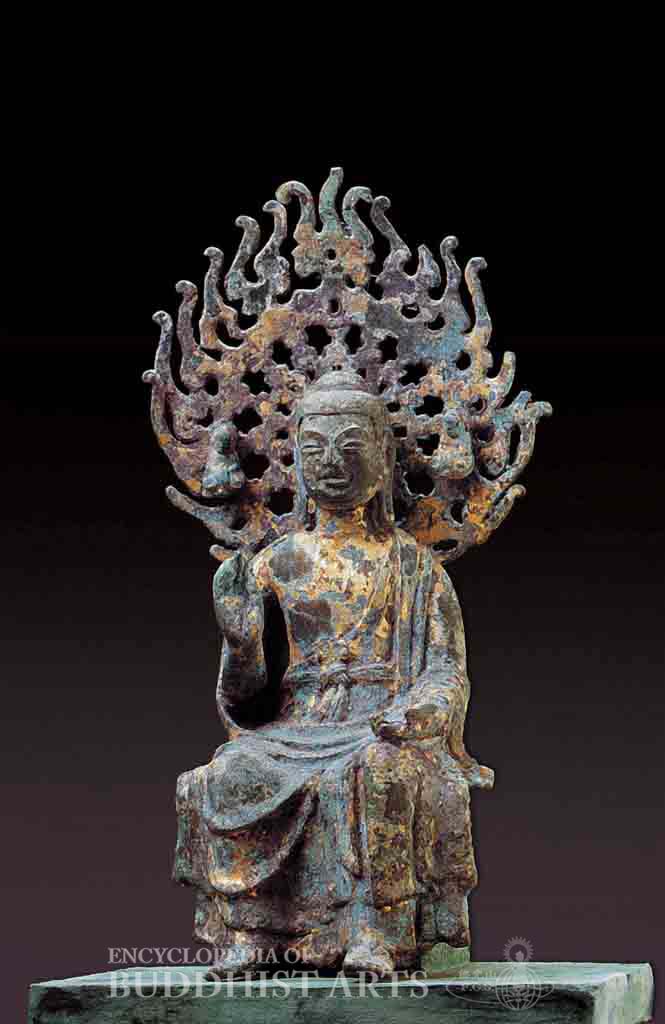
Longhua Temple Sculptures: Seated Buddha; Northern Qi dynasty
Gilt bronze
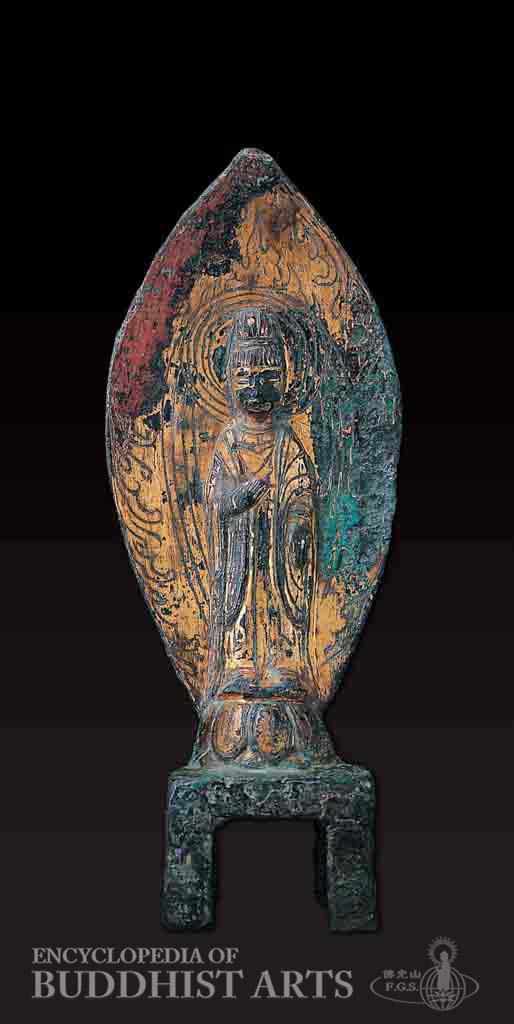
Longhua Temple Sculptures: Avalokitesvara Bodhisattva; Eastern Wei dynasty; Commissioned by Cheng Cihan
Gilt bronze
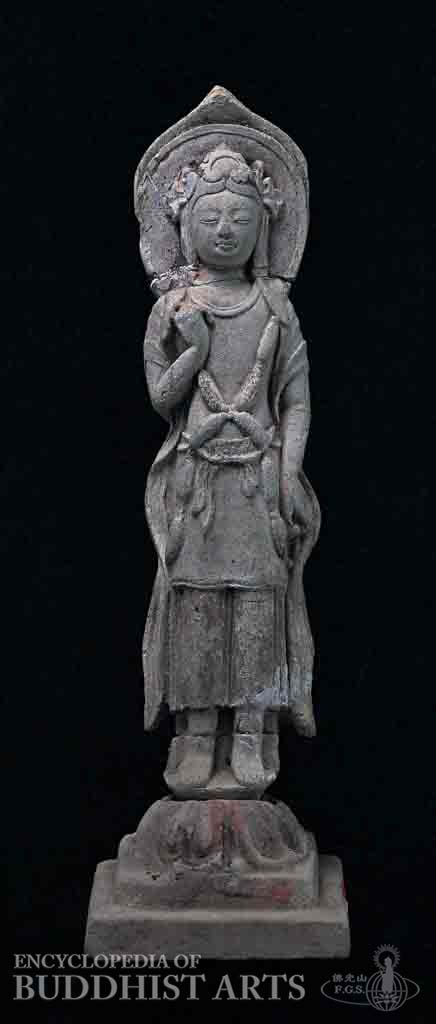
Longhua Temple Sculptures: Standing Bodhisattva; Eastern Wei dynasty; dated 545
Porcelain
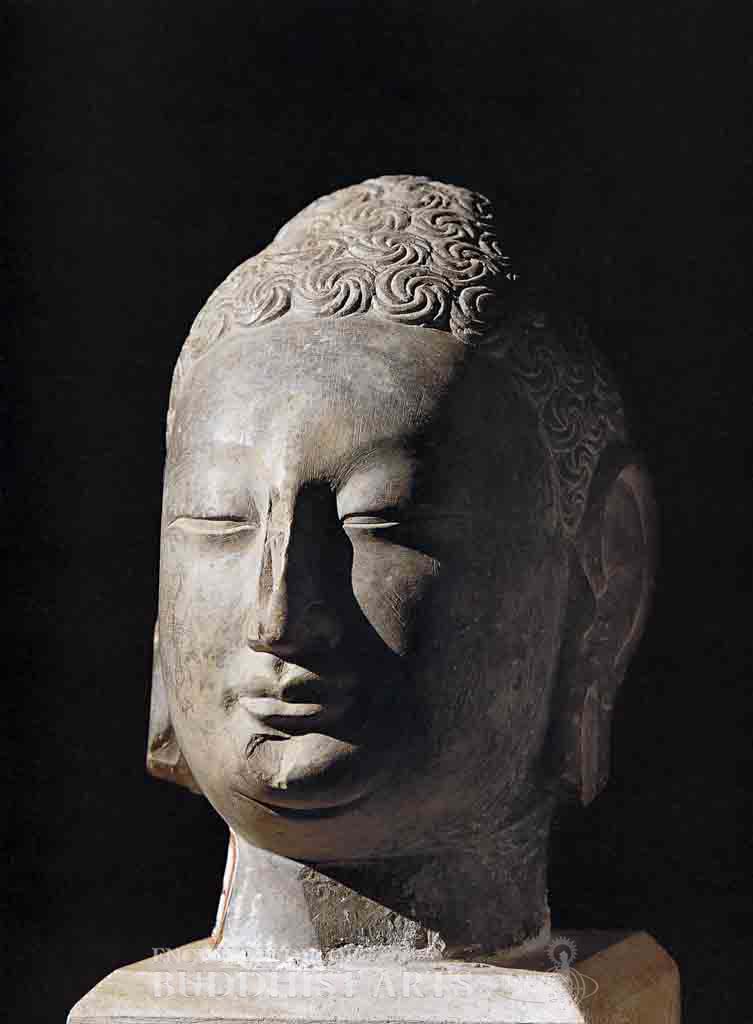
Longhua Temple Sculptures: Head of a Buddha; Eastern Wei dynasty
Limestone
Longhua Temple Sculptures
CHINA, Shandong, Binzhou
A number of sculptures have been excavated from the Longhua Temple site at Boxing, Binzhou. The ruins occupy approximately 40 ha and cover the villages of Zhangguan, Chongde, and Fengwu. Seventy-two artifacts and sculptures were discovered in Zhangguan village in 1976. They included stone carvings, unglazed porcelain figures, steles, Buddha heads and Buddha seats. Nine of these items were clearly dated between 547 to 570. A bronze Buddha was discovered in Chongde village in 1983. It contained a cache of 101 bronze figurines dated between 478 to 603.
During the Northern Wei dynasty (386–534) sculptures mainly consisted of single statues of Buddhas and Bodhisattvas, while double statues of Sakyamuni and Prabhutaratna Buddhas were also popular. The artworks were rather simple in style and came mostly with mandorlas and four-legged stands. Stone sculptures from the Eastern Wei dynasty (534–550) tended to be more delicate with slender mandorlas, and depicted in more detail. During the Northern Qi dynasty (550–577) bronze sculptures were more common. By this time craftsmen were able to cast sculpture parts separately and then join them together. Single, freestanding statues were the most common among the Sui dynasty (581–618) pieces. Many of the figures no longer had mandorlas but have nimbuses attached.
For more details, go to the Encyclopedia of Buddhist Arts: Sculpture G-M, page 613.
Cite this article:
author = Hsingyun and Youheng and Lovelock, Yann and Chou, Yuan and Huntington, Susan and Edson, Gary and Neather, Robert,
booktitle = {Encyclopedia of Buddhist Arts: Sculpture G-M},
pages = 613,
title = {{Longhua Temple Sculptures}},
volume = 11,
year = {2016}}