
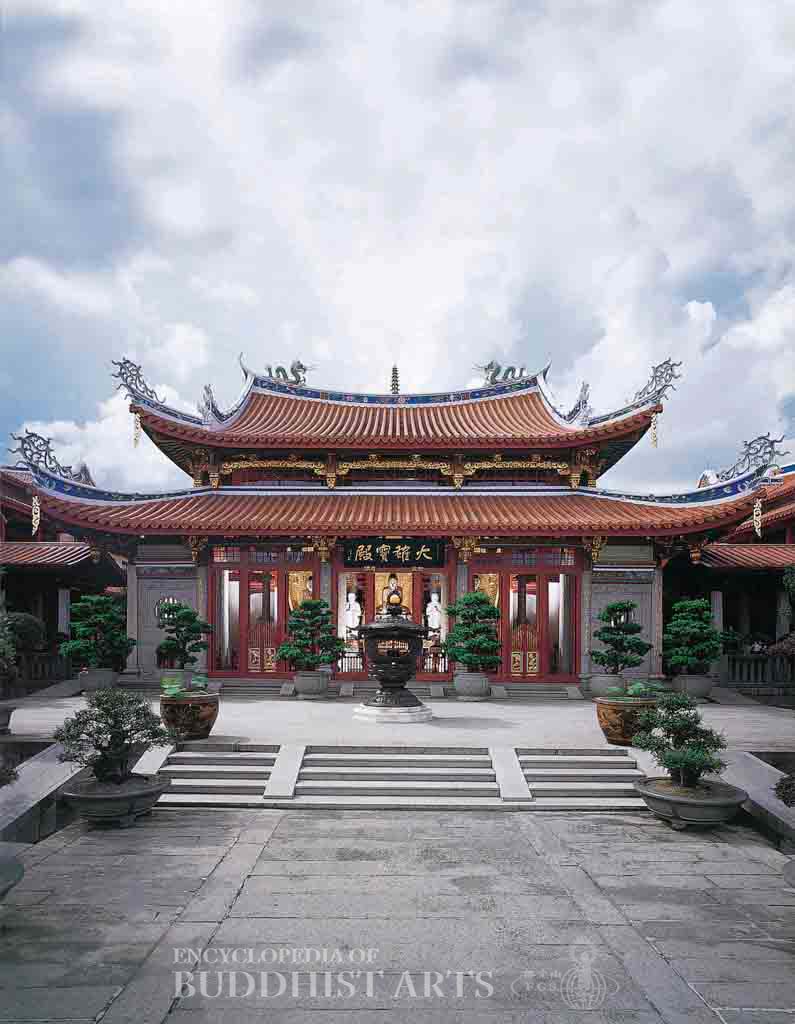
Lian Shan Shuang Lin Monastery: Great Hero Hall
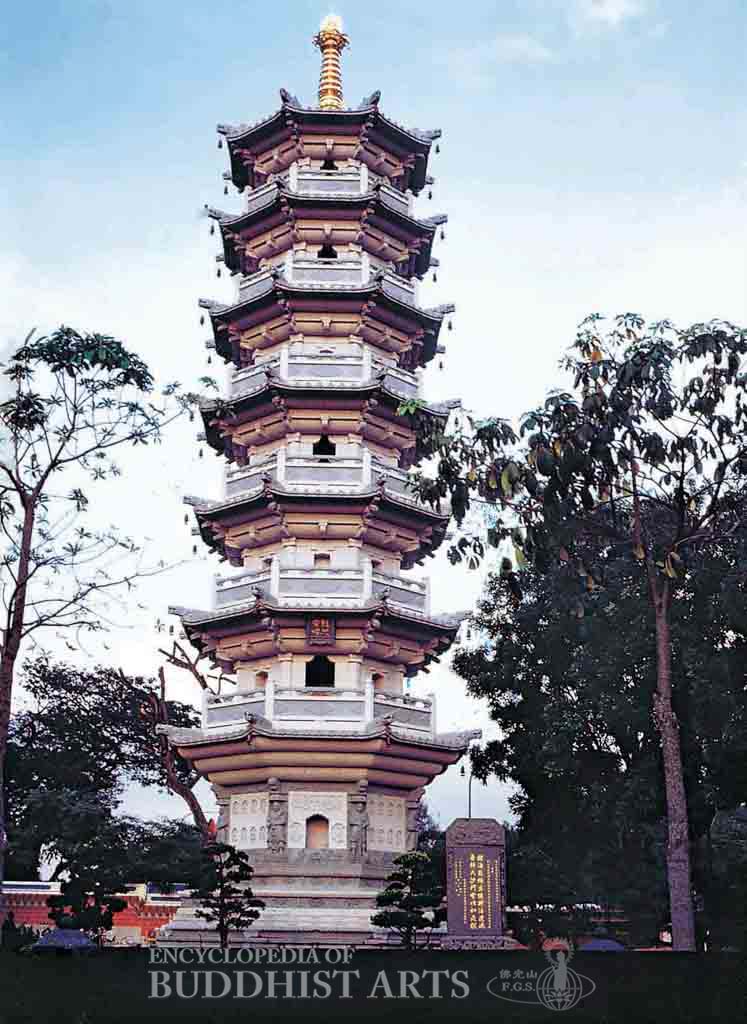
Lian Shan Shuang Lin Monastery: Dragon Light Pagoda
Lian Shan Shuang Lin Monastery
SINGAPORE
The monastery is named after the twin sala trees under which the Buddha passed into Parinirvana. It was founded in 1898 and its construction was completed in 1909. It was built by Low Kim Pong, a devotee from Fujian, and is Singapore’s oldest Buddhist temple. The temple was listed as a National Monument in 1980.
This monastery exhibits a rich Southern Fujian architectural style and has the layout of a Chan Buddhist monastery. The principal structures are the gateway, screen wall, crescent-shaped Feature Pond, main temple gate, sutra pillars, Heavenly King Hall, bell and drum towers, Great Hero Hall, and the Dharma Hall. The Dragon Light Pagoda is also situated to the east of the monastery.
The five-bay wide Great Hero Hall has a double-eave hip-and-gable roof. The decorations on the roof were created by attaching colorful shards of ceramic tiles to molded forms in a mosaic style. There are carvings of dragons and mythical creatures on the eave corners, and the pendills are carved with human figures. Outside the hall, the columns are sculpted with dragons and phoenixes. Inside there are three large medallions composed of hundreds of brackets sets, engraved with auspicious motifs such as bats, the eight treasures, and flora. In the Heavenly King Hall there are century-old clay statues sculpted in meticulous detail. In front of the hall, there is a pair of 7 m high octagonal sutra pillars inscribed with the Usnisavijaya Dharani Sutra in Chinese and Sanskrit.
The seven-story, octagonal, stone Dragon Light Pagoda is approximately 30 m high and is modeled after the Song dynasty (960–1279) Shengshou Pagoda near Changle, Fujian. A warm-hued granite and hard bluestone quarried from Fujian has been used to give the pagoda a solid feel. Each face of the base platform is finely carved with animated reliefs.
For more details, go to the Encyclopedia of Buddhist Arts: Architecture G-L, page 657.
Cite this article:
author = Hsingyun and Youheng and Johnson, Peter and Mankuang and Lancaster, Lewis,
booktitle = {Encyclopedia of Buddhist Arts: Architecture G-L},
pages = 657,
title = {{Lian Shan Shuang Lin Monastery}},
volume = 2,
year = {2016}}