
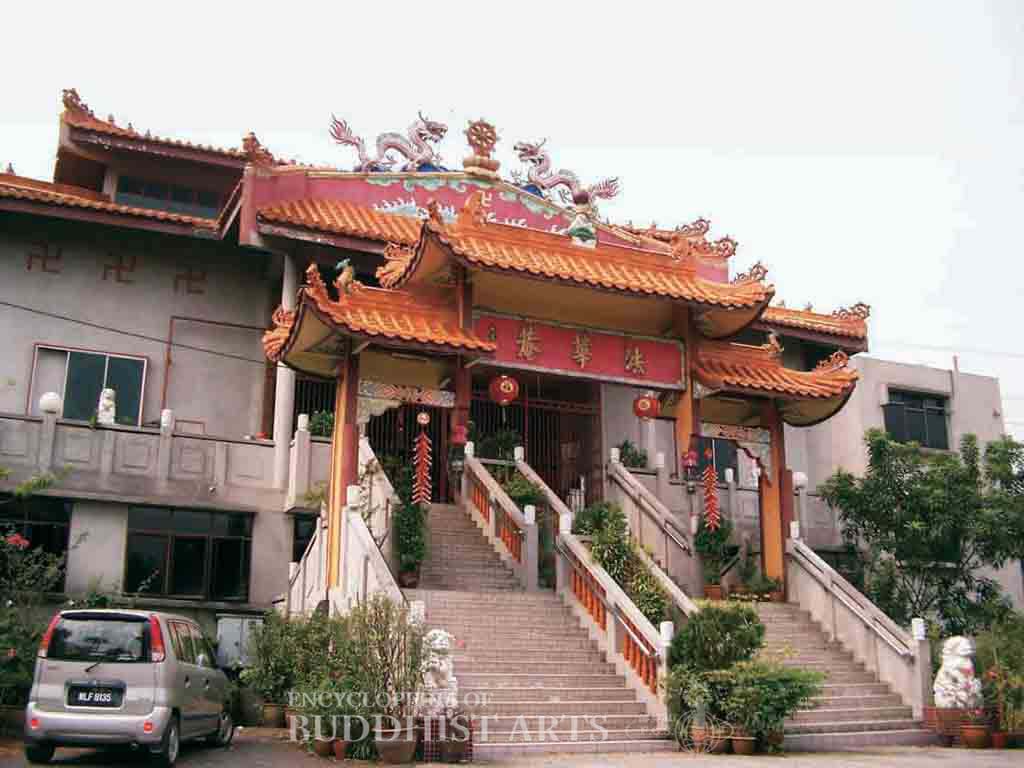
Fatt Wah Temple
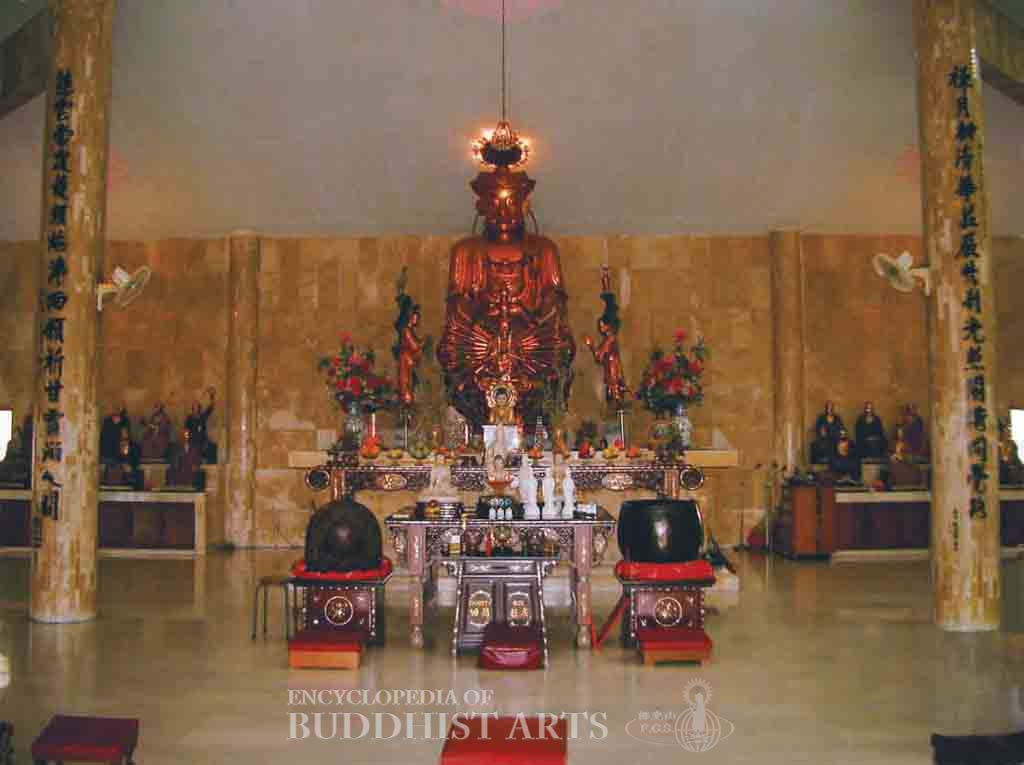
Fatt Wah Temple: Main Hall (interior)
Fatt Wah Temple
MALAYSIA, Kuala Lumpur
Fatt Wah refers to the Lotus Sutra. The temple was founded in 1936 by Qingfeng, a monk from Sichuan, China, and is the oldest temple in Kuala Lampur. It started out as a simple grass hut, but in 1958 it was reconstructed as a brick building with a zinc roof. The present appearance of the temple is the result of renovations undertaken in 1987.
The temple occupies an area of 1.9 ha and consists mainly of a three-story building. In front of the building, there are two sets of steps which lead directly to the second story. Above the steps there is a gateway with a roof in glazed yellow tiles in Chinese style. The first story of the building consists of a memorial hall and dining hall. The second story houses the activities center. The third story is the main hall. Within the main hall, there is a 5.5 m high statue of Avalokitesvara Bodhisattva in masculine form, sculpted in accordance with the vision that Qingfeng had while in meditation. In addition, there are 24 golden heavenly beings flanking both sides of the hall, each measuring 1.1 m.
For more details, go to the Encyclopedia of Buddhist Arts: Architecture A-F, page 290.
Cite this article:
author = Hsingyun and Youheng and Johnson, Peter and Mankuang and Lancaster, Lewis,
booktitle = {Encyclopedia of Buddhist Arts: Architecture A-F},
pages = 290,
title = {{Fatt Wah Temple}},
volume = 1,
year = {2016}}