
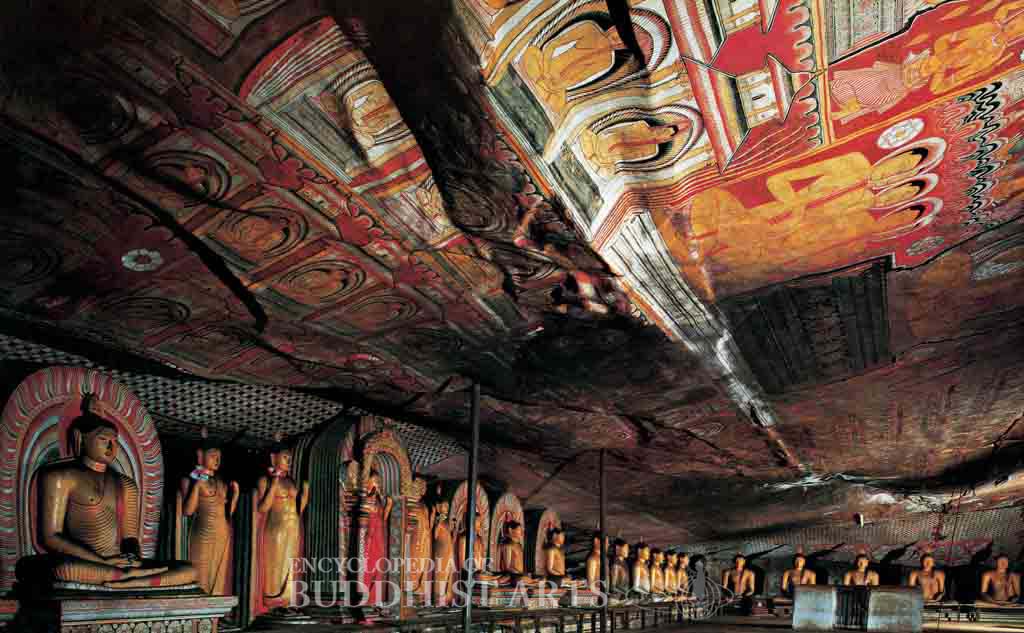
Dambulla Caves: Cave 2
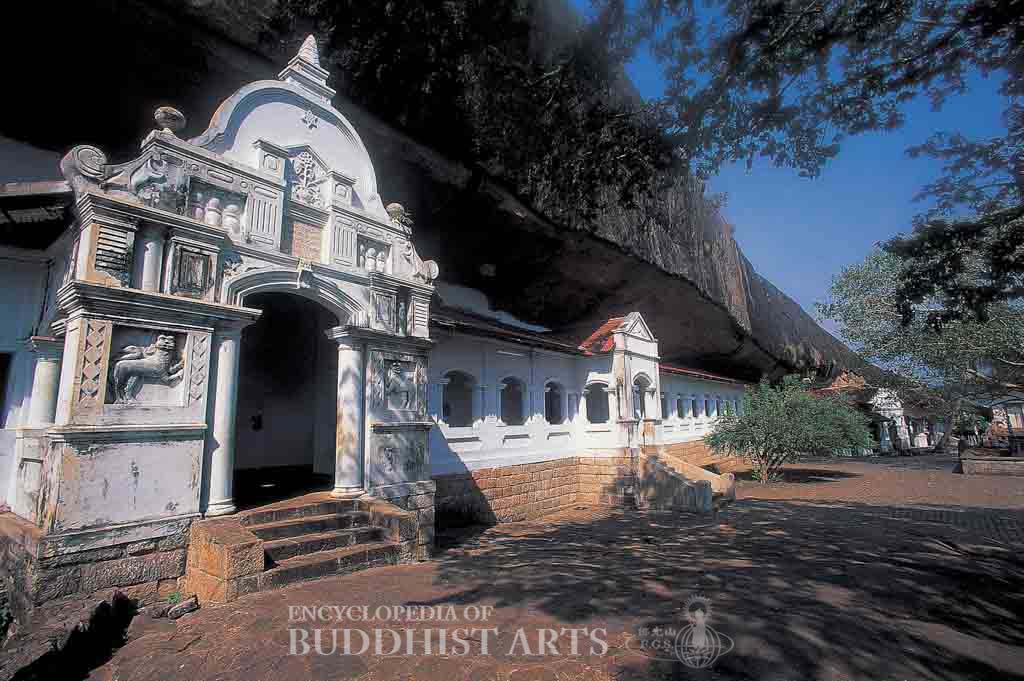
Dambulla Caves
Dambulla Caves
SRI LANKA, Central Province, Matale
The caves, located in Matale district, Central Province, represent the largest and best-preserved Buddhist cave complex in Sri Lanka. According to some records, there were originally a total of 80 caves, though currently, there are five main caves at the site. During the early transmission of Buddhism, the cave site once served as a monastic center. King Valagamba (reigned 89–77 BCE) of Anuradhapura subsequently remodeled the caves into a temple complex. He ordered the construction of the main statue of a reclining Buddha in Cave 1, and several statues in Caves 2, 4, and 5. Restoration work was carried out by King Nissanka Malla (reigned circa 1187–1196), including the gilding of 50 Buddha statues in Cave 2, according to an inscription in that cave. King Kirti Sri Rajasinha (reigned 1747–1780), ordered a large-scale restoration which involved repainting the cave’s ceiling and the wall of the shrine, as well as constructing a portico outside the cave. The caves were restored again in 1915 and 1930. They were listed as a UNESCO World Heritage Site in 1991.
The caves are set into a cliff approximately 150 m high. The five extant caves have a combined area of over 1,000 sq m, and the murals within them occupy 2,000 sq m of wall and ceiling space. The murals are painted in vivid, predominantly warm colors, and mostly illustrate Jataka tales of the Buddha’s former lives, scenes from the Life of the Buddha, major events of the transmission of Buddhism to Sri Lanka, or the stories of ancient kings. In addition to the murals, there are over 100 carved Buddha images enshrined within the five caves, as well as images of Indian deities and ancient kings, sculpted life size or larger. The statues are either gilded or painted in bright colors.
Cave 1 is known as the Heavenly King Cave. It contains images of the Buddhas and heavenly beings of Trayastrimsa Heaven. The main statue is a 14 m long reclining Buddha, with the disciple Ananda at the Buddha’s feet. Cave 2 is the largest of the five, measuring 52 m wide by 23 m deep. Known as the Great King Cave, it was rebuilt into a shrine by King Valagamba. The entrance is 6 m high, with the ceiling sloping downwards towards the back wall. The ceiling and walls are elaborately carved with over 50 Buddha images, either in standing or sitting posture. There are also several Bodhisattvas and images of both heavenly and worldly kings. In addition, the cave contains an inverted bowl stupa with eight seated Buddha statues around its base.
Cave 3, known as the Great New Temple, was used as a repository until the 18th century when it was rebuilt as a shrine by King Kirti Sri Rajasinha. The cave is approximately 27 m wide by 24 m deep. The entrance is 10 m high and the ceiling slopes down towards the back wall. Most of the murals illustrate the story of Sakyamuni Buddha’s Defeat of Mara and Enlightenment. The carvings include over 50 Buddha images in varying sizes, as well as a reclining Buddha measuring 9 m in length. Cave 4 is approximately 16 m wide by 8 m deep, and contains a stupa and several Buddha images. Cave 5 was constructed in 1915 and enshrines several Buddha images and a reclining Buddha.
For more details, go to the Encyclopedia of Buddhist Arts: Caves A-E, page 220.
Cite this article:
author = Hsingyun and Youheng and Johnson, Peter and Mankuang and Huntington, Susan and Edson, Gary and Neather, Robert,
booktitle = {Encyclopedia of Buddhist Arts: Caves A-E},
pages = 220,
title = {{Dambulla Caves}},
volume = 5,
year = {2016}}