
Sakyamuni Buddha
Bronze
Sakyamuni Buddha
THAILAND; Dvaravati Kingdom
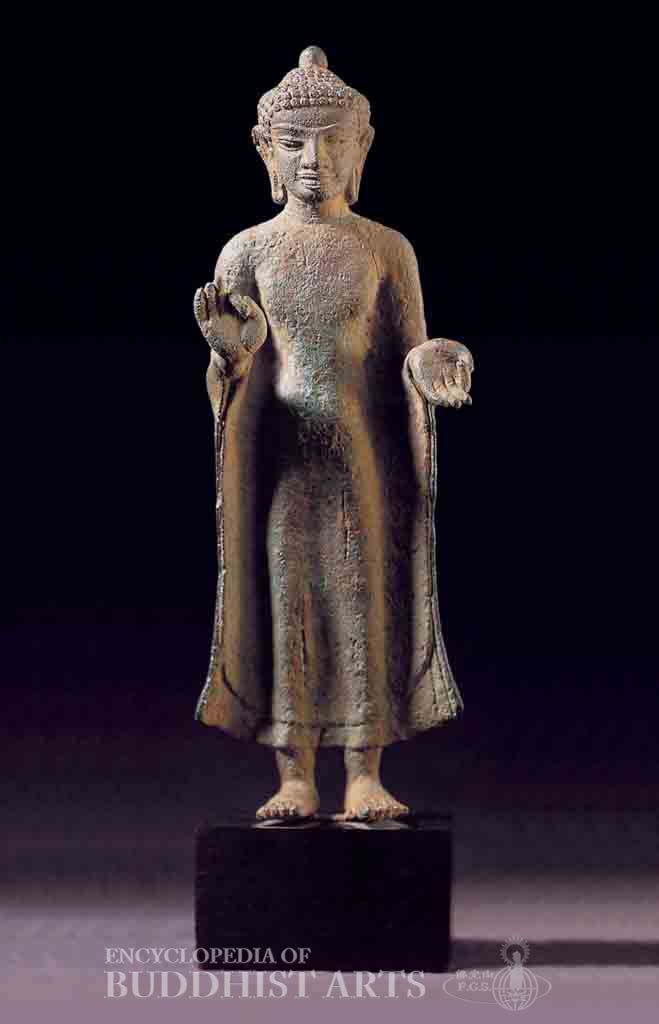
The most distinctive feature of this weathered Dvaravati (circa 6th–13th century) Buddha is the rare posture. Both hands are in vitarka (teaching) mudra, but one points up and the other is cupped. The gesture is associated with calling for rain in the area the statue was created.
The Buddha’s slightly raised usnisa is capped with a large rounded gem. The joined eyebrows form an emphatic curve over a wide nose and full lips. Outlines around the eyes and mouth further emphasize the features, while holes in the pupils suggest that they had been inlaid. The sheer monastic robe is typical of the area as it falls from the wrists, flaring at the base to curve in front of the legs.
For more details, go to the Encyclopedia of Buddhist Arts: Sculpture N-Sr, page 929.
Cite this article:
author = Hsingyun and Youheng and Lovelock, Yann and Chou, Yuan and Huntington, Susan and Edson, Gary and Neather, Robert,
booktitle = {Encyclopedia of Buddhist Arts: Sculpture N-Sr},
pages = 929,
title = {{Sakyamuni Buddha}},
volume = 12,
year = {2016}}