
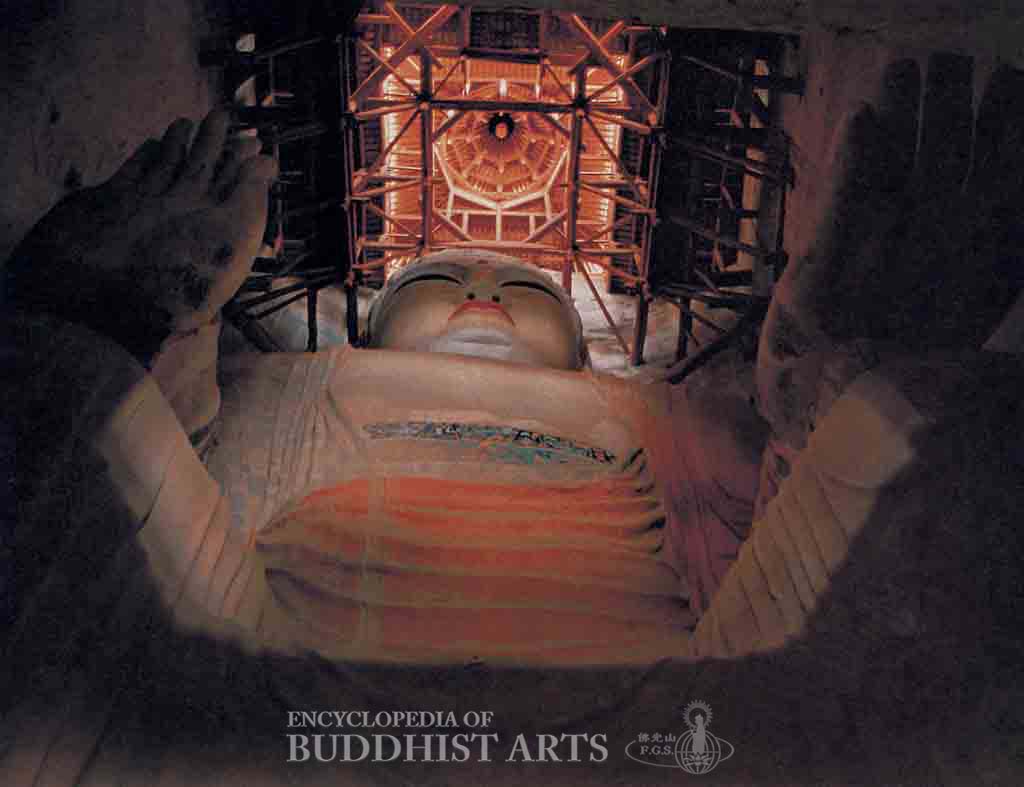
Mogao Cave 96: North Great Statue (detial)

Mogao Cave 96: North Great Statue
Mogao Cave 96
CHINA, Gansu, Dunhuang
This great Buddha cave is located in the south area of the site. Nearly 40 m in height, it was made in 695 during the Wu Zhou period. In front of the cave is a nine-story wooden tower that covers almost the entire height of the cliff face. Originally a five story structure, it was repaired and altered several times over the years, taking its current form in 1911. The tower has extended eaves at each story, and windows on the fourth and seventh stories. The upper stories form a funnel-shaped octagonal roof with a finial at the top.
The antechamber is at the first story of the nine-story tower. On the back (west) wall beside the entrance, there are paintings of Buddhas from the Qing dynasty (1644–1911), and relief carvings which commemorate the tower’s construction. On the north and south walls are Amitabha Buddha images, also from the Qing dynasty.
On the back wall of the main chamber is a giant seated Maitreya Buddha statue. At 35.2 m high, it is the largest statue in the Mogao Caves. Commonly referred to as the North Great Statue, mention of this Buddha can be found in the Record of Merits of Zhang Huaishen and the Tang Records of the Mogao Caves, the latter stating that the statue was built by Master Linyin and the hermit Yin Zu. The Buddha has a high usnisa, curled hair, a round face, and an urna between the eyebrows. There are three lines on the neck. The open-collared robes have deep folds shaped with clay, and there is a belt around the waist. The right hand forms the abhaya (fearlessness) mudra and the left hand rests on the knee. The figure is barefoot and is seated with legs pendent. A corridor runs behind the statue for circumambulation, and serves as access to a rear chamber.
For more details, go to the Encyclopedia of Buddhist Arts: Caves M-Mo, page 913.
Cite this article:
author = Hsingyun and Youheng and Johnson, Peter and Mankuang and Huntington, Susan and Edson, Gary and Neather, Robert,
booktitle = {Encyclopedia of Buddhist Arts: Caves M-Mo},
pages = 913,
title = {{Mogao Cave 96}},
volume = 7,
year = {2016}}