
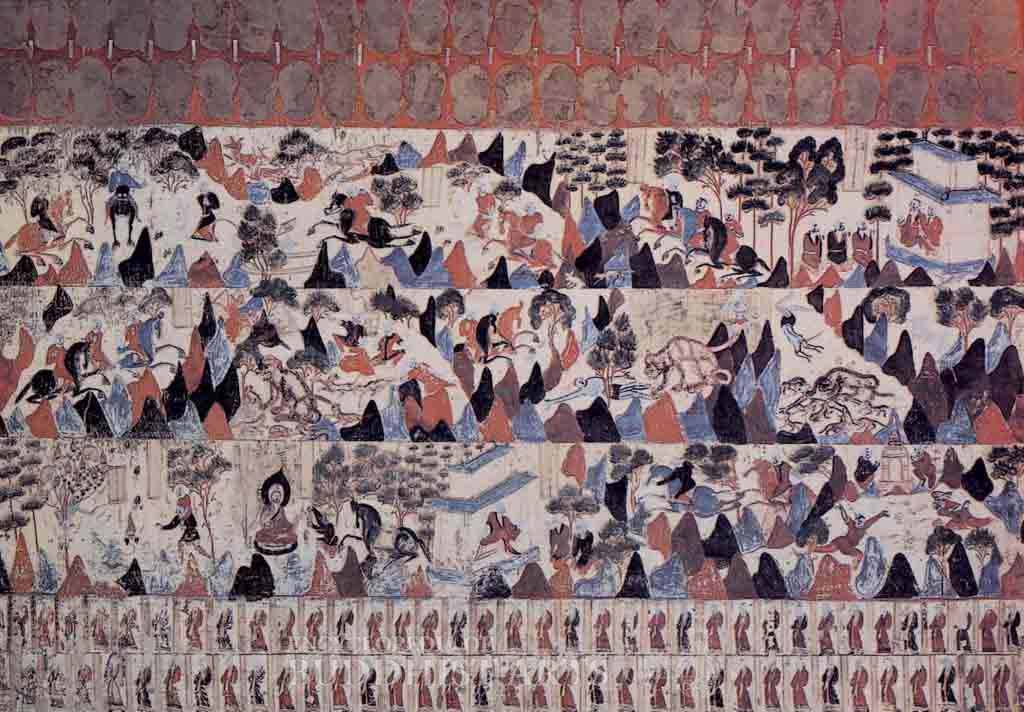
Mogao Cave 428: Prince Mahasattva Jataka
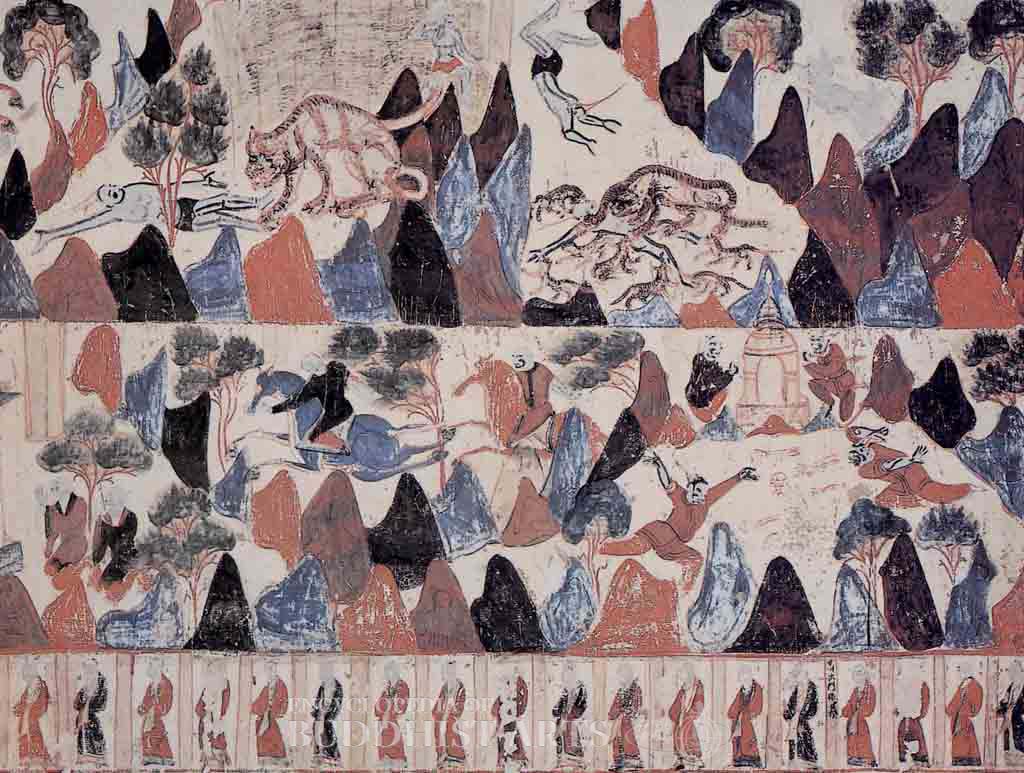
Mogao Cave 428: Prince Mahasattva Jataka (detail)
Mogao Cave 428: Prince Mahasattva Jataka
CHINA, Gansu, Dunhuang; Northern Zhou dynasty
This narrative illustration is to the right of the entrance on the front (east) wall. The layout of the mural is in the style of a horizontal scroll painting and the scenes are divided into three registers progressing in an “S” formation. Beginning at the top right are four scenes: three princes bid farewell to the king, they travel together on horseback, go hunting in a forest, and converse together while at rest. Continuing on the left of the middle register are the following scenes: the princes travel into the mountains, they encounter a starving tigress, Prince Mahasattva offers his body to the tigress, the prince ascends a cliff, stabs himself in the neck for blood, jumps off the cliff, and feeds the tigress. Finally, from the right of the lower register: Prince Mahasattva’s two elder brothers grieve at the sight of his remains; they race home on horseback and report to the king, and a stupa is constructed in the prince’s memory.
Mountains, trees and houses are pictured at intervals to both set the scenes and divide them into distinct parts while maintaining the natural flow of the narrative. The painting is full of dramatic changes which heighten the affective qualities of the mural. For example, when the brothers gallop back to the palace to report the news, the trees are depicted swaying in the wind. This technique of attaching emotions to the landscape and blending the scenes together is used to express the sense of urgency and anxiety of the characters.
For more details, go to the Encyclopedia of Buddhist Arts: Caves Mo-S, page 1211.
Cite this article:
author = Hsingyun and Youheng and Johnson, Peter and Mankuang and Huntington, Susan and Edson, Gary and Neather, Robert,
booktitle = {Encyclopedia of Buddhist Arts: Caves Mo-S},
pages = 1211,
title = {{Mogao Cave 428: Prince Mahasattva Jataka}},
volume = 8,
year = {2016}}