
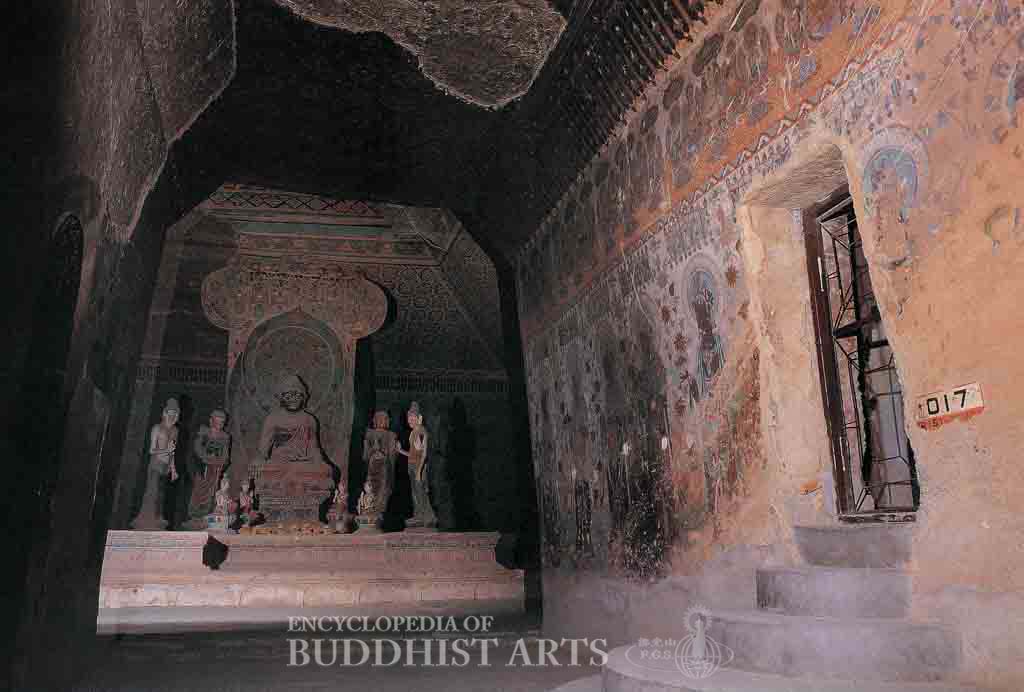
Mogao Cave 17: Entrance
Mogao Cave 17
CHINA, Gansu, Dunhuang
This cave is also called the Sutra Library Cave or the Dunhuang Stone Chamber. It is located in the northern section of the south area. The entrance to this cave is located off the north wall of Cave 16’s corridor. It was built between 851 and 862 during the Tang dynasty (618–907).
Originally, the cave was a memorial for Master Hongbian of Hexi, whose statue was installed along the back (north) wall. During the Song dynasty (960–1279), Master Hongbian’s statue was moved to another cave by monks from Sanjie Temple. A large collection of Buddhist sutras, paintings, and other religious and civil documents were put into the cave, and the entrance was sealed off. The stored items remained hidden here for centuries, presumably forgotten by the outside world. The cave was rediscovered in 1900 by a Daoist priest named Wang Yuanlu. Throughout the 20th century, expeditions from England, France, Japan, and Russia removed much of the content from the cave, resulting in the establishment of Dunhuang research centers around the world.
The cave faces south and has a vaulted ceiling. It measures 2.75 in width, 3 m in height, and 2.84 m in depth. The statue of Master Hongbian was returned to its original location in 1964 and enshrined upon a low rectangular altar on the back wall. Two trees are painted on the wall behind the figure. On the left, a bag hangs from a tree branch and a servant stands holding a long staff. On the right, a bottle hangs from the other tree and a nun holds a fan painted with two phoenix images. Two small birds are painted flying along the outside of the trees on both sides. A memorial tablet to Master Hongbian is installed on the west wall of the cave.
For more details, go to the Encyclopedia of Buddhist Arts: Caves M-Mo, page 849.
Cite this article:
author = Hsingyun and Youheng and Johnson, Peter and Mankuang and Huntington, Susan and Edson, Gary and Neather, Robert,
booktitle = {Encyclopedia of Buddhist Arts: Caves M-Mo},
pages = 849,
title = {{Mogao Cave 17}},
volume = 7,
year = {2016}}