
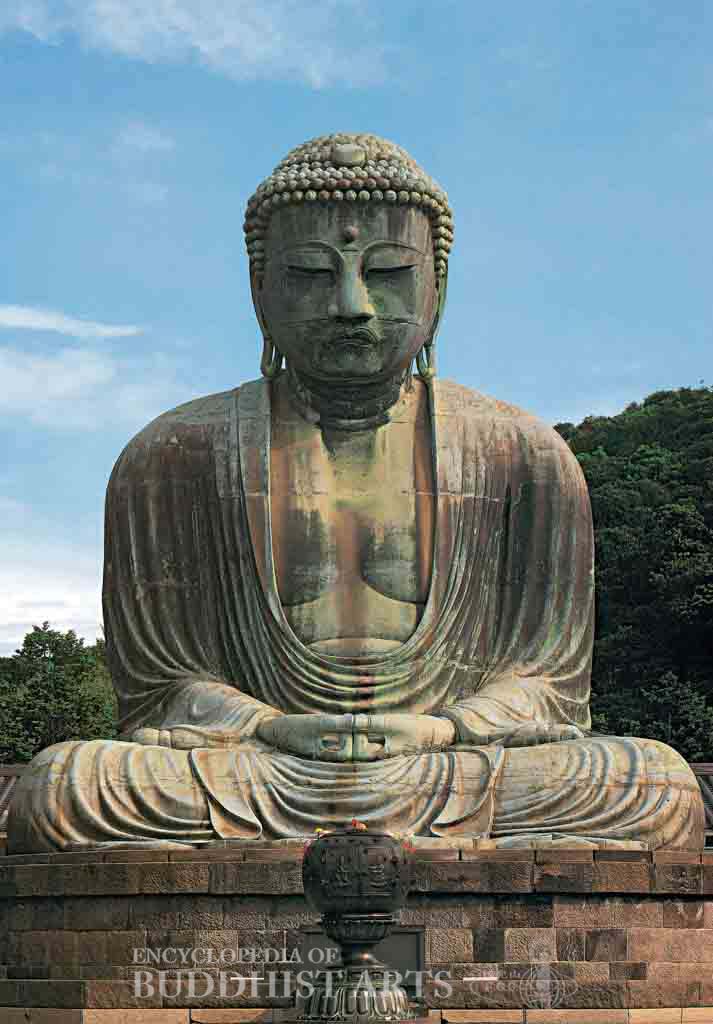
Kotokuin Temple: Amitabha Buddha
Gilt copper alloy
Kotokuin Temple: Amitabha Buddha
JAPAN, Kanagawa, Kamakura; Kamakura period
The well-known statue was cast in the 13th century and is symbolic of the Kamakura period (1185–1333). It was recognized as a National Treasure in 1958.
The statue was initially carved in wood and enshrined but was destroyed by a typhoon. In 1252, another Buddha was created in bronze. It was cast from the bottom up in twelve stages, a highly difficult method for its time. The cast is 5 cm thick and hollow within and is estimated to be over 120 t in weight. The completed statue was housed in a hall that was destroyed by a storm and tsunami. It has since been left exposed to the weather. Later generations have repaired the neck and seat.
To enhance the perspective of the Buddha’s face for those looking up from ground level, the features are relatively scaled up; the head is lowered and angled downwards, with broad shoulders and large chest, expanding the tension in form but giving a slightly hunchbacked effect. The head consists of 656 curled hair knots, a low usnisa, and an urna. Both hands are joined in the characteristic mudra of uppermost birth, a variation of the highest grade of the highest class mudra. The robe is articulated with deeply shaped drapery folds. The overall composition emanates a sense of calm and peace.
For more details, go to the Encyclopedia of Buddhist Arts: Sculpture G-M, page 564.
Cite this article:
author = Hsingyun and Youheng and Lovelock, Yann and Chou, Yuan and Huntington, Susan and Edson, Gary and Neather, Robert,
booktitle = {Encyclopedia of Buddhist Arts: Sculpture G-M},
pages = 564,
title = {{Kotokuin Temple: Amitabha Buddha}},
volume = 11,
year = {2016}}