
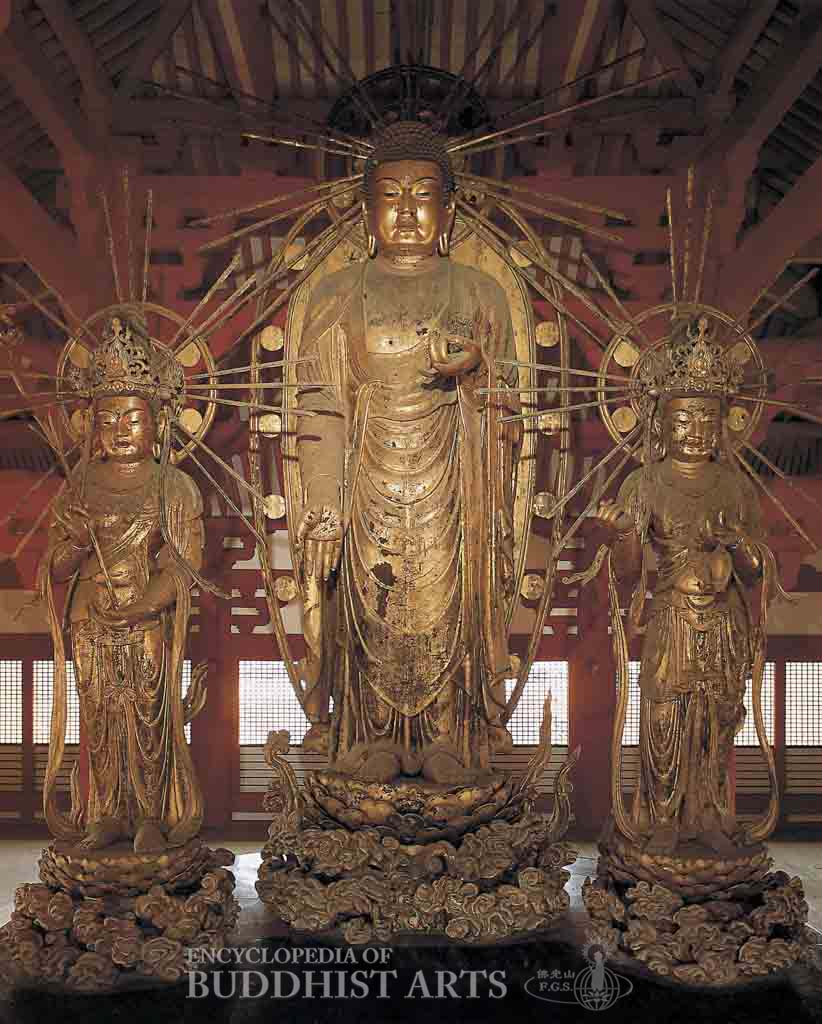
Jodoji Temple Pure Land Hall: Amitabha Buddha Triad
Cypress wood
Jodoji Temple Pure Land Hall: Amitabha Buddha Triad
JAPAN, Hyogo, Ono; Kamakura period
The Origins of Jodoji Temple chronicles that these three figures were sculpted by Kakei in 1197 and stand out for their elegance. They were listed as National Treasures in 1964.
Amitabha Buddha stands in the center, with the right hand opened in varada (wish-granting) mudra and the upturned left hand in karana (warding off evil) mudra. The Buddha towers above the attendant Bodhisattvas who both wear openwork crowns fronted with a seated Buddha and have their hair piled in a topknot. Avalokitesvara stands on the right and holds a vase in the left hand, while Mahasthamaprapta is on the left with both hands holding a long lotus stalk. All three statues have a hollow nimbus set with medallions and solar rays. The three figures stand on layered lotus pedestals supported by clouds. The garments are smooth and flowing, with fluttering stoles, as if the figures have just descended to earth.
The window partitions behind the statues enable the reflections of the sun on the wet fields outside to be brought into the hall during sunset, when the mineral-red beams of the hall are lit with dazzling colors. This artful incorporation of natural landscape lighting with architecture adds an aesthetic aid to the visualization of the Western Pure Land as described in the Amitayurdhyana Sutra.
For more details, go to the Encyclopedia of Buddhist Arts: Sculpture G-M, page 503.
Cite this article:
author = Hsingyun and Youheng and Lovelock, Yann and Chou, Yuan and Huntington, Susan and Edson, Gary and Neather, Robert,
booktitle = {Encyclopedia of Buddhist Arts: Sculpture G-M},
pages = 503,
title = {{Jodoji Temple Pure Land Hall: Amitabha Buddha Triad}},
volume = 11,
year = {2016}}